The Plateau: What to Do When Your Child Stops Improving in Karate
October 27, 2026 by Chief Master Greg Moody, Ph.D.
For the first eight months, you could see the progress from the bench every single week. New kicks, new forms, a new stripe on the belt. Now your child looks about the same as they did in spring, and you’ve started to quietly wonder whether the school has run out of things to teach. If you’ve typed “my child stopped improving in karate” into a search bar late at night, this post is for you.
I’ve taught more than 18,000 students and promoted more than 1,800 black belts, and I’ve watched this exact moment play out with thousands of families. Here is the short version. A plateau almost always comes from the structure of learning itself, and once you understand that structure, you can help your child through it.
If your child trains somewhere else and you’d like a second set of eyes on their progress, our door is open. New students get two weeks FREE plus a free uniform ($199 value). Call or text (602) 737-2098.
Why does my child seem to have stopped improving in karate?
Your child seems to have stopped improving because the kind of progress they are making has changed from the kind you can see to the kind you mostly can’t.
Early skills in martial arts are big, whole-body movements, and they are almost binary. A child either can throw a front kick or can’t. They either remember the form or blank on it. Each new skill shows up like a light switch, and parents notice every switch.
After the first year, the work shifts to refinement. The kick gets a little higher, the hip turns a little sooner, the balance holds a fraction longer. Those changes are real, and an instructor can see them up close. From twenty feet away on a bench, they are nearly invisible.
Motor learning researchers have a well-known way to describe this. Paul Fitts and Michael Posner (1967) laid out three stages of skill learning: a cognitive stage where the learner figures out what to do, an associative stage where they refine how they do it, and an autonomous stage where the skill runs without conscious effort (verify before use). Most children who seem stuck have simply moved from the first stage into the second.
What does a plateau actually look like from the bench?
From the bench, a plateau looks like the same child doing the same techniques at what seems like the same level, week after week.
Here is what you might notice:
Your child performs forms they already know, with no obvious new material.
The belt test that came quickly last time now feels far away.
Your child seems less excited on the drive to class.
You catch yourself comparing them to a newer student who seems to jump ahead.
Here is what is often happening underneath. Stances are getting deeper. Techniques are getting sharper at the end. Timing in partner drills is getting cleaner. Your child is learning to correct themselves without being told, which is the most important skill of all and the hardest one to see.
Is a plateau a sign the school has stopped teaching well?
Usually it isn’t, because nearly every child hits a plateau somewhere between eight and eighteen months, no matter where they train.
That said, you deserve a clear answer from the people teaching your child. A good school can tell you exactly what your child is working on right now, what the next rank requires, and roughly how far away they are. If you ask and get a vague shrug, that tells you something. If you get a specific answer, you’ve learned that the teaching is still happening, just at a finer grain than you can see from the wall.
What are the four real causes of a stall?
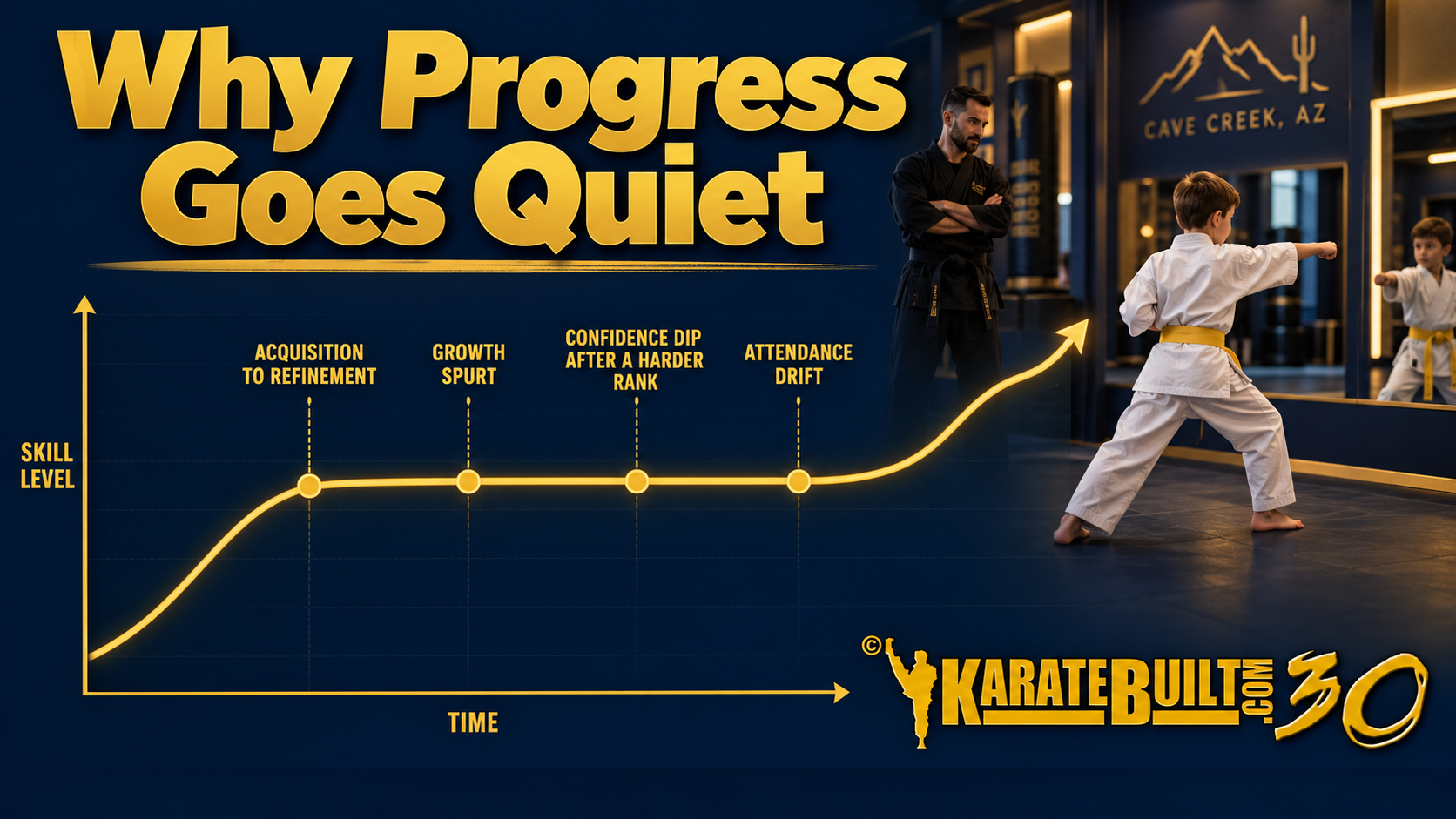
The four causes I see most often are the shift from learning to refining, a growth spurt, a confidence dip after a harder rank, and drifting attendance.
The shift from acquisition to refinement. This is the one described above. The work keeps moving at full speed, at a finer grain that’s hard to see from the bench.
A growth spurt. When a child grows two inches in a few months, their arms and legs change length faster than their brain can update its map of the body. Balance wobbles. Kicks that used to land clean start to miss. This passes as the brain catches up, and the child often comes out stronger.
A confidence dip after a harder rank. Intermediate ranks ask more, and sometimes a child who sailed through the early belts meets their first real difficulty. They may hold back, play it safe, or avoid trying the hard thing in front of the class. That caution can look like a stall.
Attendance drift. This one is the least dramatic and the most common. Two classes a week slide to one, then to one most weeks. Refinement depends on frequent repetition, so fewer classes hit the refinement stage especially hard. Check the calendar honestly before you draw conclusions.
If you want to see what steady refinement looks like in a structured program, come watch a class. Two weeks FREE plus a free uniform ($199 value) is waiting. Call or text (602) 737-2098.
What should a parent say, and what should a parent never say?
Say things that point your child toward their own small improvements, and steer clear of anything that turns the plateau into a judgment about them.
Helpful things to say:
“What are you working on in class right now?”
“Show me the part of your form that feels hardest.”
“Your stance looked lower tonight. Did you notice?”
“Plateaus happen to everyone who gets good at something.”
Things to avoid:
“Why aren’t you getting better?”
“Your brother got his belt faster.”
“We’re paying a lot of money for this.”
“Maybe you should just quit.”
Children hear those last four as statements about who they are. A child who decides they are bad at karate will start acting like it, and the plateau gets longer. Some kids also go quiet after a hard class, and it helps to know what to say on the drive home.
What should the school be doing about it?
The school should be giving your child more individual feedback, a clear target for the next rank, and a way to measure the small gains that make up intermediate progress.
At KarateBuilt, here is what that looks like. Instructors make short, specific corrections, often one at a time, so a child knows exactly what to fix. Students get a clear picture of the requirements for their next rank, and they can practice toward those requirements at home. We also give intermediate students new roles, like helping a newer student line up or demonstrating a technique, because responsibility gives a stalled child a fresh reason to sharpen their own work.
Ask your child’s school for three things: a short conversation with the instructor, the list of requirements for the next rank, and one specific thing your child can practice at home this week. Any good school can provide all three.
When is a plateau actually a reason to make a change?
A plateau becomes a reason to change schools when the school can’t explain your child’s progress, won’t give feedback, or no longer feels safe or respectful.
I want to be honest here, because some plateaus really do point to a problem. Here are the warning signs I’d take seriously:
Nobody can tell you what your child is working on or what the next rank requires.
Classes have grown so large that your child rarely gets an individual correction.
Your child has been unhappy for months, and the school treats your concern as an inconvenience.
Instructors rely on shame or harshness to motivate kids.
Safety rules feel loose, especially in partner drills.
If you see one or two of these, talk to the school first. If nothing changes, you are right to look elsewhere. Your child’s time on the floor matters too much to spend in the wrong room.
If you’re in Cave Creek and ready for a fresh look, bring your child to KarateBuilt Martial Arts at 29850 N. Tatum Blvd., Suite 105, Cave Creek, AZ 85331. Start with two weeks FREE plus a free uniform ($199 value). Call or text (602) 737-2098, ask for a few minutes with an instructor after class, and bring your questions.
Frequently asked questions
How long does a typical plateau last?
It varies with the child, the rank, and attendance. In my experience, a plateau tied to refinement or a growth spurt usually lifts within a few months of steady training.
Should I let my child skip classes during a stall?
I’d keep attendance steady, because refinement depends on repetition. Skipping classes tends to stretch a plateau longer.
Is it normal for progress to slow after the first year?
Yes. Early skills come quickly, and later skills take more time because the improvements are smaller and harder to see.
Should I ask the instructor about it or wait?
Ask. A short conversation after class will tell you what your child is working on and give you one thing to encourage at home.
Does a plateau mean my child has hit their ceiling?
Almost never. A plateau usually means your child has moved into a harder stage of learning, which is a sign of progress.
Chief Master Greg Moody, Ph.D. holds a doctorate in Special Education, is a licensed psychotherapist (LAC), and is an 8th Degree Black Belt with over 30 years of experience teaching children. He has been recognized as the nation’s #1 martial arts school owner eight times.
Sincerely,
Ch. Master Greg Moody, Ph.D.
P.S. Get Dr. Moody’s Book on Bullying – Click Here
KarateBuilt L.L.C. was founded in 1995 by Dr. Greg Moody, an 8th-degree Black Belt and Chief Master Instructor, KarateBuilt Martial Arts and Karate for Kids offer lessons for pre-school children ages 3-6 and elementary age kids ages 7 and up are designed to develop critical building blocks kids need – specialized for their age group – for school excellence and later success in life.
KarateBuilt Martial Arts Adult Karate training is a complete adult fitness and conditioning program for adults who want to lose weight, get (and stay in shape), or learn self-defense in a supportive environment.
Instructors can answer questions or be contacted 24 hours of the day, 7 days a week at 866-311-1032 for one of our nationwide locations. You can also visit our website at KarateBuilt.com.
About Dr. Greg Moody: Dr. Moody is an eighth-degree black belt and chief master instructor. He has a Ph.D. in Special Education from Arizona State University (along with a Master’s Degree in Counseling and a Bachelor’s Degree in Engineering – he actually is a rocket scientist). He has been teaching martial arts for over 25 years and has owned eight martial arts schools in Arizona and California. Chief Master Moody is a motivational speaker and educator and teaches seminars in bullying, business, and martial arts training, around the world. See more at DrGregMoody.com.
Dr. Moody is also a licensed psychotherapist and maintains a practice at Sheade Therapywhere he specializes in couples therapy and men’s issues.
The KarateBuilt Martial Arts Headquarters at KarateBuilt LLC is in Cave Creek, Arizona at 29850 N. Tatum Blvd., Suite 105, Cave Creek AZ 85331. You can locate the Chief Instructor, Master Laura Sanborn there directly at (480) 575-8171. KarateBuilt Martial Arts serves Cave Creek, Carefree, Scottsdale, and Paradise Valley Arizona as well as Grand Rapids, MI.