

Categories
Blog Our Community

What a Belt Test Actually Measures, and Why Your Child Will Remember It at Thirty
What’s Really Happening When Your Kid Stands in That Line?

You’re sitting in a folding chair against the wall. Your child is standing in a line with eight other kids, uniform pressed, waiting for their name to be called.

Their hands are shaking a little. You can see it.

Every parent thinks the same thing in that moment: I hope they don’t mess up the form. I get it, but that’s not what the test is actually measuring, and it’s not what your kid will carry with them twenty years from now.

What Does a Belt Test Actually Measure?

The plain answer: A belt test measures whether a child can perform under pressure, on a set timeline, in front of people watching, without a parent stepping in to help.

That’s a rare skill to practice on purpose. Most of childhood doesn’t ask for it.

A 2022 randomized controlled trial out of the University of Surrey, published in the journal Developmental Psychology, put this to the test directly. Researchers split 240 children ages 7 to 11 into two groups. One group took two 45-minute Taekwondo classes a week for eleven weeks. The other took regular PE classes on the same schedule.

The kids in the Taekwondo group were later rated by their teachers as having better attentional control, and they scored higher on a computer-based test of executive function, compared to the PE group, according to the University of Surrey’s published findings.

Same age group. Same amount of time. Different result. The structure of the training, including the buildup toward a graded test, made the difference.

What Does This Mean for Your Kid, Specifically?

A belt test isn’t a recital. Nobody’s grading your child against the kid next to them.

It’s a checkpoint your child worked toward for weeks, sometimes months, that they either meet or don’t meet yet. If they don’t meet it, they test again. Nobody’s life falls apart. They just try again with more practice behind them.

That’s the whole design. Small, real stakes. A clear standard. A visible outcome.

Compare that to most of what fills a kid’s schedule. Youth sports, as good as they are, rarely ask a child to sit still, get evaluated one-on-one, and demonstrate exactly what they know, and the numbers on youth sports retention tell their own story. The average child today plays a given sport for under three years and stops by around age 11, mostly because it stopped being fun, according to a national survey by the Aspen Institute’s Project Play.

A belt test works differently because the goal isn’t winning. It’s becoming capable of something you weren’t capable of three months ago. That’s a different kind of motivation, and it tends to last.

This is the insight I want you to leave with. Your child won’t remember most of what happened when they were eight, but they’ll remember the day they stood in front of an instructor, performed under pressure, and heard they earned it. That memory becomes a reference point. Years later, in a job interview or a hard conversation or a moment that calls for nerve, some part of them reaches back to that.

If you want your child building that reference point, this is the week to start. Come watch a class and see how we build toward a test before your child ever steps up to one.

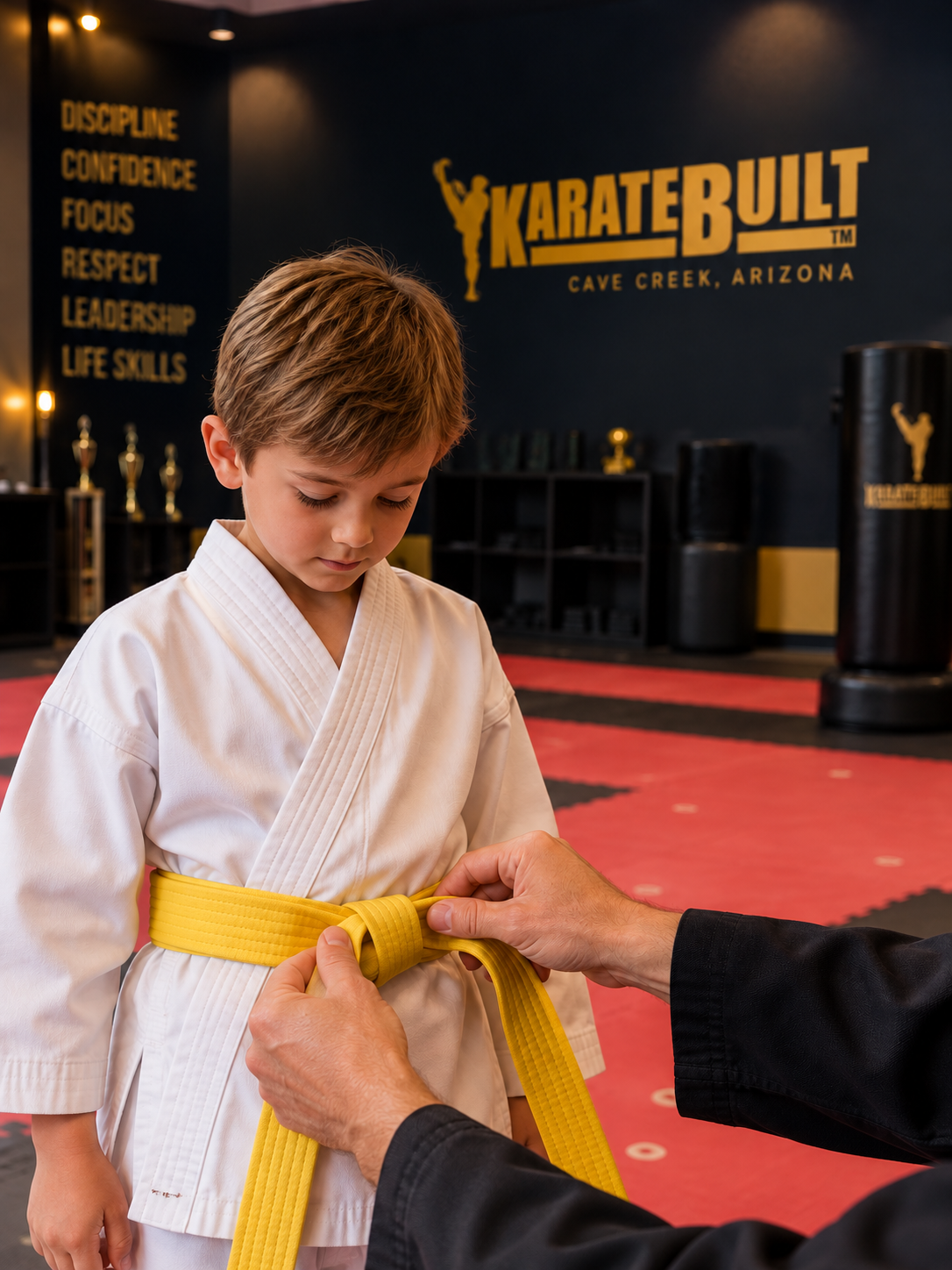
How Long Does It Take to Get a Yellow Belt?

At KarateBuilt, most kids earn their yellow belt within 8 to 12 weeks of consistent training, two classes a week. That’s the first checkpoint, not the finish line. It’s short on purpose. A new student needs an early win, something achievable and real, to understand what the process feels like before we ask for more.

From there, testing cycles space out. Each belt asks for more control, more memory, more composure than the last one. By the time a student is testing for their black belt, they’ve been through the process enough times that the nerves are still there, but they know exactly what to do with them.

What Should You Do This Week?

Ask your child one question tonight. Not “how was class.” Ask them what they’re working on right now for their next belt.

If they can answer you specifically, something like a particular kick, a form, a board break, you’re seeing the system work. They know the target. They know where they stand against it.

If they can’t answer that question, that’s useful information too. It tells you the goal hasn’t been made clear enough yet, and that’s worth a conversation with their instructor.

Either way, you’ll learn more from that one question than from watching an entire class through the window.

What Happens on a KarateBuilt Trial?

Here’s what your child actually does if you bring them in this week. 

They walk in, get fitted with a training uniform, and join a class with kids their own age. They’re not sitting on the side watching. They’re in it, learning the same drills, the same focus exercises, the same introduction to what a testing cycle looks like.

An instructor works with them directly, correcting small things and pointing out what they’re already doing well. After class, you get a real conversation about what we saw. Focus. Listening. Effort. The same qualities a belt test eventually measures.

This is the same process that’s produced more than 1,800 Black Belts and made us the nation’s number one martial arts school eight times. We’ve taught over 18,000 students, and every one of them started with a version of this exact trial class.

The Number That Matters and the Next Step

Eight to twelve weeks. That’s how long it typically takes a new student to reach their first belt and feel what earning something under pressure actually feels like.

Call KarateBuilt this week and schedule a trial class. Watch your child walk in, train for 45 minutes, and take the first step toward a moment they’ll still remember at thirty.

Sincerely,

Karate

Chief Master Greg Moody, Ph.D. holds a doctorate in Special Education, is a licensed psychotherapist (LAC), and is an 8th Degree Black Belt with over 30 years of experience teaching children. He’s taught over 18,000 students, over 1,800 of them Black Belts. He has been recognized as the nation’s #1 martial arts school owner eight times, and he’s a four-time #1 Amazon Bestselling Author.

P.S. Get Dr. Moody’s Book on Bullying – Click Here


KarateBuilt.com and KarateBuilt Martial Arts have been selected as the nation’s #1 martial arts schools for EIGHT YEARS IN A ROW!

KarateBuilt L.L.C. was founded in 1995 by Dr. Greg Moody, an 8th-degree Black Belt and Chief Master Instructor, KarateBuilt Martial Arts and Karate for Kids offer lessons for pre-school children ages 3-6 and elementary age kids ages 7 and up are designed to develop critical building blocks kids need – specialized for their age group – for school excellence and later success in life.

KarateBuilt Martial Arts Adult Karate training is a complete adult fitness and conditioning program for adults who want to lose weight, get (and stay in shape), or learn self-defense in a supportive environment.

Instructors can answer questions or be contacted 24 hours of the day, 7 days a week at 866-311-1032 for one of our nationwide locations. You can also visit our website at KarateBuilt.com.

About Dr. Greg Moody:  Dr. Moody is an eighth-degree black belt and chief master instructor.  He has a Ph.D. in Special Education from Arizona State University (along with a Master’s Degree in Counseling and a Bachelor’s Degree in Engineering – he actually is a rocket scientist). He has been teaching martial arts for over 25 years and has owned eight martial arts schools in Arizona and California. Chief Master Moody is a motivational speaker and educator and teaches seminars in bullying, business, and martial arts training, around the world. See more at DrGregMoody.com.

Dr. Moody is also a licensed psychotherapist and maintains a practice at Integrated Mental Health Associates (IntegratedMHA.com) where he specializes in couples therapy and men’s issues.

The KarateBuilt Martial Arts Headquarters at KarateBuilt LLC is in Cave Creek, Arizona at 29850 N. Tatum Blvd., Suite 105, Cave Creek AZ 85331. You can locate the Chief Instructor, Master Laura Sanborn there directly at ‭(480) 575-8171‬. KarateBuilt Martial Arts serves Cave Creek, Carefree, Scottsdale, and Paradise Valley Arizona as well as Grand Rapids, MI.

Also, check us out on Today in Business and Educators Observer!

Here is Dr. Moody’s Amazon Author Page with over 16 of his Amazon Bestselling books: Click HERE

P.P.P.S. From a parent:

“Since joining this program, my son Herman is more disciplined, motivated, and unstoppable in every challenge he faces!” – Emily Green