Learning to Lose: How Martial Arts Trains a Child to Handle Defeat
October 1, 2026 by Chief Master Greg Moody, Ph.D.
By Chief Master Greg Moody, Ph.D., 8th Degree Black Belt, founder of KarateBuilt Martial Arts in Cave Creek, Arizona
It’s family game night, and your eight-year-old is losing. You can see it coming. The jaw tightens, the cards hit the table a little too hard, and then someone announces that this game is stupid.
Maybe it ends in tears. Maybe it ends with a slammed door. Either way, the game is over, and so is the evening.
Maybe you see the same thing at soccer, or with a math worksheet that looks hard, or with anything new. Your child would rather skip the whole thing than risk being bad at it in front of anyone.
If that sounds like your house, you have plenty of company. I see this in nearly every group of new students who walk into our school. It gets better, often faster than parents expect, once a child gets the right kind of practice.
The right kind of practice is losing. On purpose, in small doses, with an adult right there to help them get back up.
Why do some kids fall apart when they lose?
A child who melts down after losing usually believes, deep down, that losing says something about who they are.
To a six-year-old, a lost game can feel like proof that they are bad, or dumb, or less loved. You know that’s false. Their nervous system hasn’t learned it yet, so it sounds the alarm at full volume over a small event.
I hold a master’s in counseling, and I see the same pattern in teenagers and adults. Many of them got very little low-stakes practice at losing when they were young. Their alarm kept ringing because nothing ever taught it that the danger was small.
The brain learns what is survivable by surviving it. One loss teaches almost nothing. A few hundred small ones, handled well, can change a child.
How do most children’s activities handle losing?
Many youth activities are set up to keep children from feeling a loss at all.
Everyone gets a trophy. Younger leagues skip the score. Coaches rotate players so nobody sits long, and a game stops when a child gets upset. I understand every one of those choices. They come from adults who care about kids.
The cost shows up later. A child who has been shielded from losing until age twelve meets it for the first time in middle school, on a team tryout list or a report card, with classmates watching and nobody coaching them through it.
That is a hard way to learn a skill that could have been built slowly at six.
Why does martial arts put failure into every class on purpose?
Martial arts and failure go together by design. Every class hands your child a few small losses and then shows them what to do next.
Here is what that looks like on an ordinary weeknight at our school:
Your child forgets a move in the middle of a form, with the whole class watching.
A board holds when they strike it.
A sparring partner scores a clean point.
They drop a block during a drill and get tagged three times in a row.
Each of these is small. Each one stings a little. And each one happens with a trained instructor a few feet away.
That last part matters most. A loss by itself teaches a child to avoid the thing that hurt. A loss followed by good coaching teaches a child how to recover. We build the second kind, over and over, week after week.
How do instructors coach a child through a loss?
Teaching kids to lose gracefully comes down to the thirty seconds right after the mistake.
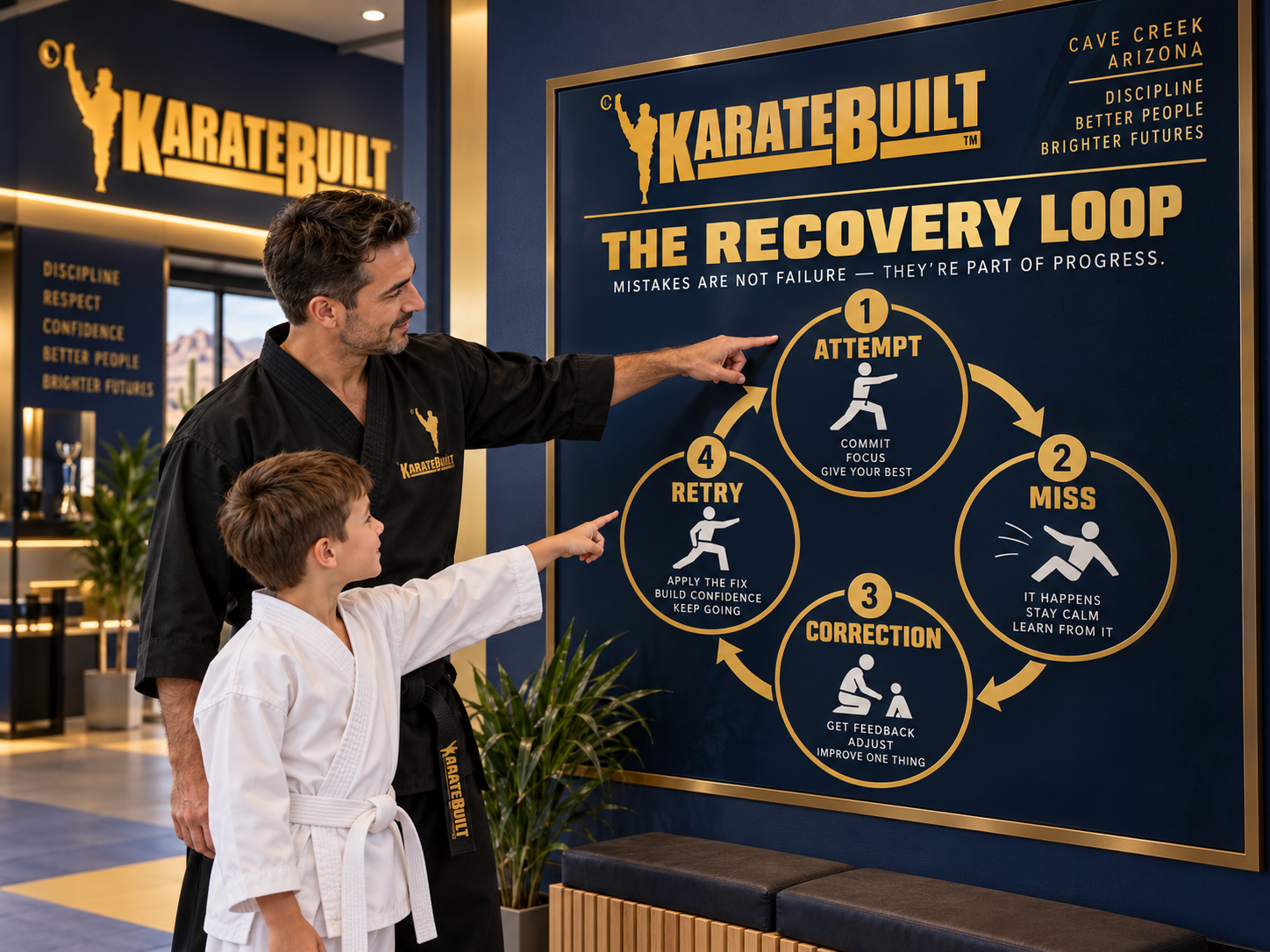
When a student gets it wrong, our instructors follow a simple pattern.
Name it plainly. “That board won this round. Your strike landed a little high.” The child hears a fact about their technique and nothing about their worth.
Give one fix. A single correction the child can use right now. Aim lower. Turn the hip. Keep the hands up. One thing is enough.
Go again. Right away, while the feeling is still fresh. The child gets to replace the memory of the miss with the memory of the next attempt.
We also lean on ritual. In sparring, when your partner scores, you bow. Every time. That bow gives a frustrated child’s body something to do besides throw a fit. It says, “You got me,” with dignity, and it keeps the match moving.
Kids pick this up fast. After a few months, I watch students who used to cry at a missed kick shake it off, bow, and square up again. They still feel the sting. They have simply learned what comes after it.
How does martial arts build resilience in children?
Resilience in children is the ability to get beaten on Tuesday and walk back into the school on Thursday ready to go again.
Before I ever taught a class, I worked as an aerospace engineer. Resilience was an engineering word to me long before it was a counseling word. In materials science, it describes how much stress a material can take and still spring back to its shape. A resilient part bends under load. Then it returns.
Your child works the same way. People picture resilient kids as tough kids who never flinch. Watch real resilient kids and you’ll see them flinch plenty. They get mad. Sometimes they cry. Then they come back.
The coming back is the skill. Martial arts gives children a chance to practice it twice a week, for years, in a place where the stakes stay low and the coaching stays close.
Over time, that pattern leaves the mat. The child who learned to bow after being scored on starts to handle the lost board game differently. The one who kept trying the board break starts raising a hand in class even when they aren’t sure. I hear these stories from parents all the time, and they never get old.
What can parents do at home when their child melts down after losing?
Stay calm, stay close, and help them go again. You can borrow the same pattern we use in class.
Let the feeling land. A child who just lost is allowed to be upset. Skip the lecture and sit with them for a minute.
Name what happened in one sentence. “You wanted to win, and your sister got the last card.” Short and plain works best.
Ask for one more round. Keep the offer light. The goal is to show your child that the game, and the evening, can continue.
Let them see you lose. Play honestly and lose sometimes. Then say out loud, “Oh, I really wanted that one. Good game.” Children learn more from watching you handle a loss than from anything you tell them about it.
Hold off on rescuing. Letting a child win every time feels kind in the moment. It also takes away the practice they need most.
How can I see this for myself?
Come watch a class at our school. You’ll see this happen within the first few minutes.
Here is what to look for. Wait for a student to get something wrong. Maybe they miss a technique, lose a point, or blank on a form. Then watch the next thirty seconds closely.
Watch where the instructor stands. Listen to what they say. Notice how fast that student is back in line, trying again. That half minute will tell you more about what your child would learn here than any brochure could.
Call the school this week and ask which class fits your child’s age. Then pick a night, take a seat along the wall, and wait for someone to miss.
Sincerely,
Chief Master Greg Moody, Ph.D. holds a doctorate in Special Education, is a licensed psychotherapist (LAC), and is an 8th Degree Black Belt with over 30 years of experience teaching children. He’s taught over 18,000 students, over 1,800 of them Black Belts. He has been recognized as the nation’s #1 martial arts school owner eight times, and he’s a four-time #1 Amazon Bestselling Author.
P.S. Get Dr. Moody’s Book on Bullying – Click Here
KarateBuilt L.L.C. was founded in 1995 by Dr. Greg Moody, an 8th-degree Black Belt and Chief Master Instructor, KarateBuilt Martial Arts and Karate for Kids offer lessons for pre-school children ages 3-6 and elementary age kids ages 7 and up are designed to develop critical building blocks kids need – specialized for their age group – for school excellence and later success in life.
KarateBuilt Martial Arts Adult Karate training is a complete adult fitness and conditioning program for adults who want to lose weight, get (and stay in shape), or learn self-defense in a supportive environment.
Instructors can answer questions or be contacted 24 hours of the day, 7 days a week at 866-311-1032 for one of our nationwide locations. You can also visit our website at KarateBuilt.com.
About Dr. Greg Moody: Dr. Moody is an eighth-degree black belt and chief master instructor. He has a Ph.D. in Special Education from Arizona State University (along with a Master’s Degree in Counseling and a Bachelor’s Degree in Engineering – he actually is a rocket scientist). He has been teaching martial arts for over 25 years and has owned eight martial arts schools in Arizona and California. Chief Master Moody is a motivational speaker and educator and teaches seminars in bullying, business, and martial arts training, around the world. See more at DrGregMoody.com.
The KarateBuilt Martial Arts Headquarters at KarateBuilt LLC is in Cave Creek, Arizona at 29850 N. Tatum Blvd., Suite 105, Cave Creek AZ 85331. You can locate the Chief Instructor, Master Laura Sanborn there directly at (480) 575-8171. KarateBuilt Martial Arts serves Cave Creek, Carefree, Scottsdale, and Paradise Valley Arizona as well as Grand Rapids, MI.