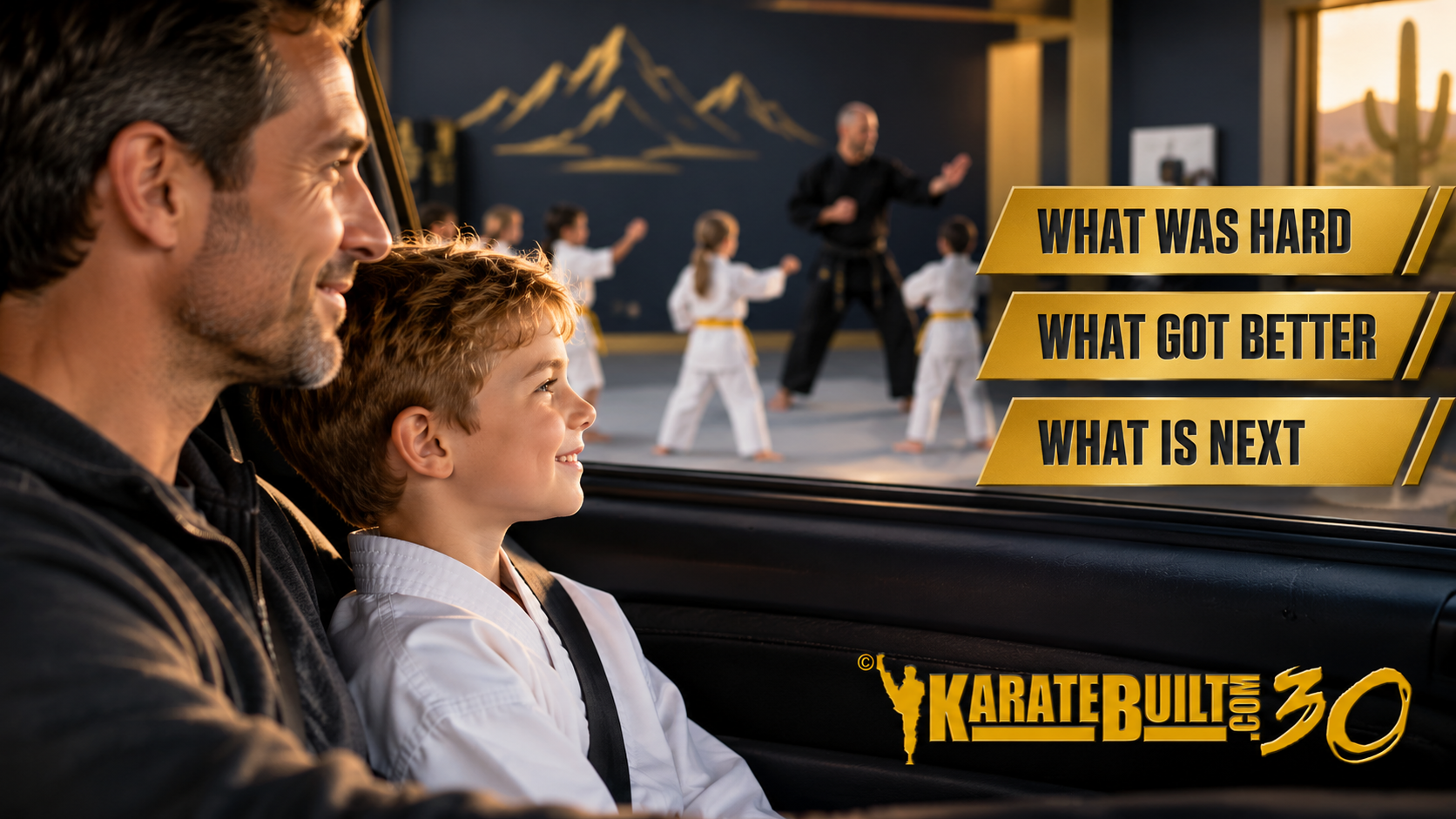
The Drive Home: What to Say to Your Child After a Hard Class
October 21, 2026 by Chief Master Greg Moody, Ph.D.
Your child got corrected in front of everyone tonight. Maybe they lost a drill, or sat out a round, or just had one of those classes where nothing clicked. Now they’re buckled in, staring out the window, and you have a few minutes to figure out what to say to your child after a hard practice.
Those few minutes matter more than most parents realize. The drive home can turn a rough night into a lesson your child keeps, or into the reason they ask to quit next month.
Here is what I’ve learned from decades on the training floor and in the counseling office: three questions to ask, one sentence to drop for good, and why it all adds up.
What should I say to my child after a hard class?
Say less than you want to and ask three short questions in this order once your child has had a minute to settle.
“What was the best part of class today?” Start with something good, even on a bad night. It reminds your child that the whole hour was more than its worst moment, and it gets them talking about something easy.
“What was the hardest part?” Now let them name the tough moment in their own words. You’ll often hear something different from what you saw from the parent chairs. The kick you worried about might not even register. The thing that bothered them might be a comment from another kid.
“What do you want to try next time?” This one turns the conversation forward. Your child picks the goal, so they own it.
Then stop. Let the answers sit. If your child gives you one word, accept the one word. Silence in a car can be a comfortable thing, and sometimes the real answer shows up ten minutes later at the dinner table.
Why does the drive home matter so much?
The drive home matters because it’s the moment your child decides what the class meant, and that meaning shapes whether they want to go back.
Researchers followed 148 youth soccer players, ages 10 to 14, through a season and checked a year later to see who was still on the team. The quality of a child’s relationship with their mother, combined with their friendships on the team, helped predict who kept playing (Ullrich-French & Smith, 2009).
That study looked at soccer and at relationships in general, so I won’t claim it was about car rides. The point still applies directly. Your relationship with your child is part of why they stay in an activity, and the drive home is where that relationship gets tested twice a week.
Do the math on your own schedule. Say your drive home takes eight minutes and your child trains twice a week. Across a year, that’s close to fourteen hours of car time, which is more one-on-one coaching than I’ll ever give your child in class.
There’s also the seating. In a car, you sit side by side and nobody has to make eye contact. For a child who feels embarrassed, that makes talking much easier. Quiet kids especially open up there, which ties into what we teach about helping a quiet child speak up.
What is the one thing I should not say?
The one sentence to drop for good is “Why didn’t you try harder?”
It sounds like a question, but your child hears a verdict. They hear that you watched, that you were disappointed, and that the problem is their character. A seven-year-old has no good answer to that question, so they go quiet or get defensive, and the conversation is over before it started.
Its cousins do the same damage. “What were you doing out there?” “Everybody else got it.” “I’m paying for this, you know.” Each one replaces curiosity with a grade.
Before I opened a school, I worked as an aerospace engineer. We never debriefed a test while the engine was still hot. You wait until things cool down, and then you look at the data together. Your child deserves at least the courtesy we gave a rocket motor.
What if my child says they want to stop going?
If your child says they want to stop going, listen, thank them for telling you, and save the decision for another day.
“I want to quit” in the car usually means “tonight was hard and I feel bad.” It’s a feeling with a lot of energy behind it. Big decisions made at that moment tend to be bad ones, for kids and for adults.
Try something like this: “That sounded like a rough class. I’m glad you told me. Let’s talk about it this weekend.” Then actually talk about it this weekend, at the kitchen table, once everyone is calm.
When you do, ask what specifically felt bad. Then call the school and tell the instructor. We would much rather hear “she’s struggling with the new form” on a Tuesday than see an empty spot on the floor on a Thursday.
Praise effort by naming one specific thing you actually saw and skip the general labels.
Kids can spot empty praise from across a parking lot. “You were awesome!” after a class where they plainly struggled teaches them that your praise doesn’t mean much.
Specific praise lands because it proves you were paying attention. Compare these:
“Good job” versus “You kept your hands up the whole sparring round.”
“You’re so talented” versus “You got that kick wrong three times and tried it a fourth.”
“Great class” versus “I saw you help the new kid find his spot in line.”
My doctorate is in special education, and one principle from that field holds up every time: describe the behavior you want to see more of. When you name exactly what your child did, they know exactly what to do again.
On a truly rough night, praise the showing up. “You were frustrated, and you still finished class.” That sentence is true, it’s specific, and it rewards the thing that matters most.
What do instructors wish parents said in the car?
Instructors wish parents would say “I love watching you train” and then leave the coaching to us.
That sentence carries no grade and no correction. It tells your child that your attention is on them as a person, and that their place in the family doesn’t move with their performance.
We also hope parents leave the technical feedback in class. When a parent re-teaches the stance in the car, the child now has two coaches giving slightly different instructions. Your child’s instructor will fix the stance next class. Your job in the car is to help your child want to come back for it. We covered more of this in Should Parents Watch Class?.
Families train with us from Carefree and all over Cave Creek. In my experience, the kids who stay with training for years usually have parents who keep the drive home warm, short, and curious.
Frequently Asked Questions
What should I say if my child was corrected in front of the class?
Tell them that being corrected means the instructor was watching and believes they can do it better. Then ask what the correction was and let them explain it to you.
Should I ask my child what they learned?
You can, but “what did you learn?” often gets a shrug. “Show me the coolest thing you did today” usually gets a demonstration in the living room.
My child cried after class. Is that normal?
Yes. Tears after hard effort are normal and usually pass quickly, so sit with them, keep it calm, and skip the lecture. Parents in Cave Creek and Carefree see this at every age, and it rarely means anything more than a long day.
How do I know whether to push or back off?
Push gently when your child is frustrated with a skill, and back off when they seem afraid, hurt, or stressed about something outside class. If you can’t tell which it is, call the instructor and compare notes.
Here is your next step. Bring your child to a Karate for Kids class at KarateBuilt Martial Arts, 29850 N. Tatum Blvd., Suite 105, Cave Creek, AZ 85331. Then use the drive home: one good thing, one hard thing, one goal for next time. New students start with two weeks FREE plus a free uniform, a $199 value. Call or text (602) 737-2098 to book the first class.
References
Ullrich-French, S., & Smith, A. L. (2009). Social and motivational predictors of continued youth sport participation. Psychology of Sport and Exercise, 10(1), 87–95. https://doi.org/10.1016/j.psychsport.2008.06.007
Chief Master Greg Moody, Ph.D. holds a doctorate in Special Education, is a licensed psychotherapist (LAC), and is an 8th Degree Black Belt with over 30 years of experience teaching children. He has been recognized as the nation’s #1 martial arts school owner eight times.
Sincerely,
Ch. Master Greg Moody, Ph.D.
P.S. Get Dr. Moody’s Book on Bullying – Click Here
KarateBuilt L.L.C. was founded in 1995 by Dr. Greg Moody, an 8th-degree Black Belt and Chief Master Instructor, KarateBuilt Martial Arts and Karate for Kids offer lessons for pre-school children ages 3-6 and elementary age kids ages 7 and up are designed to develop critical building blocks kids need – specialized for their age group – for school excellence and later success in life.
KarateBuilt Martial Arts Adult Karate training is a complete adult fitness and conditioning program for adults who want to lose weight, get (and stay in shape), or learn self-defense in a supportive environment.
Instructors can answer questions or be contacted 24 hours of the day, 7 days a week at 866-311-1032 for one of our nationwide locations. You can also visit our website at KarateBuilt.com.
About Dr. Greg Moody: Dr. Moody is an eighth-degree black belt and chief master instructor. He has a Ph.D. in Special Education from Arizona State University (along with a Master’s Degree in Counseling and a Bachelor’s Degree in Engineering – he actually is a rocket scientist). He has been teaching martial arts for over 25 years and has owned eight martial arts schools in Arizona and California. Chief Master Moody is a motivational speaker and educator and teaches seminars in bullying, business, and martial arts training, around the world. See more at DrGregMoody.com.
Dr. Moody is also a licensed psychotherapist and maintains a practice at Sheade Therapywhere he specializes in couples therapy and men’s issues.
The KarateBuilt Martial Arts Headquarters at KarateBuilt LLC is in Cave Creek, Arizona at 29850 N. Tatum Blvd., Suite 105, Cave Creek AZ 85331. You can locate the Chief Instructor, Master Laura Sanborn there directly at (480) 575-8171. KarateBuilt Martial Arts serves Cave Creek, Carefree, Scottsdale, and Paradise Valley Arizona as well as Grand Rapids, MI.