What Your Child Learns From Training Next to Someone Better Than They Are
November 19, 2026 by Chief Master Greg Moody, Ph.D.
Your child watches everything. They notice who is faster, who is taller, and who got picked first. So before the first class, a quiet worry shows up, and maybe you’ve typed it into a search bar: will my child feel behind in karate class? Picture them in a white belt, standing two spots down from a child who can kick head height.
I’ve taught more than 18,000 students. Here is what I can tell you about that worry, and why the stronger student on the floor turns out to be one of the best things in the room for your child.
You can see this for yourself with two weeks FREE plus a free uniform ($199 value). Call or text (602) 737-2098.
Will my child feel behind in karate class?
Your child will probably feel behind for a few classes, and that feeling is where the learning starts.
Every student in the room was a white belt once, including the black belts. On the first night, your child will notice the gap between where they are and where the senior students are. That’s normal. What matters is what the adults do with that moment.
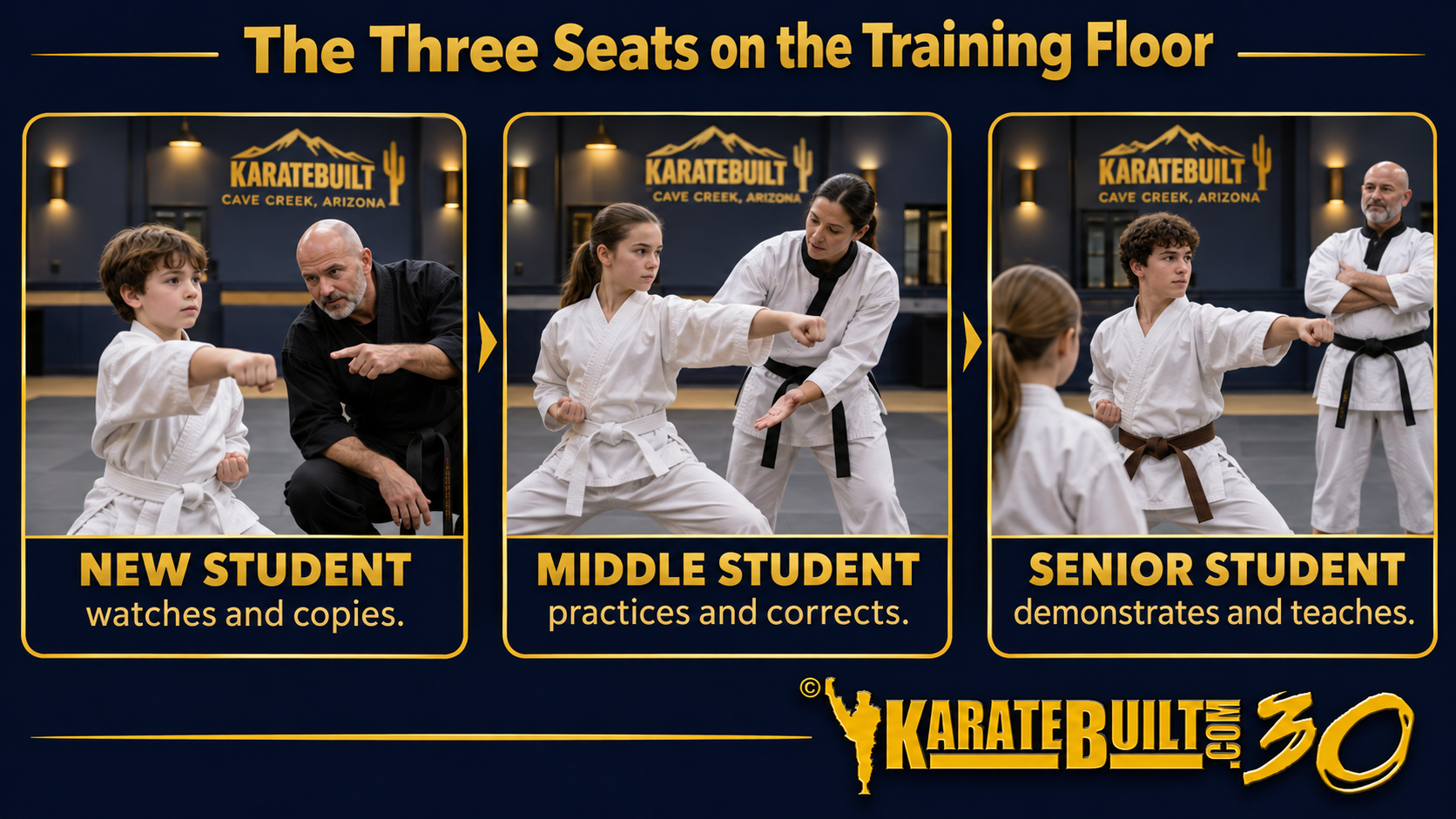
In a good class, the gap becomes a map. Your child can see exactly what a front kick looks like three belts from now, performed by a kid only a little older than they are. The senior student becomes a model to study, and your child learns to measure progress against their own last class.
Why do classes mix experience levels at all?
Classes mix experience levels because beginners learn faster when they can watch skilled students up close, and skilled students learn more when they help.
At KarateBuilt, we group children by age first. Preschoolers ages 3 to 6 train in their own program, and children 7 and up train in Karate for Kids. Within those classes, white belts often train in the same room as students who have been coming for years.
That mix gives every drill a built-in demonstration. When an instructor says, “watch Ava’s chamber,” your child sees the technique done right, from a few feet away, by a kid their own size.
What does a beginner actually learn from a senior student?
A beginner learns that the skill is possible for someone like them, which is often the hardest thing to teach.
Research on children’s learning backs this up. Schunk and Hanson (1985) worked with elementary students who had struggled with subtraction. Children who watched a peer model work through the problems came away with higher confidence in their ability to learn the skill, and higher achievement, compared with children who watched a teacher do the same work. That study took place in a classroom, and the principle travels well. When the model looks like you, success feels closer.
On our floor, beginners pick up the small things from senior students: where to stand, when to bow, how to tie a belt, how to recover after a mistake without falling apart.
How do instructors keep a new student from getting discouraged?
Instructors keep new students encouraged by giving them early wins, specific corrections, and a job to do.
A new student hears their name in the first few minutes. They get one or two corrections they can fix right away, so they feel themselves improving inside a single class. If a child freezes, the instructor might hand them a target to hold beside a senior student. Holding a target feels safe, and a few minutes later most kids want a turn to kick it.
If your child tends to hang back, read Is My Child Too Shy for Karate?, which walks through the first three classes step by step. Every new student also starts with a private first lesson, so they meet an instructor before they meet the whole class.
Ready to watch your child try it? Two weeks FREE plus a free uniform ($199 value). Call or text (602) 737-2098.
What happens when my child becomes the experienced one?
When your child becomes the experienced one, they start teaching, and the lesson that began on their first night finally completes.
It happens sooner than parents expect. A few months in, a new white belt joins the line, and an instructor says, “Show him how to bow in.” Your child, who felt behind not long ago, now knows something another child needs. Often, they start helping before anyone asks.
That shift changes how a child carries themselves. The student who once watched now gets watched. They practice more carefully because someone is copying them. The same dynamic shows up at home, too, which I wrote about in a post on siblings in the same class.
How long before my child stops feeling like the new kid?
Most children stop feeling new within a couple of weeks, once they know the warm-up, a few names and where to line up.
By the second week, the routine is familiar. By the first belt test, which comes on a cycle of roughly two months, your child has a new rank around their waist and a white belt behind them in line. The feeling of being behind gets replaced by something more useful: a clear next step.
Help that along at home. Ask your child which senior student they watch most, and why. Then ask them to show you one thing they learned and let them teach it to you.
Parents in Carefree and Cave Creek often tell me the moment they relaxed was the night their child came home talking about a senior student by name, as someone to catch.
Bring your child to KarateBuilt Martial Arts, 29850 N. Tatum Blvd., Suite 105, Cave Creek, AZ 85331, and watch it start. Two weeks FREE plus a free uniform ($199 value). Call or text (602) 737-2098.
Frequently asked questions
Are beginners in the same class as advanced students?
Often, yes. Classes are grouped by age, and students of different ranks train together inside those groups.
What if my child is the only new student?
That’s common and works well. Your child starts with a private first lesson, and in class an instructor often pairs them with a senior student who shows them the routine.
Do you have classes grouped by age?
Yes. Preschoolers ages 3 to 6 train in their own program, children 7 and up train in Karate for Kids, and teens and adults have their own classes.
How soon does a new student earn their first belt?
Students test on a cycle of roughly two months, and a child tests when the instructor sees they’re ready. There is no belt testing fee at any rank.
References
Schunk, D. H., & Hanson, A. R. (1985). Peer models: Influence on children’s self-efficacy and achievement. Journal of Educational Psychology, 77(3), 313-322. https://doi.org/10.1037/0022-0663.77.3.313
Sincerely,
Chief Master Greg Moody, Ph.D. holds a doctorate in Curriculum and Instruction, is a licensed psychotherapist (LAC), and is an 8th Degree Black Belt with over 30 years of experience teaching children. He has been recognized as the nation’s #1 martial arts school owner eight times.
P.S. Get Dr. Moody’s Book on Bullying – Click Here
KarateBuilt L.L.C. was founded in 1995 by Dr. Greg Moody, an 8th-degree Black Belt and Chief Master Instructor, KarateBuilt Martial Arts and Karate for Kids offer lessons for pre-school children ages 3-6 and elementary age kids ages 7 and up are designed to develop critical building blocks kids need – specialized for their age group – for school excellence and later success in life.
KarateBuilt Martial Arts Adult Karate training is a complete adult fitness and conditioning program for adults who want to lose weight, get (and stay in shape), or learn self-defense in a supportive environment.
Instructors can answer questions or be contacted 24 hours of the day, 7 days a week at 866-311-1032 for one of our nationwide locations. You can also visit our website at KarateBuilt.com.
About Dr. Greg Moody: Dr. Moody is an eighth-degree black belt and chief master instructor. He has a Ph.D. in Curriculum and Instruction from Arizona State University (along with a Master’s Degree in Counseling and a Bachelor’s Degree in Engineering – he actually is a rocket scientist). He has been teaching martial arts for over thirty years and has owned nine martial arts schools in Arizona, California and Virginia. Chief Master Moody is a motivational speaker and educator and teaches seminars in bullying, business, and martial arts training, around the world. See more at DrGregMoody.com.
Dr. Moody is also a licensed psychotherapist and maintains a practice at Sheade Therapywhere he specializes in couples therapy and men’s issues.
The KarateBuilt Martial Arts Headquarters at KarateBuilt LLC is in Cave Creek, Arizona at 29850 N. Tatum Blvd., Suite 105 & 106, Cave Creek AZ 85331. You can locate the Chief Instructor, Senior Master Laura Sanborn there directly at (602) 737-2098. KarateBuilt Martial Arts serves Cave Creek, Carefree, Scottsdale, and Paradise Valley Arizona as well as Grand Rapids, MI.


 Chief Master Greg Moody, Ph.D. holds a doctorate in Curriculum and Instruction, is a licensed psychotherapist (LAC), and is an 8th Degree Black Belt with over 30 years of experience teaching children. He has been recognized as the nation’s #1 martial arts school owner eight times.