

Thirteen Is the Cliff: Why Most Kids Stop Playing Sports by Middle School, and What Changes That
Your child used to beg to go to practice. Now you hear “Do I have to?” from the back seat, and late at night you’ve typed why do kids quit sports at thirteen into your phone. You’re watching something real. Somewhere between fifth grade and eighth grade, a huge number of children walk away from activities they once loved, and the reasons are more predictable than most parents expect.
I’ve taught children for more than thirty years and promoted more than 1,800 black belts. Here is what I’ve learned about this age, and what you can do about it this week.
If your child is drifting and you want to see what training looks like for a middle schooler, start with two weeks FREE plus a free uniform ($199 value). Call or text (602) 737-2098.
Why do kids quit sports at thirteen?
Kids quit sports at thirteen because the activity stops being theirs, and it turns into tryouts, playing time and a ranking against the kid next to them.
At seven, a game is a game. Everyone plays. By twelve or thirteen, many programs start to sort children. Some make the travel team and some don’t. Some start and some sit. The child on the bench learns one lesson very clearly: the adults have decided who matters, and it was somebody else.
Researchers who study youth sport see the same pattern. A systematic review by Crane and Temple (2015) grouped the reasons children and teens leave organized sport into five areas: lack of enjoyment, perceptions of competence, social pressures, competing priorities, and physical factors such as maturation and injury. Look closely at the second and third items. A child who believes they aren’t good enough, and who feels judged by peers, is already halfway out the door.
Is my child quitting because of the activity or because of middle school?
Usually it’s both, and the two feed each other.
Middle school redraws a child’s whole social map. Friend groups shift and bodies change on wildly different timelines, so one twelve-year-old looks fifteen and another looks ten. Homework grows. Phones arrive. A child who already feels a little behind in their sport now has a dozen new reasons to step away from it, and every one of those reasons sounds sensible at the dinner table.
Here is a quick test. Ask your child what they would miss if they stopped. If the answer is a friend, a coach or a feeling, the activity still matters to them and the trouble is probably the structure around it. If the answer is a shrug, the interest may have faded on its own, and that deserves respect too.
What makes martial arts different at this age?
Martial arts measure a child against their own last test, so a thirteen-year-old always has a next step that belongs to them. 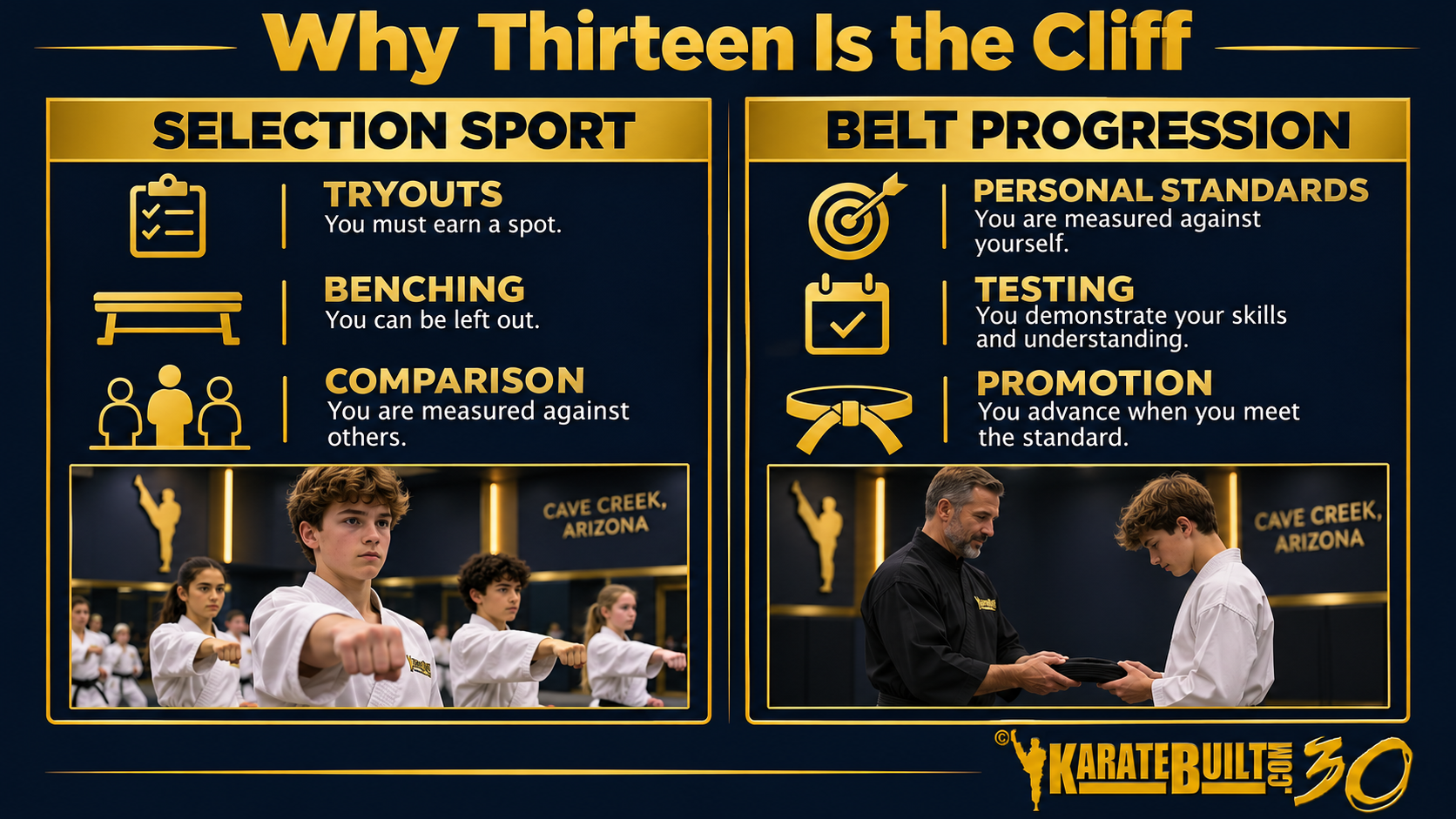
Nobody gets cut, and nobody sits the bench. A student earns the next rank by showing the required technique and character skills at a belt test, and the standard is the same whether they started at six or at twelve. The student beside them might be further along, yet that student is a model to learn from, and their progress takes nothing away from anyone else on the floor.
This matters most for the late bloomer. In a roster sport, the early-maturing kid gets the playing time and the late bloomer gets discouraged right when they’re about to catch up. On a training floor, the late bloomer keeps training, keeps testing and keeps moving forward while their body sorts itself out.
Teens also get responsibility. At KarateBuilt, experienced students help newer ones line up, hold targets, and learn the basics. A thirteen-year-old who teaches a seven-year-old a front kick starts to see themselves as someone others rely on. That picture of themselves holds a child steady through the years when everything else feels uncertain.
Want to see it in person? Bring your child to a class this week. Two weeks FREE plus a free uniform ($199 value). Call or text (602) 737-2098.
Should I let my child quit if they want to?
Let your child finish what they committed to and then make the next decision together with real information.
Walking out halfway through a season or a belt cycle teaches a child that discomfort is a reason to leave. Finishing teaches them they can do hard things while unhappy, which is one of the most useful skills a teenager can carry into high school. Losing and struggling are part of the deal, and I’ve written about how kids learn to handle defeat on the training floor.
Once the commitment is complete, sit down and ask three questionsL: What part do you still like? What part feels bad? What would make it feel like yours again? Sometimes the answer is a different activity, and that’s fine. Sometimes the answer is a different structure for the same love of moving and competing.
What does a teenager actually get out of staying with it?
A teenager who stays with a demanding activity gets proof, earned over years, that effort changes results.
That proof shows up in specific ways. They learn to perform under pressure in front of people, because every belt test is a performance in front of family, with names called. I’ve written about what a belt test actually measures, and it goes well past the kicks. They learn to take a correction without taking it personally. They learn to walk into a room of strangers and stand up straight.
They also gain adults outside the family who know them well. A thirteen-year-old will sometimes tell an instructor what they won’t yet tell a parent. Parents in Carefree and Cave Creek have told me this was the part they never saw coming.
How do I restart a child who already stopped?
Restart with something new and keep the first step small.
A child who quit soccer at twelve rarely wants to go back to the same field with the same kids who kept playing. A fresh start in a place where they have no history removes that weight. Here is a simple plan:
- Pick one class to watch together, with no promise attached.
- Let your child try a class before you discuss anything long term.
- Ask the instructor what your child would work on in their first month.
- Agree on a short trial, then decide together.
Teens at KarateBuilt train in our teen and adult classes, on the same rank system as every other student. Every new student starts the same way, with a private first lesson so your child can get comfortable before joining a real class.
If your middle schooler is drifting, come see us at KarateBuilt Martial Arts, 29850 N. Tatum Blvd., Suite 105, Cave Creek, AZ 85331. Start with two weeks FREE plus a free uniform ($199 value). Call or text (602) 737-2098.
Frequently asked questions
Is eleven too late to start martial arts?
Eleven is a strong age to start. Preteens can focus longer than younger children, so they often pick up the early ranks quickly.
What does the teen program look like at KarateBuilt?
Teens train in the teen and adult classes, working forms, self-defense and sparring on the same belt system as every student.
My child was in karate years ago. Can they come back?
Yes. Call or text (602) 737-2098, tell us their old rank, and an instructor will see where they stand at a private first lesson.
Does my teenager have to spar?
Sparring at KarateBuilt is controlled contact, the gear is included in tuition, and an instructor decides when a student is ready to start.
References
- Crane, J., & Temple, V. (2015). A systematic review of dropout from organized sport among children and youth. European Physical Education Review, 21(1), 114-thirteen1. https://doi.org/10.1177/thirteen56336X14555294
Sincerely,

Chief Master Greg Moody, Ph.D. holds a doctorate in Curriculum and Instruction, is a licensed psychotherapist (LAC), and is an 8th Degree Black Belt with over 30 years of experience teaching children. He has been recognized as the nation’s #1 martial arts school owner eight times.
P.S. Get Dr. Moody’s Book on Bullying – Click Here
KarateBuilt.com and KarateBuilt Martial Arts have been selected as the nation’s #1 martial arts schools for EIGHT YEARS IN A ROW!
KarateBuilt L.L.C. was founded in 1995 by Dr. Greg Moody, an 8th-degree Black Belt and Chief Master Instructor, KarateBuilt Martial Arts and Karate for Kids offer lessons for pre-school children ages 3-6 and elementary age kids ages 7 and up are designed to develop critical building blocks kids need – specialized for their age group – for school excellence and later success in life.
KarateBuilt Martial Arts Adult Karate training is a complete adult fitness and conditioning program for adults who want to lose weight, get (and stay in shape), or learn self-defense in a supportive environment.
Instructors can answer questions or be contacted 24 hours of the day, 7 days a week at 866-311-1032 for one of our nationwide locations. You can also visit our website at KarateBuilt.com.
About Dr. Greg Moody: Dr. Moody is an eighth-degree black belt and chief master instructor. He has a Ph.D. in Curriculum and Instruction from Arizona State University (along with a Master’s Degree in Counseling and a Bachelor’s Degree in Engineering – he actually is a rocket scientist). He has been teaching martial arts for over thirty years and has owned nine martial arts schools in Arizona, California and Virginia. Chief Master Moody is a motivational speaker and educator and teaches seminars in bullying, business, and martial arts training, around the world. See more at DrGregMoody.com.
Dr. Moody is also a licensed psychotherapist and maintains a practice at Sheade Therapy where he specializes in couples therapy and men’s issues.
The KarateBuilt Martial Arts Headquarters at KarateBuilt LLC is in Cave Creek, Arizona at 29850 N. Tatum Blvd., Suite 105 & 106, Cave Creek AZ 85331. You can locate the Chief Instructor, Senior Master Laura Sanborn there directly at (602) 737-2098. KarateBuilt Martial Arts serves Cave Creek, Carefree, Scottsdale, and Paradise Valley Arizona as well as Grand Rapids, MI.
Also, check us out on Today in Business and Educators Observer!
Here is Dr. Moody’s Amazon Author Page with 20 of his books, including Amazon bestsellers: Click HERE
P.P.S. From a parent:
“Since joining this program, my son Herman is more disciplined, motivated, and unstoppable in every challenge he faces!” – Emily Green