Should Parents Watch Class? What Helps Your Child and What Gets in the Way
October 9, 2026 by KarateBuilt Staff
By Chief Master Greg Moody, Ph.D., 8th Degree Black Belt, ATA Songahm Taekwondo
It’s your child’s first week. You’ve paid for the program, you’ve brought the snack, and now you’re standing in the lobby wondering whether to sit down or head for the car. Somewhere in the back of your mind is the question parents type in at night: should parents watch their child’s karate class?
Yes. Please watch.
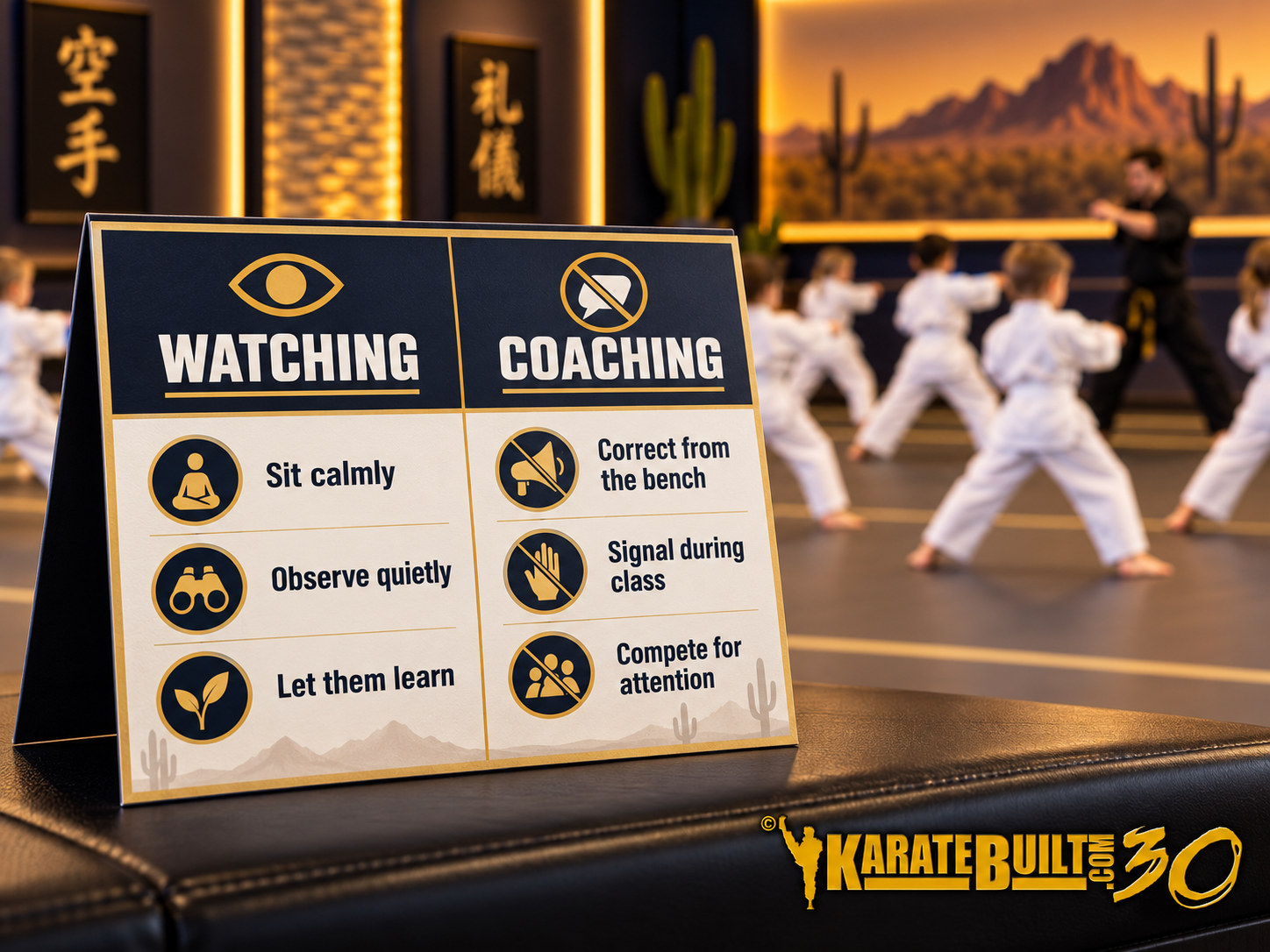
There’s one rule that comes with it, and it makes all the difference. Watch, smile, and leave the coaching to the instructor on the floor.
I’ve trained more than 18,000 students over thirty-plus years, and I’ve seen every kind of parent on the bench. The ones who help their children most follow that rule, and then they do their real job in the car on the way home.
Can I watch my child’s class?
Yes, you can watch your child’s class, and we want you to.
You’re paying for your child’s training, and you should be able to see it. Watching also tells you things a progress report can’t: how your child handles a hard drill, how they treat a partner, and what their face does when they get something right.
Watching is optional, too. Plenty of parents who drive in from Anthem and Desert Hills catch up on email from the bench or take a walk during class, and that’s perfectly fine. Your child benefits from the training either way.
Does watching help or distract a child?
Watching helps a child when the parent stays calm and quiet, and it distracts a child when the parent becomes a second instructor.
Here’s what happens inside a young child’s head during class. Their attention is a small flashlight, and they can point it at one adult at a time. When that beam stays on the instructor, they hear the cue, see the demonstration, and try the technique.
When a parent starts sending signals from the bench, the flashlight swings. The child turns to check your face, misses the next instruction, and turns back a beat late. Do that a dozen times in a class, and they’ve missed a dozen pieces of what you’re paying for.
My doctorate is in special education, and divided attention is one of the first things I look for when a child struggles. A calm, quiet parent in the chairs gives a child one thing to focus on. A busy, signaling parent gives them two.
What should I do if my child keeps looking at me?
If your child keeps looking at you, give a small smile and a nod, then turn your eyes back to the instructor.
Children look at their parents to check for approval, and that’s normal, especially in the first few weeks. Your job is to make each check quick and boring. A warm smile tells them you’re happy, and your eyes on the instructor tell them where theirs belong.
Skip the thumbs-up, the waving, and the mouthed words. Those invite a longer look and sometimes a conversation across the room.
Most kids stop checking within a few weeks, once they trust that you’re still there and still pleased. If the looking goes on much longer than that, mention it to the instructor after class, and we’ll help.
Why does coaching from the bench backfire?
Coaching from the bench backfires because it gives a child two sets of directions at the same moment, and they can only follow one.
The instructor says “Turn your hip,” and from the side you call out “Kick higher!” Now your child has to choose between the two adults they most want to please. Whatever they choose, one of you is disappointed, and they know it.
There’s a quieter cost as well. A child who hears corrections from the bench starts performing for the bench, and the room stops being theirs. Our school works best when the floor belongs to your child and the instructor.
What should I say on the ride home?
On the ride home, say one specific, warm thing about what you saw, and then let your child lead the conversation.
Here’s the sentence I recommend in place of “Good job“: “I loved watching you ____ tonight.” Fill in the blank with something real and specific, like keeping your hands up, getting back in line fast after you slipped, or helping the new kid find his spot.
That sentence does three things at once. It tells your child you were paying attention, it praises effort and attitude over results, and it asks nothing of them.
After your one sentence, ask an open question and wait. Try “What was the hardest part tonight?” If your child talks, listen. If they’d rather look out the window, let them, and try again at dinner.
When is it better to step out of the room?
Step out of the room when your presence is making it harder for your child to join in.
Here are the situations where I most often suggest it:
Your child clings or cries at drop-off. Many young children settle within minutes once the parent leaves, and they settle much more slowly while you’re still in sight.
Your child performs for you. If they clown around, show off, or keep running over to you, the audience is the problem. Give them a class without one.
Your child shuts down when you watch. Some kids freeze up under a parent’s eyes, even a loving parent’s. Give them space to make mistakes in private for a while.
Stepping out is almost always temporary. Talk with the instructor, step out for a few classes, and then come back and watch from the chairs once your child is settled.
What should I watch for to know it is working?
Watch for three things: how fast your child recovers from a mistake, where their eyes go, and how strong their voice sounds.
Recovery time. Early on, a missed technique might mean a frown, a pause, or tears. Over weeks, that gap shrinks until your child misses, resets, and tries again within a few seconds. That’s resilience growing in front of you.
Eyes on the instructor. In the first weeks, your child’s eyes bounce between the floor, the mirror, and you. As training takes hold, they lock onto the instructor and stay there. That’s focus.
A stronger voice. Listen to the class answers and the kiai. A child who mumbled “Yes, sir” in week one and answers clearly in week eight is gaining confidence you can actually hear.
You won’t see all three in a single class. Watch over a month, and you’ll start to notice the shift.
If your child isn’t training with us yet, come watch a class before you decide anything. New students get two weeks FREE plus a free uniform, a $199 value, at KarateBuilt Martial Arts, 29850 N. Tatum Blvd., Suite 105, Cave Creek, AZ 85331.
Write down your one sentence before your child’s next class, so it’s ready for the ride home. To book a first class, call or text (602) 737-2098.
Frequently Asked Questions
Is there a viewing area at the Cave Creek school?
Yes. Parents can sit in the chairs along the wall and watch every class from start to finish.
Do you ever close class to parents?
Rarely. Classes stay open to parents, and an instructor may suggest stepping out for a few classes if a child is having a hard time settling while a parent is in the room.
My child behaves differently when I watch. Is that normal?
Yes, it’s very common. Some kids show off for a parent and others freeze up, and both usually fade within a few weeks; if it doesn’t, ask the instructor whether a short break from watching would help.
What is the one thing I should say after class?
Try “I loved watching you ____ tonight,” and fill in the blank with something specific you saw. Then let your child decide where the conversation goes.
References
Knight, C. J., Boden, C. M., & Holt, N. L. (2010). Junior tennis players’ preferences for parental behaviors. Journal of Applied Sport Psychology, 22(4), 377–391. https://doi.org/10.1080/10413200.2010.495324
Tamminen, K. A., Poucher, Z. A., & Povilaitis, V. (2017). The car ride home: An interpretive examination of parent–athlete sport conversations. Sport, Exercise, and Performance Psychology, 6(4), 325–339. https://psycnet.apa.org/journals/spy/6/4/325/
Sincerely,
Chief Master Greg Moody, Ph.D. holds a doctorate in Special Education, is a licensed psychotherapist (LAC), and is an 8th Degree Black Belt with over 30 years of experience teaching children. He’s taught over 18,000 students, over 1,800 of them Black Belts. He has been recognized as the nation’s #1 martial arts school owner eight times, and he’s a four-time #1 Amazon Bestselling Author.
P.S. Get Dr. Moody’s Book on Bullying – Click Here
KarateBuilt L.L.C. was founded in 1995 by Dr. Greg Moody, an 8th-degree Black Belt and Chief Master Instructor, KarateBuilt Martial Arts and Karate for Kids offer lessons for pre-school children ages 3-6 and elementary age kids ages 7 and up are designed to develop critical building blocks kids need – specialized for their age group – for school excellence and later success in life.
KarateBuilt Martial Arts Adult Karate training is a complete adult fitness and conditioning program for adults who want to lose weight, get (and stay in shape), or learn self-defense in a supportive environment.
Instructors can answer questions or be contacted 24 hours of the day, 7 days a week at 866-311-1032 for one of our nationwide locations. You can also visit our website at KarateBuilt.com.
About Dr. Greg Moody: Dr. Moody is an eighth-degree black belt and chief master instructor. He has a Ph.D. in Special Education from Arizona State University (along with a Master’s Degree in Counseling and a Bachelor’s Degree in Engineering – he actually is a rocket scientist). He has been teaching martial arts for over 25 years and has owned eight martial arts schools in Arizona and California. Chief Master Moody is a motivational speaker and educator and teaches seminars in bullying, business, and martial arts training, around the world. See more at DrGregMoody.com.
The KarateBuilt Martial Arts Headquarters at KarateBuilt LLC is in Cave Creek, Arizona at 29850 N. Tatum Blvd., Suite 105, Cave Creek AZ 85331. You can locate the Chief Instructor, Master Laura Sanborn there directly at (480) 575-8171. KarateBuilt Martial Arts serves Cave Creek, Carefree, Scottsdale, and Paradise Valley Arizona as well as Grand Rapids, MI.