Why We Make Kids Speak Up in Class, and What Changes at Home
October 8, 2026 by KarateBuilt Staff
By Chief Master Greg Moody, Ph.D., 8th Degree Black Belt, ATA Songahm Taekwondo
The waiter leans down and asks your daughter what she’d like. She looks at the table, then at you, and waits for you to answer for her. You’ve searched “how to help a quiet child speak up with confidence” more than once, and most of what you found told you to be patient.
Patience matters, but practice matters more.
Walk into any class at our school, and you’ll hear it within a minute. An instructor gives a direction, and twenty kids answer at once: “Yes, sir!”
Parents sometimes wince the first time they hear it. They picture a drill sergeant. What they’re actually hearing is a carefully built exercise in being heard, and I’ll explain exactly how it works.
Why does a martial arts class make children answer out loud?
We ask children to answer out loud because every answer is a small, safe rehearsal of using their voice in front of other people.
In a single class, a child answers out loud dozens of times. They answer the instructor, they call out their count during drills, and they kiyap on a strike. Every one of those moments asks the same tiny question: Can I make a sound, and will I be okay?
The answer is always yes. Nobody laughs, nobody stares, and the class keeps moving. After enough of those yeses, the child’s body starts to believe it.
I’ve trained more than 18,000 students over thirty-plus years. The children who walk in quietest are often the ones who change the most, because they’re getting practice no other part of their week gives them.
Is this about obedience?
Only a small part of it is. Respect matters to us, and the bigger goal is a child who believes their voice counts.
A quiet child usually knows the answer. What stops them is the moment of speaking, with its pounding heart and hot face and the feeling that every eye in the room has turned their way.
A clear “Yes, sir!” is the smallest possible version of that moment. It’s two words long, it’s the same every time, and it’s said alongside a room full of other kids. That makes it the perfect first rung on a ladder.
Over time, the rungs get taller. The child who learned to answer in a group starts answering alone, then calling out a count for the class, and eventually leading a warm-up. Students in our Beyond Black Belt leadership track teach whole drills, and some of them started out whispering.
What is actually being trained when a child speaks up?
The training targets the body’s alarm system, which treats speaking up as a risk until repeated safe practice teaches it otherwise.
I hold a master’s in counseling, and in that field this process has a name: graded exposure. A person faces a feared situation in small steps, starting with one they can handle and moving up only when that step feels easy.
A martial arts class runs graded exposure without ever calling it that. The steps are tiny, the room is safe, and the repetitions come fast. A child who speaks up dozens of times a week, twice a week, for months, has done more practice than a child who gets called on in school a few times a month.
Here’s the important part. The confidence your child builds is attached to their voice, so it travels with them out the door.
How long before a parent sees it outside class?
Most parents notice the first small change within the first two months.
It rarely looks dramatic. Parents in Carefree and here in Cave Creek tell me they usually see it first at a restaurant, when their child orders for herself without looking over for help.
After that, it starts showing up in more places. A teacher mentions that your son raised his hand. Your daughter answers a coach’s question at practice instead of shrugging. A grandparent calls and your child actually talks.
Watch for those moments and say nothing big about them. A small smile is plenty. Making a fuss can put the spotlight back on a child who’s only just learned to stand in it.
What if my child refuses to speak at first?
If your child won’t speak at first, we start where they are and build up in steps small enough that each one feels doable.
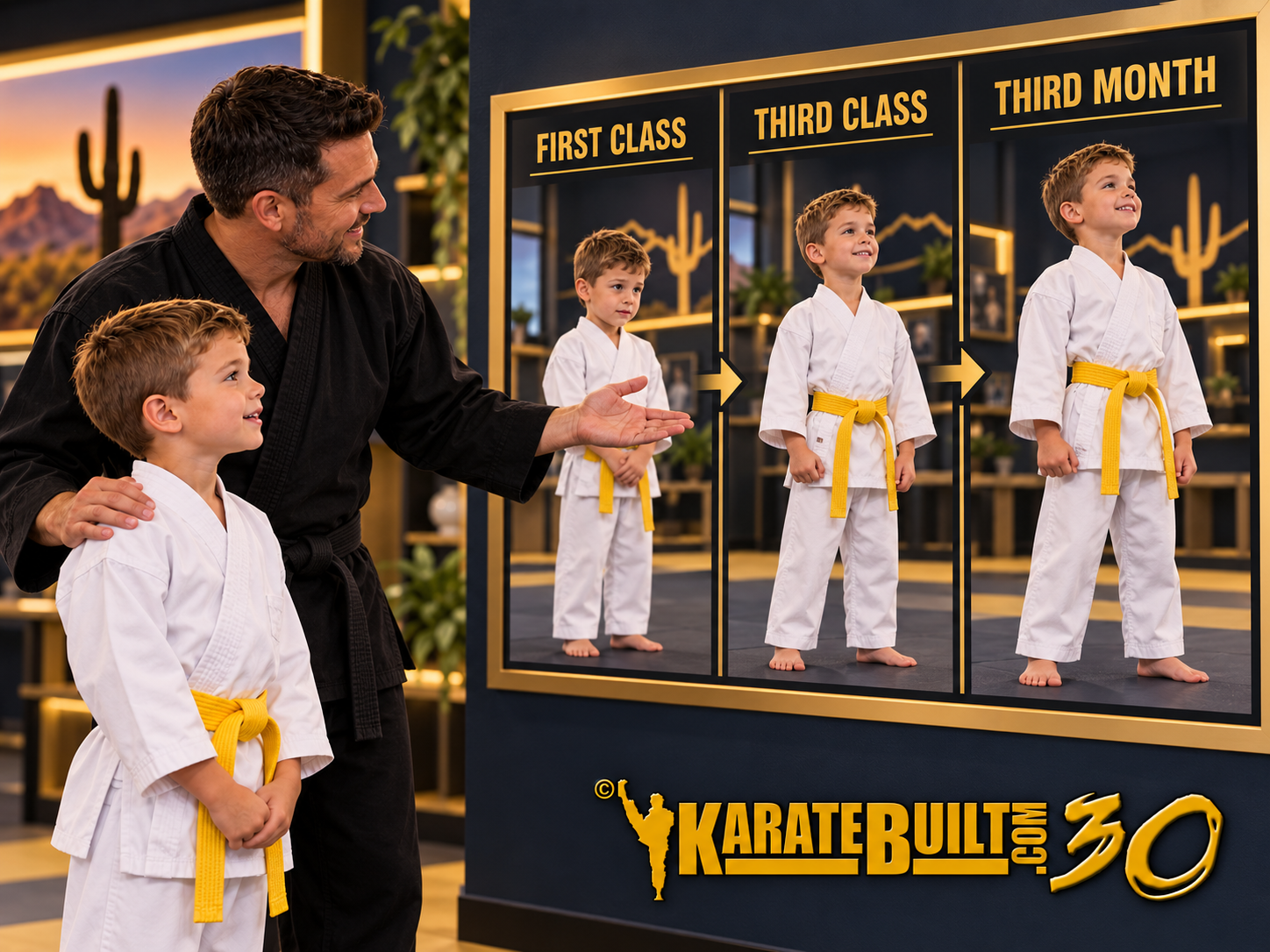
Here’s what the first three classes typically look like for a child who isn’t ready to talk yet.
Class one: Nodding counts. The instructor crouches to eye level, says the child’s name warmly, and accepts a nod or a thumbs-up as an answer. We place the child next to a steady, friendly student. When the class answers together, the child’s voice can hide in the crowd, and if no voice comes out yet, that’s fine too.
Class two: Join the group. We invite the child to say the group answers along with everyone else, even in a whisper. The instructor might look over and give a quick nod when they do it, without stopping class or drawing attention.
Class three: One word, one listener. Before or after class, the instructor asks the child for one short answer, just between the two of them. It might be their name or a simple “Yes, sir.” That one word is a big deal, and we treat it calmly, with a high five and a grin.
From there, the steps keep coming at the child’s pace. A solo answer in a small group comes next, then a solo answer with the whole class listening, then a kiyap the back row can hear.
We never shame a child for staying quiet, and we never put them on the spot in front of the room before they’re ready. Pushing too hard teaches the alarm system the exact lesson we’re trying to unteach.
How can I reinforce this at home without pressure?
The single most helpful thing you can do at home is wait three seconds before speaking for your child.
When the waiter asks what your daughter wants, count to three in your head. Keep your eyes on the menu, and give her the gap. If she answers, wonderful. If she doesn’t, step in kindly and try again next time.
Most parents of quiet kids fill the silence out of love, and they do it fast. Three seconds feels long to you, and to your child it’s a door left open.
If you’d like one more idea, let your child be the instructor at home. Have them call out commands for a few minutes while you answer, “Yes, sir!” as loudly as you can. Kids love bossing their parents around, and they’re using a strong voice from a position of total safety.
Skip the reminders, the bribes, and the “Speak up, honey” in front of other people. Those turn a chance into a test.
What does this look like for a child with anxiety?
For a child with anxiety, the steps are smaller, the pace is slower, and we work alongside the family and any professionals involved.
My doctorate is in special education, and I’ve worked with many children whose fear runs deeper than shyness. Some have social anxiety. A few have selective mutism, where a child speaks freely at home but can’t get words out at school or in public.
Those children deserve real treatment from a qualified therapist, and class should never replace it. What class can offer is a structured place to practice the steps a therapist is already working on.
If your child sees a therapist, tell us what they’re working on. We’ll match their plan on the floor, step for step, and keep you posted on what we see.
Many parents of reserved kids start with a trial class, where their child can watch, try a little, and see that the room is safe. New students get two weeks FREE plus a free uniform, a $199 value, at KarateBuilt Martial Arts, 29850 N. Tatum Blvd., Suite 105, Cave Creek, AZ 85331.
This week, try the three-second wait at least once. Then call or text (602) 737-2098 to book your child’s first class.
Frequently Asked Questions
My child is very shy. Will this be too much?
We start every shy child at a step they can handle, even if that first step is a nod. Each new step comes only after the last one feels easy.
What happens in the first class if she will not speak?
She’ll take part in class like everyone else, and a nod or thumbs-up counts as an answer. The instructor will greet her at eye level and pair her with a friendly student, with no pressure to talk.
Do you make children yell?
No. We ask for a clear, confident voice, and a child builds up to it gradually, starting with group answers and working toward a solo kiyap.
Does this work for a child with selective mutism or social anxiety?
Class can be a helpful place to practice alongside professional treatment, and it should never replace that treatment. Share your child’s therapy goals with us, and we’ll match those steps in class.
References
Whiteside, S. P. H., Sim, L. A., Morrow, A. S., Farah, W. H., Hilliker, D. R., Murad, M. H., & Wang, Z. (2020). A meta-analysis to guide the enhancement of CBT for childhood anxiety: Exposure over anxiety management. Clinical Child and Family Psychology Review, 23(1), 102–121. https://doi.org/10.1007/s10567-019-00303-2
Sincerely,
Chief Master Greg Moody, Ph.D. holds a doctorate in Special Education, is a licensed psychotherapist (LAC), and is an 8th Degree Black Belt with over 30 years of experience teaching children. He’s taught over 18,000 students, over 1,800 of them Black Belts. He has been recognized as the nation’s #1 martial arts school owner eight times, and he’s a four-time #1 Amazon Bestselling Author.
P.S. Get Dr. Moody’s Book on Bullying – Click Here
KarateBuilt L.L.C. was founded in 1995 by Dr. Greg Moody, an 8th-degree Black Belt and Chief Master Instructor, KarateBuilt Martial Arts and Karate for Kids offer lessons for pre-school children ages 3-6 and elementary age kids ages 7 and up are designed to develop critical building blocks kids need – specialized for their age group – for school excellence and later success in life.
KarateBuilt Martial Arts Adult Karate training is a complete adult fitness and conditioning program for adults who want to lose weight, get (and stay in shape), or learn self-defense in a supportive environment.
Instructors can answer questions or be contacted 24 hours of the day, 7 days a week at 866-311-1032 for one of our nationwide locations. You can also visit our website at KarateBuilt.com.
About Dr. Greg Moody: Dr. Moody is an eighth-degree black belt and chief master instructor. He has a Ph.D. in Special Education from Arizona State University (along with a Master’s Degree in Counseling and a Bachelor’s Degree in Engineering – he actually is a rocket scientist). He has been teaching martial arts for over 25 years and has owned eight martial arts schools in Arizona and California. Chief Master Moody is a motivational speaker and educator and teaches seminars in bullying, business, and martial arts training, around the world. See more at DrGregMoody.com.
The KarateBuilt Martial Arts Headquarters at KarateBuilt LLC is in Cave Creek, Arizona at 29850 N. Tatum Blvd., Suite 105, Cave Creek AZ 85331. You can locate the Chief Instructor, Master Laura Sanborn there directly at (480) 575-8171. KarateBuilt Martial Arts serves Cave Creek, Carefree, Scottsdale, and Paradise Valley Arizona as well as Grand Rapids, MI.