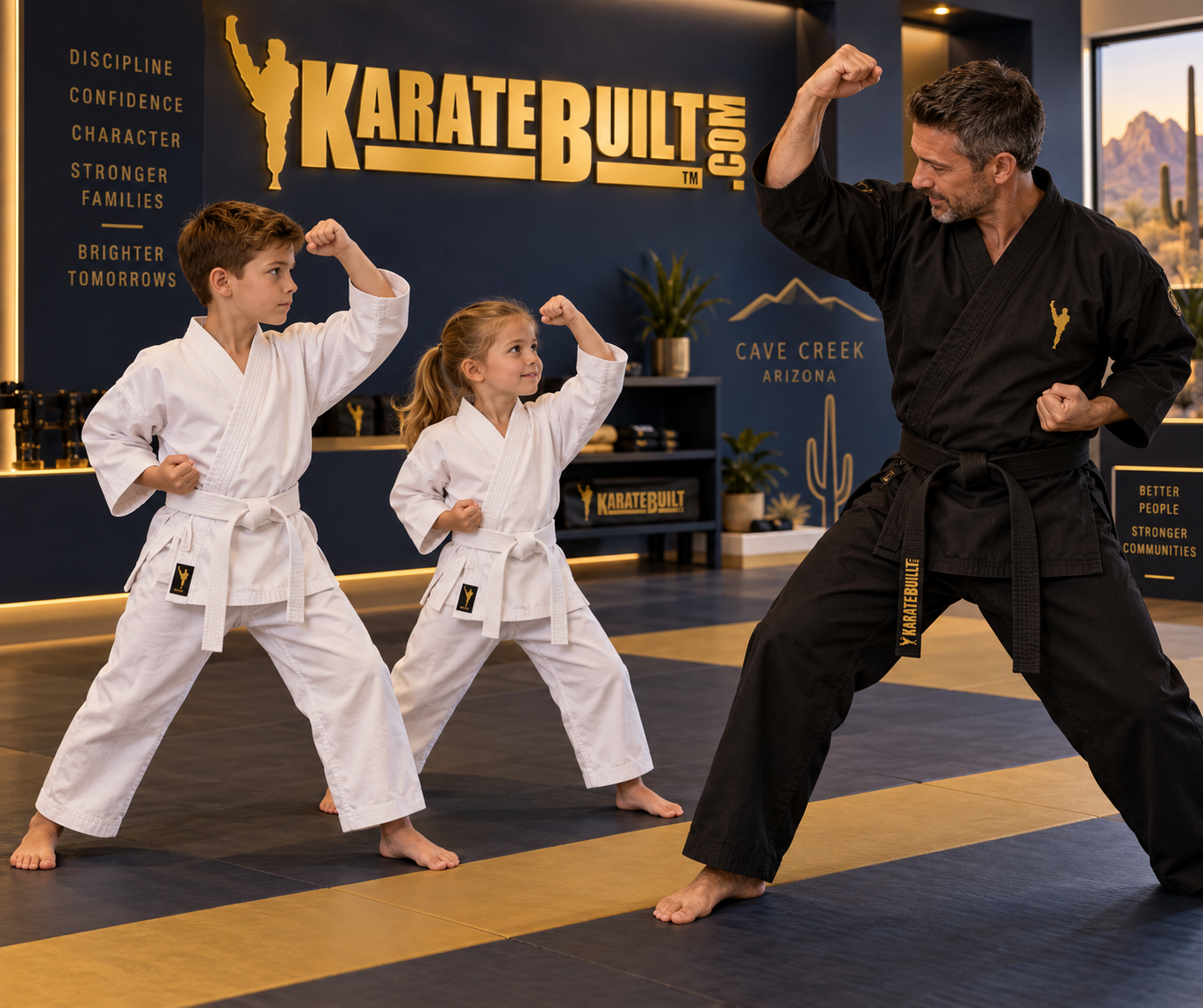
Siblings in the Same Karate Class: When It Works, When It Doesn’t, and How We Handle It
September 25, 2026 by Chief Master Greg Moody, Ph.D.
What’s Actually Happening in the Back Seat Right Now?
You’re driving home, and your two kids are at it again. One accused the other of copying, and someone’s crying about a seat belt buckle.
You glance in the rearview mirror and think the same thought every parent thinks: is this normal, or is something actually wrong between them?
The answer, before we go any further, is that it’s normal, and it has almost nothing to do with whether they can train in the same class together.
How Often Do Siblings Actually Clash?
Let’s put a real number on this instead of guessing.
Young children between the ages of 2 and 9 experience sibling conflict at a strikingly high rate, with some studies documenting close to eight disputes per hour among 2- to 4-year-olds, and comparable rates among 3- to 9-year-olds, according to research published by University of Illinois psychologist Laurie Kramer in Child Development Perspectives.
Read that again. Eight times an hour. That’s not a broken relationship. That’s Tuesday.
Kramer’s research makes a point that most parents never hear: conflict frequency alone doesn’t predict whether siblings will grow up close. What predicts it is whether they also share positive, constructive activities together, ones structured to fit each child’s own developmental level, according to the same research.
What Does This Mean for Your Family?
You’re not failing as a parent because your kids bicker in the car. You’d actually be in unusual territory if they didn’t.
What matters more is what else is happening between them. Do they also have moments of shared effort, shared pride, shared fun? If the only time they interact is the fight over the front seat, that’s a signal worth paying attention to. If they fight in the car and then high-five each other during a video game an hour later, that’s a completely normal sibling relationship doing exactly what it’s supposed to do.
This is where a shared class becomes useful, not because it eliminates conflict, but because it gives siblings something structured to do together where the usual triggers, whose turn it is, who’s faster, who got more attention, get handled by an instructor instead of negotiated between two kids with no referee.
A karate class also solves a problem most shared activities can’t. Siblings are almost never the same age or skill level. A class organized around individual belt rank, where a nine-year-old and a six-year-old can train side by side but are evaluated against their own progress, not against each other, is exactly the kind of activity Kramer’s research points to: one that accommodates differing developmental levels while still being genuinely shared.
If you’ve been putting off enrolling siblings together because you’re worried it’ll just be another arena for competition, this week is a good time to test that assumption directly. Bring both kids in for a trial class and watch how they actually behave on the mat, not how you assume they’ll behave based on the car ride over.
When Does a Shared Class Work, and When Doesn’t It?
I’ll be straight with you. It doesn’t always work, and pretending otherwise would be dishonest.
It tends to work well when: Both kids genuinely want to be there, not just the one who asked first. The age or skill gap is moderate enough that neither child feels constantly behind or constantly held back. And the siblings’ temperaments are more cooperative than competitive by nature.
It tends to struggle when: One sibling is significantly more advanced and the other feels perpetually behind in front of them. One or both children have a strong need to win every interaction, turning shared drills into constant contests. Or one sibling only agreed to join because a parent pushed the idea, not because they wanted to train.
None of these problems are permanent. Most of them are manageable with the right structure, which is exactly what a good instructor provides.
Here’s how we actually handle it. We group students by belt rank and skill level for drills, not by family, so siblings aren’t automatically paired against each other in ways that invite comparison. When siblings do partner up, we watch for competitive escalation and redirect it before it turns into resentment. And we talk to each child individually about their own goals, not their sibling’s, so progress gets measured against their own last belt test, never against a brother or sister in the room.
What Should You Try This Week?
Here’s something concrete, not another thing to worry about.
Set up one 15-minute activity this week that your kids do together, something with a shared, structured goal. Building something, cooking a simple recipe, even a board game with clear rules. Watch the ratio of positive moments to negative ones.
You’re not looking for zero conflict. Based on what the research shows, that’s not realistic and honestly not even healthy. You’re looking for whether the positive moments are showing up too, alongside the friction. That ratio tells you far more about your kids’ relationship than the fight in the back seat ever will.
What Happens on a KarateBuilt Family Trial?
Here’s what it actually looks like if you bring both kids in.
Each child gets fitted with a training uniform and joins the class matched to their age and current ability, which may mean they’re on the mat together or in adjacent groups depending on where each of them is developmentally. An instructor runs them through the same warmup, the same core drills, and gives each child individual, specific feedback.
After class, you get a conversation with the instructor about both kids, not a combined summary, but a real read on how each one showed up, how they interacted with each other, and whether training together looks like a fit.
Many families ask about enrolling more than one child, and most schools, including ours, offer a reduced family rate when siblings train together. Ask us about current pricing when you come in. It’s one of the most common questions we get, and we’re glad to walk you through the specifics in person.
We’ve worked with thousands of sibling pairs across our 18,000-plus students, and we’ve built our program around exactly the kind of individualized, rank-based structure that lets brothers and sisters share a class without one of them feeling like they’re constantly losing to the other.
The Number That Matters and the Next Step
Eight conflicts an hour is normal for young siblings. It’s not a reason to keep them apart, and it’s not a reason to assume a shared class will end in disaster.
Call KarateBuilt this week and schedule a trial class for both kids. Come watch how they actually do together on the mat and let us help you figure out whether training side by side is the right fit for your family.
Sincerely,
Chief Master Greg Moody, Ph.D. holds a doctorate in Special Education, is a licensed psychotherapist (LAC), and is an 8th Degree Black Belt with over 30 years of experience teaching children. He’s taught over 18,000 students, over 1,800 of them Black Belts. He has been recognized as the nation’s #1 martial arts school owner eight times, and he’s a four-time #1 Amazon Bestselling Author.
P.S. Get Dr. Moody’s Book on Bullying – Click Here
KarateBuilt L.L.C. was founded in 1995 by Dr. Greg Moody, an 8th-degree Black Belt and Chief Master Instructor, KarateBuilt Martial Arts and Karate for Kids offer lessons for pre-school children ages 3-6 and elementary age kids ages 7 and up are designed to develop critical building blocks kids need – specialized for their age group – for school excellence and later success in life.
KarateBuilt Martial Arts Adult Karate training is a complete adult fitness and conditioning program for adults who want to lose weight, get (and stay in shape), or learn self-defense in a supportive environment.
Instructors can answer questions or be contacted 24 hours of the day, 7 days a week at 866-311-1032 for one of our nationwide locations. You can also visit our website at KarateBuilt.com.
About Dr. Greg Moody: Dr. Moody is an eighth-degree black belt and chief master instructor. He has a Ph.D. in Special Education from Arizona State University (along with a Master’s Degree in Counseling and a Bachelor’s Degree in Engineering – he actually is a rocket scientist). He has been teaching martial arts for over 25 years and has owned eight martial arts schools in Arizona and California. Chief Master Moody is a motivational speaker and educator and teaches seminars in bullying, business, and martial arts training, around the world. See more at DrGregMoody.com.
The KarateBuilt Martial Arts Headquarters at KarateBuilt LLC is in Cave Creek, Arizona at 29850 N. Tatum Blvd., Suite 105, Cave Creek AZ 85331. You can locate the Chief Instructor, Master Laura Sanborn there directly at (480) 575-8171. KarateBuilt Martial Arts serves Cave Creek, Carefree, Scottsdale, and Paradise Valley Arizona as well as Grand Rapids, MI.