Is My Child Too Shy for Karate? What Happens in the First Three Classes
September 24, 2026 by Chief Master Greg Moody, Ph.D.
What’s Happening When Your Child Hides Behind Your Leg?
You’re standing at the edge of a birthday party, a new classroom, or the entrance to a class you just paid for. Your child is gripping your leg, eyes down, not moving.
You’re already rehearsing the apology. “She’s just shy, she’ll warm up.” You’ve said it a hundred times.
Here’s what I want you to know before you read another word. That reaction isn’t a red flag. It’s not a sign your child can’t handle a new activity. It’s one of the most common temperaments in childhood, and it tells you almost nothing about how the next three classes will go.
How Many Kids Are Actually Wired This Way?
Plainly stated, roughly 15 to 20 percent of children are classified as behaviorally inhibited in early childhood, meaning they show a consistent pattern of caution, watchfulness, and initial withdrawal around new people and situations, according to research published in the Journal of the American Academy of Child and Adolescent Psychiatry.
That’s not a rare trait, rather it’s one in five or six kids in any classroom, any birthday party, any first martial arts class.
This temperament shows up early and tends to be stable. A child who hangs back at two is often the same child who hangs back at seven, unless something in their environment teaches them a different pattern is possible.
What Does This Mean for Your Family?
Your child isn’t broken, and you didn’t do anything wrong.
Shy and inhibited kids process new environments differently. They watch before they act. They need more information before they feel safe enough to participate. It’s not weakness but a nervous system doing exactly what it’s built to do.
The problem is that most kids’ activities aren’t built for that nervous system. A soccer field on day one is loud, fast, and social all at once. A birthday party throws a room full of unfamiliar kids at a child with zero warmup. For a child who needs to observe before engaging, that’s overwhelming before they’ve had a chance to try.
Martial arts training works differently, and the research backs up why. A study of children practicing recreational martial arts found they showed significantly lower hostility and significantly higher self-esteem compared to peers who didn’t train, according to research published in Scientific Dissertations of the Academy of Physical Education in Wrocław. The effect was even stronger in girls.
That difference comes from structure. A class where everyone faces the same direction, follows the same instructor, and moves through the same drill in a line gives a shy child something a chaotic playground never does: a script. They know exactly what’s coming next. That predictability is what lets a cautious kid start to participate without being forced into the spotlight before they’re ready.
This week, here’s something concrete you can do. Watch your child in one low-pressure group setting, a library story time, a cousin’s playdate, anything with mild structure, and notice how long it takes them to settle in. That number, five minutes or twenty, tells you what pace to expect on their first day of class. Bring that observation with you when you come try a class. It helps the instructor meet your child where they are instead of where a generic timeline says they should be.
Will My Child Actually Like Karate?
I can’t promise every child will love it. I can tell you what determines the answer, and it’s rarely the activity itself.
It’s whether the environment gives them room to warm up at their own pace. Kids who are pushed to perform before they’re ready shut down. Kids who are allowed to watch, copy, and gradually step forward tend to come around, often faster than their parents expect.
The insight I want you to sit with is this: shy kids don’t need less structure. They need more of it. Structure is what makes a new environment feel safe enough to try.
If you’re on the fence, don’t wait for your child to announce they’re ready. That day may not come on its own. Bring them in and let the structure do the work.
What Actually Happens in the First Three Classes?
The honest walkthrough, class by class:
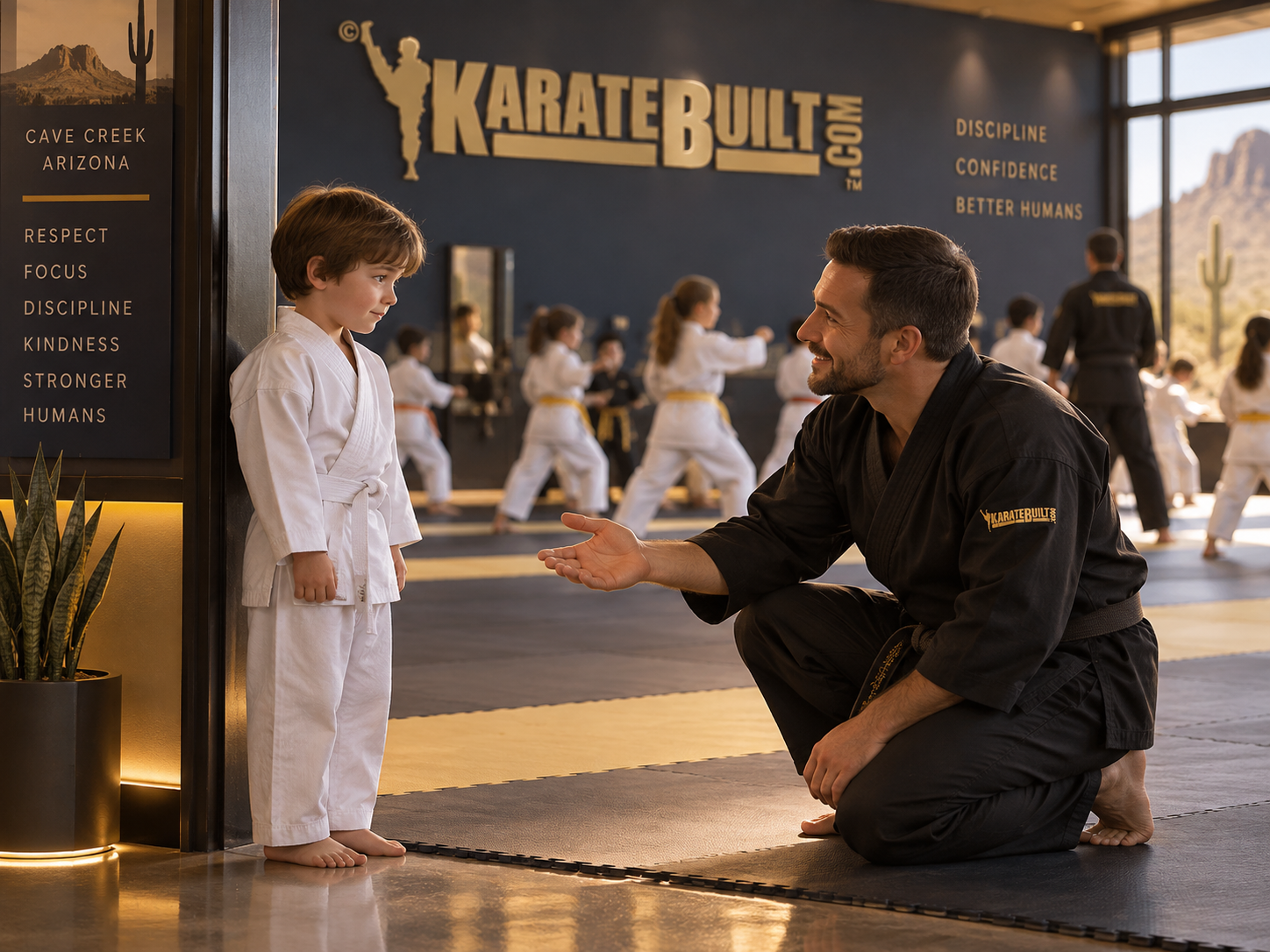
Class one. Your child is not expected to speak, lead, or perform in front of anyone. They stand in line, watch the student next to them, and copy basic movements. The instructor calls on volunteers, never singles out a hesitant child, and lets your child’s first job simply be showing up and standing in the group.
Class two. Familiarity starts doing its work. Your child recognizes the warmup, recognizes a few classmates, and usually starts moving through the drills with slightly more confidence, even if they’re still not talking much. The instructor begins offering small, direct interactions, a fist bump, a specific compliment, something low-stakes that builds a one-on-one connection.
Class three. This is usually where something shifts. Your child has now succeeded at the same routine twice. They know the structure. Many kids start partnering with another student for a simple drill for the first time, a moment that would have felt impossible in class one. It’s small, but it’s also the beginning of real change.
None of this requires your child to transform into an extrovert. It requires three repetitions of a predictable, safe structure. That’s it.
What Should You Do Before the First Class?
Don’t build it up. Don’t tell your child three days in advance that they’re going to “make so many new friends.” For a shy kid, that kind of pressure creates dread, not excitement.
Instead, tell them plainly what will happen. “We’re going to a class. You’ll wear a uniform. You’ll stand in a line and follow along. I’ll be right there.” Predictability lowers anxiety more than encouragement does. When you arrive, resist the urge to hover or narrate. Let the instructor lead. Your calm presence in the room is worth more than any pep talk.
What Happens on a KarateBuilt Trial?
Here’s exactly what your child will experience if you bring them in.
They’ll get fitted with a training uniform and join a class with kids their own age. Nobody puts them on the spot. They follow the group, copy the instructor, and move at the pace the structure sets, not the pace a stranger expects from them.
After class, you’ll get a direct conversation with the instructor about what we actually saw. Not vague praise. Specific observations about how your child responded to structure, whether they made eye contact by the end, whether they followed along without prompting.
We’ve walked thousands of shy, cautious, hesitant kids through exactly this process. Out of the 18,000-plus students we’ve taught and the 1,800-plus Black Belts we’ve produced, a meaningful share started exactly where your child is standing right now, gripping a leg at the door.
The Number That Matters and the Next Step
One in five kids shows this exact temperament. Your child isn’t the exception. They’re the rule.
Call KarateBuilt this week and schedule a trial class. Come watch what three classes of structure and patience can do before you decide whether karate is right for your child.
Sincerely,
Chief Master Greg Moody, Ph.D. holds a doctorate in Special Education, is a licensed psychotherapist (LAC), and is an 8th Degree Black Belt with over 30 years of experience teaching children. He’s taught over 18,000 students, over 1,800 of them Black Belts. He has been recognized as the nation’s #1 martial arts school owner eight times, and he’s a four-time #1 Amazon Bestselling Author.
P.S. Get Dr. Moody’s Book on Bullying – Click Here
KarateBuilt L.L.C. was founded in 1995 by Dr. Greg Moody, an 8th-degree Black Belt and Chief Master Instructor, KarateBuilt Martial Arts and Karate for Kids offer lessons for pre-school children ages 3-6 and elementary age kids ages 7 and up are designed to develop critical building blocks kids need – specialized for their age group – for school excellence and later success in life.
KarateBuilt Martial Arts Adult Karate training is a complete adult fitness and conditioning program for adults who want to lose weight, get (and stay in shape), or learn self-defense in a supportive environment.
Instructors can answer questions or be contacted 24 hours of the day, 7 days a week at 866-311-1032 for one of our nationwide locations. You can also visit our website at KarateBuilt.com.
About Dr. Greg Moody: Dr. Moody is an eighth-degree black belt and chief master instructor. He has a Ph.D. in Special Education from Arizona State University (along with a Master’s Degree in Counseling and a Bachelor’s Degree in Engineering – he actually is a rocket scientist). He has been teaching martial arts for over 25 years and has owned eight martial arts schools in Arizona and California. Chief Master Moody is a motivational speaker and educator and teaches seminars in bullying, business, and martial arts training, around the world. See more at DrGregMoody.com.
The KarateBuilt Martial Arts Headquarters at KarateBuilt LLC is in Cave Creek, Arizona at 29850 N. Tatum Blvd., Suite 105, Cave Creek AZ 85331. You can locate the Chief Instructor, Master Laura Sanborn there directly at (480) 575-8171. KarateBuilt Martial Arts serves Cave Creek, Carefree, Scottsdale, and Paradise Valley Arizona as well as Grand Rapids, MI.