What Self-Defense Actually Means for a Nine-Year-Old
October 15, 2026 by KarateBuilt Staff
By Chief Master Greg Moody, Ph.D., 8th Degree Black Belt, ATA Songahm Taekwondo
You want your child safe, and you also have no interest in raising a kid who settles arguments with his fists. If you’ve been looking at self-defense classes for kids Cave Creek offers, you’ve probably felt both of those at the same time. Here is the good news: the two goals point in the same direction, because real self-defense for a nine-year-old is mostly about staying out of a fight, with the hands saved for last.
Every school in the Valley lists self-defense on its flyer. Very few explain what it means for a child of a specific age. I’ll do that here, step by step, because the order of the steps is the whole safety plan.
What does self-defense actually mean for a nine-year-old?
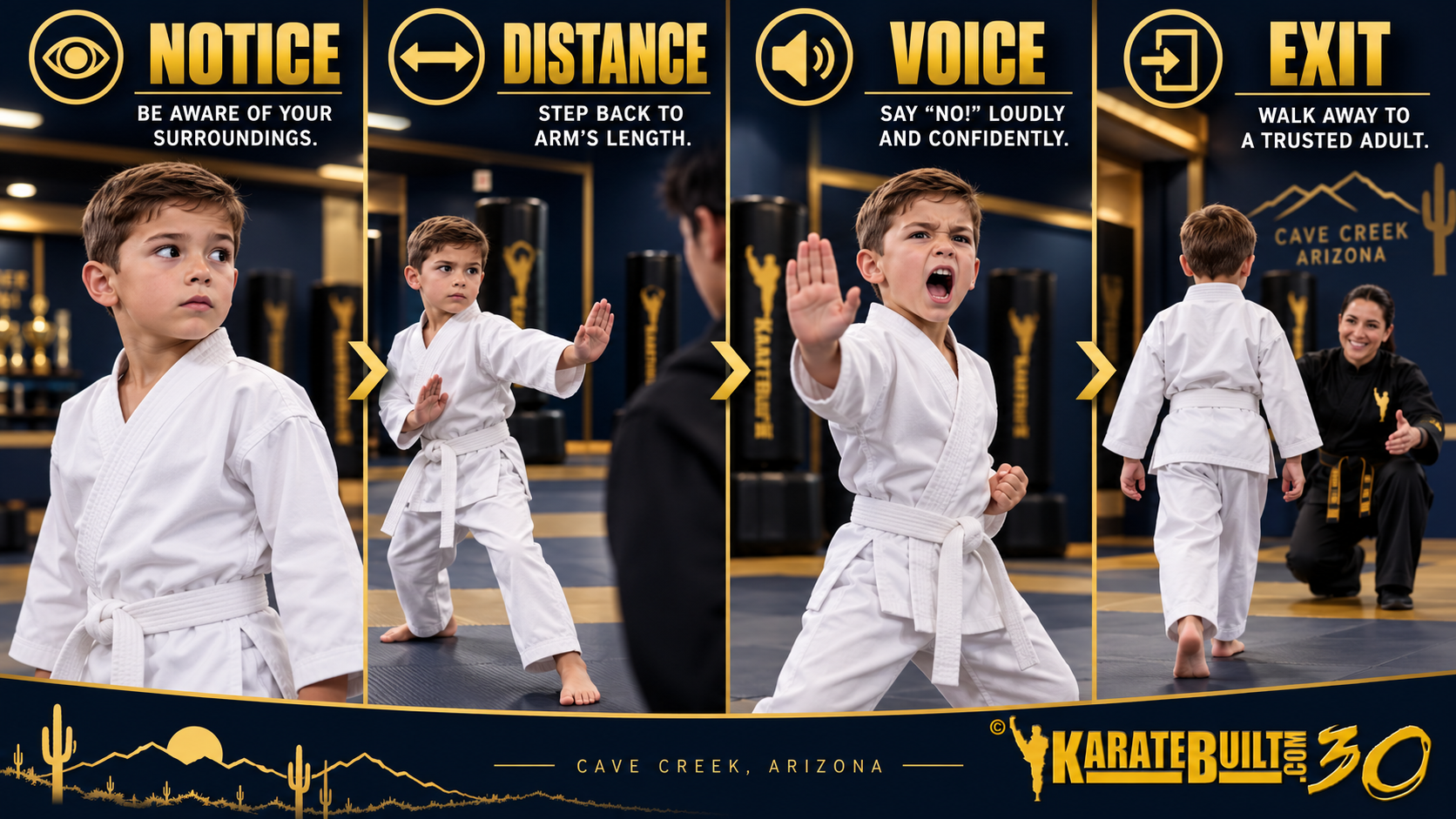
For a nine-year-old, self-defense means five skills in a fixed order: notice trouble early, create distance, use a loud voice, get to a safe adult, and use physical technique only when nothing else has worked.
Each step makes the next one less likely to be needed. A child who notices early rarely needs distance. A child who keeps distance rarely needs to shout. A child who shouts and walks toward a crowd almost never needs to strike anyone.
That’s why we teach them in this sequence and practice them in this sequence. Under stress, a child will do what they’ve rehearsed, in the order they rehearsed it.
Is my child learning to fight?
Your child is learning how to avoid a fight, and how to end one quickly if there’s truly no way out.
Physical technique is the smallest slice of what we teach in this area. Most of the time goes to awareness, distance and voice. The rules come with it from the first day. You never start it. You walk away whenever you can. You tell a trusted adult every single time.
I’m a licensed associate counselor, and I’ve spent years working with children who act out. In my experience, a child who hits is often a child who feels powerless. Training tends to move a child the other way. When a kid knows they can handle themselves, the need to prove it on the playground usually fades.
What does a child do first when something feels wrong?
First, your child trusts the feeling and moves. They step back, put space between themselves and the person, and head toward other people.
That last part surprises parents. We teach children to walk toward people, away from empty spaces. A store clerk, a parent with kids, a group at the park. Isolation is what a child should avoid, so the move is toward a crowd.
Next comes the voice. A nine-year-old learns to say a full sentence, loudly, to an adult they don’t know. “I don’t know you. Back up.” Saying it once in class feels silly. Saying it twenty times makes it automatic.
Rehearsal is the reason any of this works. Researchers who taught young children safety responses through instruction, modeling, practice and feedback found the children learned to refuse, get away and tell an adult, and they still used those skills at follow-up checks months later (Johnson et al., 2005). A child who has practiced the first three seconds doesn’t have to invent them while scared.
How do we teach distance and awareness without making a child fearful?
We teach awareness the way you taught your child to look both ways before crossing the street: as a calm, ordinary habit.
Nobody in our classes tells scary stories. We skip the news headlines and the worst-case scenarios. Fear tends to grow when a child has no idea what they’d do. A plan shrinks it.
So the drills feel like practice, because they are. A partner steps in, and your child steps back to arm’s length. An instructor walks past, and the class points to the nearest exit. Kids take turns using their big voice, and the room usually ends up laughing at how loud a quiet kid can get.
My doctorate is in special education, and one principle from that field applies here. When a child knows the steps of a routine ahead of time, their stress drops. Self-defense works the same way. Your child walks into a parking lot with a few steps already in their pocket, and that knowledge feels like confidence.
What does a nine-year-old practice in class that matters outside of class?
A nine-year-old practices five habits in class that travel straight home with them.
Scanning a room on the way in. Where are the exits? Where are the adults? Who’s here?
Keeping an arm’s length from someone they don’t know. The space buys time to react.
Saying a full sentence loudly to an adult. Plenty of kids find this the hardest part, which is why we make kids speak up in class on purpose.
Walking toward people. A child in trouble heads for a crowd, a counter or a family.
Every time something feels wrong, your child tells a trusted adult, even if nothing happened.
Whether you live in Cave Creek or North Phoenix, these are the same skills your child needs at a park, a store or a school pickup line. Our Bully Prevention program builds on them for situations kids face with peers.
When does physical technique actually come into it?
Physical technique comes last, and it takes up the smallest part of the class.
It still gets taught carefully, for one reason. When everything else has failed, a child can’t make up a wrist escape on the spot. That move has to be drilled until the body knows it. Improvised technique under stress usually falls apart.
So we keep it simple and practical. A nine-year-old learns to break free from a grab, protect their head, get up off the ground quickly, and make enough room to run. Every physical skill points to the same goal, which is getting away and getting to an adult.
We also teach control. Your child learns to stop a strike short of a partner and to match force to the situation. That control is part of why trained kids tend to be safer playmates, too.
Frequently Asked Questions
At what age should a child start self-defense training?
Children can begin learning awareness, voice and distance in preschool. Around seven to nine, they’re usually ready for the full sequence, including simple escapes.
Will self-defense training make my child more aggressive?
In my experience, training usually lowers aggression. Children learn clear rules about when force is allowed, and the confidence they gain reduces the urge to prove themselves.
What does my child actually practice in a self-defense class?
Awareness, distance, a strong voice, getting to a safe adult and a small set of physical escapes. The physical piece is the smallest part.
Do you teach self-defense to kids in North Phoenix as well as Cave Creek?
Yes. Our school is at 29850 N. Tatum Blvd., Suite 105, in Cave Creek, and children from North Phoenix are welcome in our Karate for Kids classes.
The best way to judge any self-defense program is to watch a class and listen to what the instructor emphasizes. Come see ours at KarateBuilt Martial Arts, 29850 N. Tatum Blvd., Suite 105, Cave Creek, AZ 85331. Call or text (602) 737-2098 to watch a class, and when your child is ready to join, start with two weeks FREE plus a free uniform, a $199 value.
References
Johnson, B. M., Miltenberger, R. G., Egemo-Helm, K., Jostad, C. M., Flessner, C., & Gatheridge, B. (2005). Evaluation of behavioral skills training for teaching abduction-prevention skills to young children. Journal of Applied Behavior Analysis, 38(1), 67–78. https://doi.org/10.1901/jaba.2005.26-04
Sincerely,
Chief Master Greg Moody, Ph.D. holds a doctorate in Special Education, is a licensed psychotherapist (LAC), and is an 8th Degree Black Belt with over 30 years of experience teaching children. He’s taught over 18,000 students, over 1,800 of them Black Belts. He has been recognized as the nation’s #1 martial arts school owner eight times, and he’s a four-time #1 Amazon Bestselling Author.
P.S. Get Dr. Moody’s Book on Bullying – Click Here
KarateBuilt L.L.C. was founded in 1995 by Dr. Greg Moody, an 8th-degree Black Belt and Chief Master Instructor, KarateBuilt Martial Arts and Karate for Kids offer lessons for pre-school children ages 3-6 and elementary age kids ages 7 and up are designed to develop critical building blocks kids need – specialized for their age group – for school excellence and later success in life.
KarateBuilt Martial Arts Adult Karate training is a complete adult fitness and conditioning program for adults who want to lose weight, get (and stay in shape), or learn self-defense in a supportive environment.
Instructors can answer questions or be contacted 24 hours of the day, 7 days a week at 866-311-1032 for one of our nationwide locations. You can also visit our website at KarateBuilt.com.
About Dr. Greg Moody: Dr. Moody is an eighth-degree black belt and chief master instructor. He has a Ph.D. in Special Education from Arizona State University (along with a Master’s Degree in Counseling and a Bachelor’s Degree in Engineering – he actually is a rocket scientist). He has been teaching martial arts for over 25 years and has owned eight martial arts schools in Arizona and California. Chief Master Moody is a motivational speaker and educator and teaches seminars in bullying, business, and martial arts training, around the world. See more at DrGregMoody.com.
The KarateBuilt Martial Arts Headquarters at KarateBuilt LLC is in Cave Creek, Arizona at 29850 N. Tatum Blvd., Suite 105, Cave Creek AZ 85331. You can locate the Chief Instructor, Master Laura Sanborn there directly at (480) 575-8171. KarateBuilt Martial Arts serves Cave Creek, Carefree, Scottsdale, and Paradise Valley Arizona as well as Grand Rapids, MI.