Back on the Floor: How a Child Returns to Martial Arts After an Injury
October 29, 2026 by Chief Master Greg Moody, Ph.D.
The scooter hit a crack in the sidewalk, and now your nine-year-old has a cast from knuckles to elbow. Or the soccer cleat caught the turf wrong. Or the surgery was planned months ago, and recovery starts Monday. Somewhere in the back of your mind, a second question is forming: should training pause for a month, or should we just stop? If you’re thinking about a child returning to karate after injury, you are making one of the most important decisions in your child’s training, and most parents make it quietly, without talking to anyone.
I’ve taught more than 18,000 students, and I’ve watched a lot of kids get hurt outside our school. Here is what I’ve learned. The gap after an injury ends far more training than the injury itself. Six weeks away is long enough for a child to feel behind, embarrassed, and ready to walk away, and a good plan during those six weeks keeps that from happening.
New to KarateBuilt and planning ahead for a return? We offer two weeks FREE plus a free uniform ($199 value) once your child’s doctor gives the green light. Call or text (602) 737-2098.
What should a parent do first when a child is injured mid-training?
First, get your child the medical care they need, and then call the school so we can plan for the weeks ahead together.
I want to be completely clear about one thing. Clearance to train belongs to your child’s physician, every time. A martial arts school has no business deciding when a broken wrist or a sprained ankle is ready for load. Our job begins after the doctor says yes, and until then, our job is to keep your child connected.
So call us early. Tell us what happened, what the doctor said, and what restrictions your child has. We’ll take it from there.
Should my child stop coming to class while they heal?
In most cases, no, because staying connected to the school during recovery protects the habit of training even while the body rests.
With your doctor’s okay, a sidelined child can often still come to class in street clothes. The physical training stops. The routine, the friendships, and the learning keep going.
Think about what a child loses during six weeks at home. They lose the drive to class, the bow at the door, the classmates who ask where they’ve been. They lose the feeling that this place belongs to them. Those losses are what make coming back hard.
What can a sidelined child still do at the school?
A sidelined child can watch with a specific job, run mental repetitions of their forms, learn terminology, and help with a younger class.
Watch with a job. Passive watching gets boring fast. We give the child something to look for, like counting how many students keep their hands up in a drill, or watching one senior student’s stance during a form.
Run mental repetitions. The child walks through their form in their head, move by move, while the class practices it. Research on mental practice suggests it helps people hold on to a skill when they can’t physically practice it (Driskell et al., 1994, verify before use). It works best alongside physical practice later, and it keeps the form fresh during the gap.
Learn the language. Terminology, counting, and the meaning behind each form are perfect material for a child who can’t move. Many kids come back knowing more than they did before the injury.
Help a younger class. Where it’s safe, a sidelined student can help a younger group line up, hold a target for a demonstration, or model a good bow. Responsibility gives an injured child a reason to keep showing up.
If your child is new and you’d like to see how our classes keep every student involved, two weeks FREE plus a free uniform ($199 value) is ready when the doctor clears them. Call or text (602) 737-2098.
How is a return to full training staged?
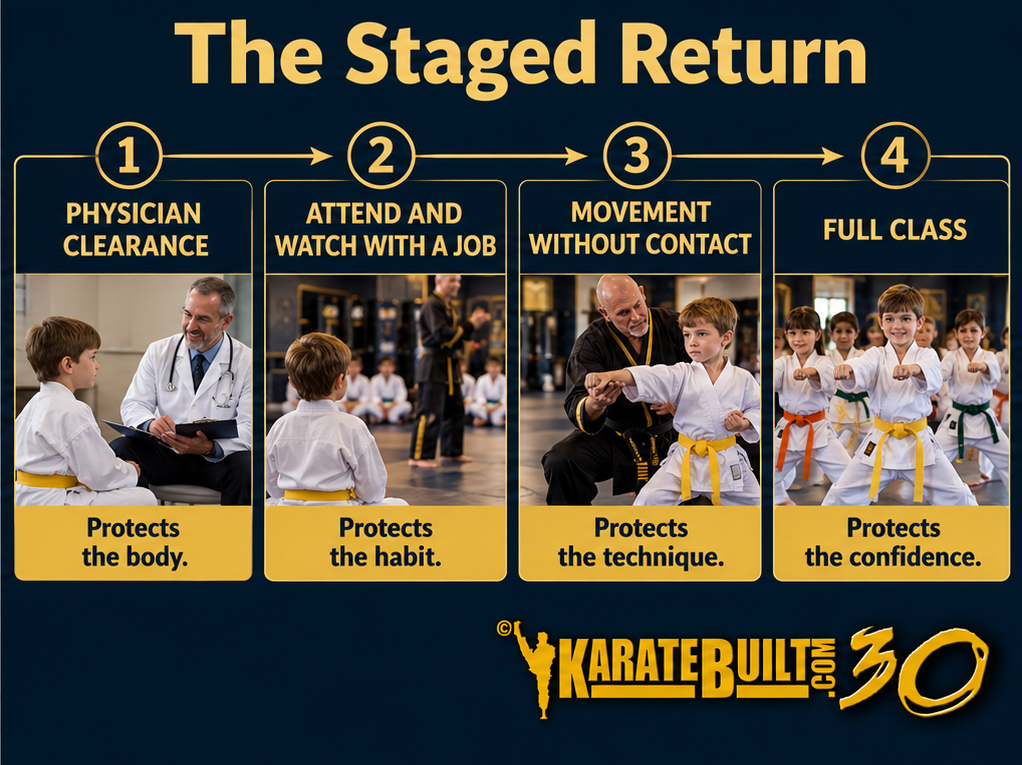
A return is staged in four steps: physician clearance, attending with a job, movement without contact, and then full class.
Step 1: Physician clearance. Nothing physical starts until your child’s doctor clears it in writing, with any limits spelled out. That step protects the body.
Step 2: Attend and watch with a job. This step protects the habit. It often overlaps with recovery and can start well before clearance, with the doctor’s okay.
Step 3: Movement without contact. Once cleared, the child moves through techniques slowly, with no partner contact, inside whatever limits the doctor set. An instructor watches closely and keeps the pace easy. This step protects the technique, because it lets the child rebuild form before speed.
Step 4: Full class. The child rejoins their group for everything. This step protects confidence, because the child arrives ready.
The pace between steps depends on the injury and the doctor’s guidance, and we follow both. We’ll never rush a child ahead of what their physician allows.
Why do most children who quit after an injury quit during the gap, not the injury?
Children quit during the gap because time away lets three feelings grow: feeling behind, feeling like an outsider, and fear of getting hurt again.
A child who has been gone six weeks walks back in and sees classmates doing new material. Some may have tested for a new belt. The child thinks, “I’ll never catch up,” and that thought is powerful.
Connection during recovery cuts all three feelings down to size. A child who kept coming in street clothes knows what the class has been learning. They’ve stayed part of the group. And they’ve watched their classmates train safely every week, which takes some of the edge off the fear.
What does a parent need to tell the instructor?
Tell the instructor what the injury is, what the doctor has cleared and restricted, and how your child is feeling about coming back.
Here is a simple checklist:
The injury and the date it happened.
The doctor’s restrictions, in writing if possible.
The clearance date, once you have it.
Any lingering pain or limits your child has mentioned at home.
How your child feels about returning. Excited, nervous, or quiet all count.
That last item matters more than parents expect. A child who seems fine on the outside may be scared of the exact technique that hurt them. When we know, we can plan around it.
How do we keep the fear from outlasting the injury?
Keep the fear small by breaking the scary technique into tiny steps, letting the child set the pace inside the doctor’s limits, and celebrating each step out loud.
Fear after an injury is normal. It’s the body’s alarm system doing its job. The goal is to teach that alarm what is safe again, one small dose at a time.
If a child sprained an ankle landing a jump, we might start with a stationary version of the move, then a small hop, then a slightly bigger one, always within what the doctor has cleared. The child gets to say when they’re ready for the next step. Every successful step tells the nervous system that this movement is safe again.
At home, keep your own worry in check. Children read their parents closely. If you’re calm about the return, your child can borrow that calm.
Getting your child back on the floor is worth the effort. If you’re in Cave Creek and planning a return to training after an injury, or starting fresh once your child is cleared, come see us at KarateBuilt Martial Arts, 29850 N. Tatum Blvd., Suite 105, Cave Creek, AZ 85331. New students get two weeks FREE plus a free uniform ($199 value). Call or text (602) 737-2098, tell us about the injury, and we’ll build the plan with you.
Frequently asked questions
Can my child attend class in a cast?
With the doctor’s okay, many children can attend in street clothes and watch with a job to do. Any physical participation waits for written clearance from the physician.
How long is a typical return after a sprain?
That timeline belongs to your child’s doctor, because every injury is different. Once your child is cleared, we stage the return gradually and follow any limits the doctor sets.
Do we pay while my child is out?
Talk to us about your account as soon as the injury happens. Every family’s situation is different, and we’ll walk you through the options.
Will my child fall behind their rank group?
Some catching up is normal, and children who stay connected during recovery catch up faster. We help returning students rebuild before they test.
What if my child is scared to try the technique again?
That’s common. We break the technique into small steps, let your child set the pace within medical limits, and build confidence one step at a time.
Chief Master Greg Moody, Ph.D. holds a doctorate in Special Education, is a licensed psychotherapist (LAC), and is an 8th Degree Black Belt with over 30 years of experience teaching children. He has been recognized as the nation’s #1 martial arts school owner eight times.
Sincerely,
Ch. Master Greg Moody, Ph.D.
P.S. Get Dr. Moody’s Book on Bullying – Click Here
KarateBuilt L.L.C. was founded in 1995 by Dr. Greg Moody, an 8th-degree Black Belt and Chief Master Instructor, KarateBuilt Martial Arts and Karate for Kids offer lessons for pre-school children ages 3-6 and elementary age kids ages 7 and up are designed to develop critical building blocks kids need – specialized for their age group – for school excellence and later success in life.
KarateBuilt Martial Arts Adult Karate training is a complete adult fitness and conditioning program for adults who want to lose weight, get (and stay in shape), or learn self-defense in a supportive environment.
Instructors can answer questions or be contacted 24 hours of the day, 7 days a week at 866-311-1032 for one of our nationwide locations. You can also visit our website at KarateBuilt.com.
About Dr. Greg Moody: Dr. Moody is an eighth-degree black belt and chief master instructor. He has a Ph.D. in Special Education from Arizona State University (along with a Master’s Degree in Counseling and a Bachelor’s Degree in Engineering – he actually is a rocket scientist). He has been teaching martial arts for over 25 years and has owned eight martial arts schools in Arizona and California. Chief Master Moody is a motivational speaker and educator and teaches seminars in bullying, business, and martial arts training, around the world. See more at DrGregMoody.com.
Dr. Moody is also a licensed psychotherapist and maintains a practice at Sheade Therapywhere he specializes in couples therapy and men’s issues.
The KarateBuilt Martial Arts Headquarters at KarateBuilt LLC is in Cave Creek, Arizona at 29850 N. Tatum Blvd., Suite 105, Cave Creek AZ 85331. You can locate the Chief Instructor, Master Laura Sanborn there directly at (480) 575-8171. KarateBuilt Martial Arts serves Cave Creek, Carefree, Scottsdale, and Paradise Valley Arizona as well as Grand Rapids, MI.