Karate and the Report Card: What Training Changes About Homework Habits
October 28, 2026 by Chief Master Greg Moody, Ph.D.
You already pay for a math tutor. Soccer takes Saturdays. Now you’re looking at martial arts and asking the practical question every busy parent eventually asks: does karate help with school work, or is it one more thing on the calendar?
Here is my honest answer, and I’ve thought about it from two angles. I’ve spent more than thirty years on the training floor, and my doctorate is in special education, with a master’s in counseling on top of it. Karate changes three specific behaviors that show up on a report card. A child who trains learns to start a task on the first request, to stay with something hard after frustration kicks in, and to take a correction without falling apart. Better grades can follow from those three habits, and I’ll explain how each one crosses from the training floor to the kitchen table.
If you’d like to see these habits being built, KarateBuilt offers two weeks FREE plus a free uniform ($199 value). Call or text (602) 737-2098.
Does karate help with school work?
Karate helps with school work indirectly, by training the behaviors a child needs to sit down, stay with an assignment, and use a teacher’s feedback.
Those three behaviors sit underneath almost every grade. A bright child who won’t start a worksheet scores like a struggling child. A capable child who quits at the first hard problem leaves points on the table. A child who hears every red mark as an insult stops reading the comments.
Martial arts training works on all three, every class, with an instructor watching and a clear standard to meet.
Which three school behaviors does training actually change?
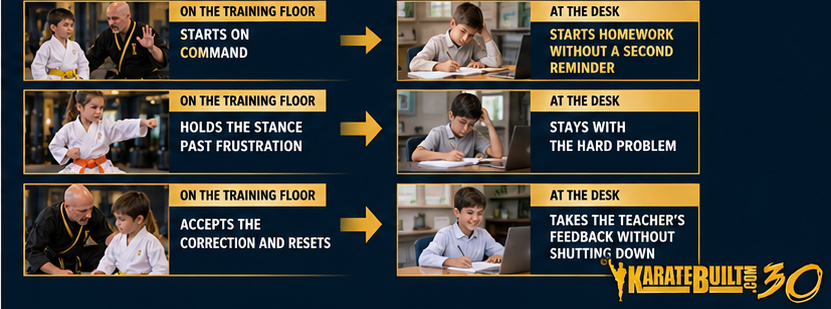
The three behaviors are starting on the first request, persisting past frustration, and accepting correction.
Starting on the first request. In class, a drill begins on the instructor’s command. Students who wait for a second invitation get left behind, and they notice. After months of this, starting promptly becomes a habit.
Persisting past frustration. Holding a low stance for a long count burns. So does repeating a form that keeps falling apart in the same spot. Children learn, slowly and in their bodies, that the hard feeling peaks and then passes if they stay with it.
Accepting correction. Instructors correct students constantly, out loud, with classmates nearby. A child who trains for a year has heard hundreds of corrections and survived every one.
Why does a child who can hold a stance sit down to homework faster?
A child who can hold a stance has practiced overriding the urge to quit, and sitting down to homework calls on that same skill.
The mechanism is repetition under mild discomfort. Every time a child holds a stance for one more second than they wanted to, they practice telling an impulse to wait. Psychologists call this inhibitory control, and it sits at the center of what educators call executive function.
Movement itself also seems to help children settle. In a classroom study, teachers added short bouts of physical activity to the school day, and students spent more time on task afterward, with the biggest gains among the students who had been least focused to begin with (Mahar et al., 2006, verify before use). A martial arts class gives a child a much longer, more structured dose of that same thing a few afternoons a week.
The practical upshot at home: many parents find homework goes smoother on training days. Try scheduling the hardest assignment for right after class and see what happens in your house.
What does martial arts training not do for grades?
Martial arts training won’t teach your child fractions, spelling, or how to write a thesis statement, and I won’t pretend it will.
I want to be direct about the limits, because you’re spending real money on this decision.
Training won’t fill a gap in content knowledge. If your child is behind in reading, they still need reading instruction.
Training won’t diagnose or treat a learning disability. If you suspect one, talk to your child’s school and pediatrician.
Training won’t move a grade by itself. Grades depend on teaching, tutoring, sleep, and a dozen other things, and the habits built at our school help all of those land better.
Training won’t work overnight. Habits form over months of steady attendance.
So if your child needs a tutor, keep the tutor. The question to ask is whether your child would get more from that tutor if they started faster and quit less often.
How does accepting a correction on the floor transfer to a teacher’s feedback?
Accepting correction transfers because a child who hears “lower stance” twenty times a class learns that feedback is information about the work, said by someone who wants them to improve.
Many children treat a teacher’s red pen as a verdict on themselves. They shut down, argue, or hide the paper. Instructors at our school coach corrections in a specific way: name the fix, show it once, have the child try again right away. The child hears the correction, uses it, and sees the result within seconds.
Do that a few hundred times and the emotional charge around correction starts to fade. The child begins to hear a teacher’s comment the same way they hear “turn your hip,” as a direction toward something better.
Speaking up matters here too. Children who learn to answer loudly in class, ask a question, and say “Yes, sir” or “Yes, ma’am” tend to find it easier to raise a hand at school and ask for help. That’s a big reason we make kids speak up in class.
Families from Carefree and Cave Creek often tell me the first change they notice at school is a calmer reaction to feedback. Two weeks FREE plus a free uniform ($199 value) is the easiest way to see whether your child responds the same way. Call or text (602) 737-2098.
What should a parent watch for in the first ninety days?
In the first ninety days, watch for small changes in how your child starts tasks, handles frustration, and reacts to correction.
Here are the signs I’d track:
Weeks 1 to 4: Your child responds to class commands faster. At home, you may hear fewer “in a minute”s.
Weeks 5 to 8: Your child starts to talk about a hard technique they kept practicing. Watch for the same persistence on a tough worksheet.
Weeks 9 to 12: Your child takes a correction from you or a teacher with less argument.
Keep a simple note on the fridge. Write down one moment each week when you saw one of the three behaviors. After ninety days, read the list. Parents are often surprised by how much changed without anyone announcing it.
How do we reinforce it at home without turning homework into a drill?
Use the same short language your child hears in class, praise the behavior when it happens, and keep the tone light.
A few ideas that work in real homes:
Borrow the command. “Ready, begin” can start homework the same way it starts a drill. Kids often respond to the familiar cue.
Name the stance. When your child stays with a hard problem, say, “That’s your low stance. You held it.” One sentence, then move on.
Correct like an instructor. Point to one fix, show it once, and let them try again. Skip the lecture.
Celebrate the start. Praise sitting down quickly, even before the work is done. Starting is the habit you’re building.
Keep homework time from becoming a second martial arts class. Your job is to connect the dots, and your child will do the rest.
If you’re in Cave Creek or Carefree and want to see whether training helps your child’s school habits, come try a class. KarateBuilt Martial Arts offers two weeks FREE plus a free uniform ($199 value). Visit us at 29850 N. Tatum Blvd., Suite 105, Cave Creek, AZ 85331, or call or text (602) 737-2098 to book your first class.
Frequently asked questions
Will karate improve my child’s grades?
Karate trains the behaviors that support better grades: starting on time, sticking with hard work, and using feedback. Grade changes depend on your child, their teachers, and steady attendance.
Is twice a week enough to see a difference at school?
Twice a week gives most children enough repetition to build these habits over a few months. More consistent attendance usually brings faster change.
My child has a hard time starting homework. Will this help?
Starting on command is one of the first habits we train. Pair class with a consistent homework start time at home for the best results.
Should I choose tutoring over an activity?
If your child has a content gap, keep the tutor. Training can make that tutoring more effective by building the habits your child brings to each session.
Do you work with families in Carefree?
Yes. We welcome families from Carefree, and our school on North Tatum Boulevard in Cave Creek is ready to help you find a class time that fits your schedule.
Chief Master Greg Moody, Ph.D. holds a doctorate in Special Education, is a licensed psychotherapist (LAC), and is an 8th Degree Black Belt with over 30 years of experience teaching children. He has been recognized as the nation’s #1 martial arts school owner eight times.
Sincerely,
Ch. Master Greg Moody, Ph.D.
P.S. Get Dr. Moody’s Book on Bullying – Click Here
KarateBuilt L.L.C. was founded in 1995 by Dr. Greg Moody, an 8th-degree Black Belt and Chief Master Instructor, KarateBuilt Martial Arts and Karate for Kids offer lessons for pre-school children ages 3-6 and elementary age kids ages 7 and up are designed to develop critical building blocks kids need – specialized for their age group – for school excellence and later success in life.
KarateBuilt Martial Arts Adult Karate training is a complete adult fitness and conditioning program for adults who want to lose weight, get (and stay in shape), or learn self-defense in a supportive environment.
Instructors can answer questions or be contacted 24 hours of the day, 7 days a week at 866-311-1032 for one of our nationwide locations. You can also visit our website at KarateBuilt.com.
About Dr. Greg Moody: Dr. Moody is an eighth-degree black belt and chief master instructor. He has a Ph.D. in Special Education from Arizona State University (along with a Master’s Degree in Counseling and a Bachelor’s Degree in Engineering – he actually is a rocket scientist). He has been teaching martial arts for over 25 years and has owned eight martial arts schools in Arizona and California. Chief Master Moody is a motivational speaker and educator and teaches seminars in bullying, business, and martial arts training, around the world. See more at DrGregMoody.com.
Dr. Moody is also a licensed psychotherapist and maintains a practice at Sheade Therapywhere he specializes in couples therapy and men’s issues.
The KarateBuilt Martial Arts Headquarters at KarateBuilt LLC is in Cave Creek, Arizona at 29850 N. Tatum Blvd., Suite 105, Cave Creek AZ 85331. You can locate the Chief Instructor, Master Laura Sanborn there directly at (480) 575-8171. KarateBuilt Martial Arts serves Cave Creek, Carefree, Scottsdale, and Paradise Valley Arizona as well as Grand Rapids, MI.