What Changes at Home When a Child Learns to Finish What They Start
November 23, 2026 by Chief Master Greg Moody, Ph.D.
The puzzle sits half-built on the floor. The science project is a pile of poster board. The guitar leans in the corner where it landed in October. If you’ve searched how to teach a child to follow through, you already know the pattern, and you’re wondering whether it’s a phase or the start of a habit.
Here is the good news after more than thirty years of teaching children. Follow-through is a skill that can be learned and mastered. Children build it through repetition that someone corrects, and through finishing a hard thing in front of people who watched them do it.
If you’d like to see that process up close, start with two weeks FREE plus a free uniform ($199 value). Call or text (602) 737-2098.
How do you teach a child to follow through?
You teach follow-through by giving a child a clear standard, many repetitions with correction, and a finish line they reach in front of witnesses.
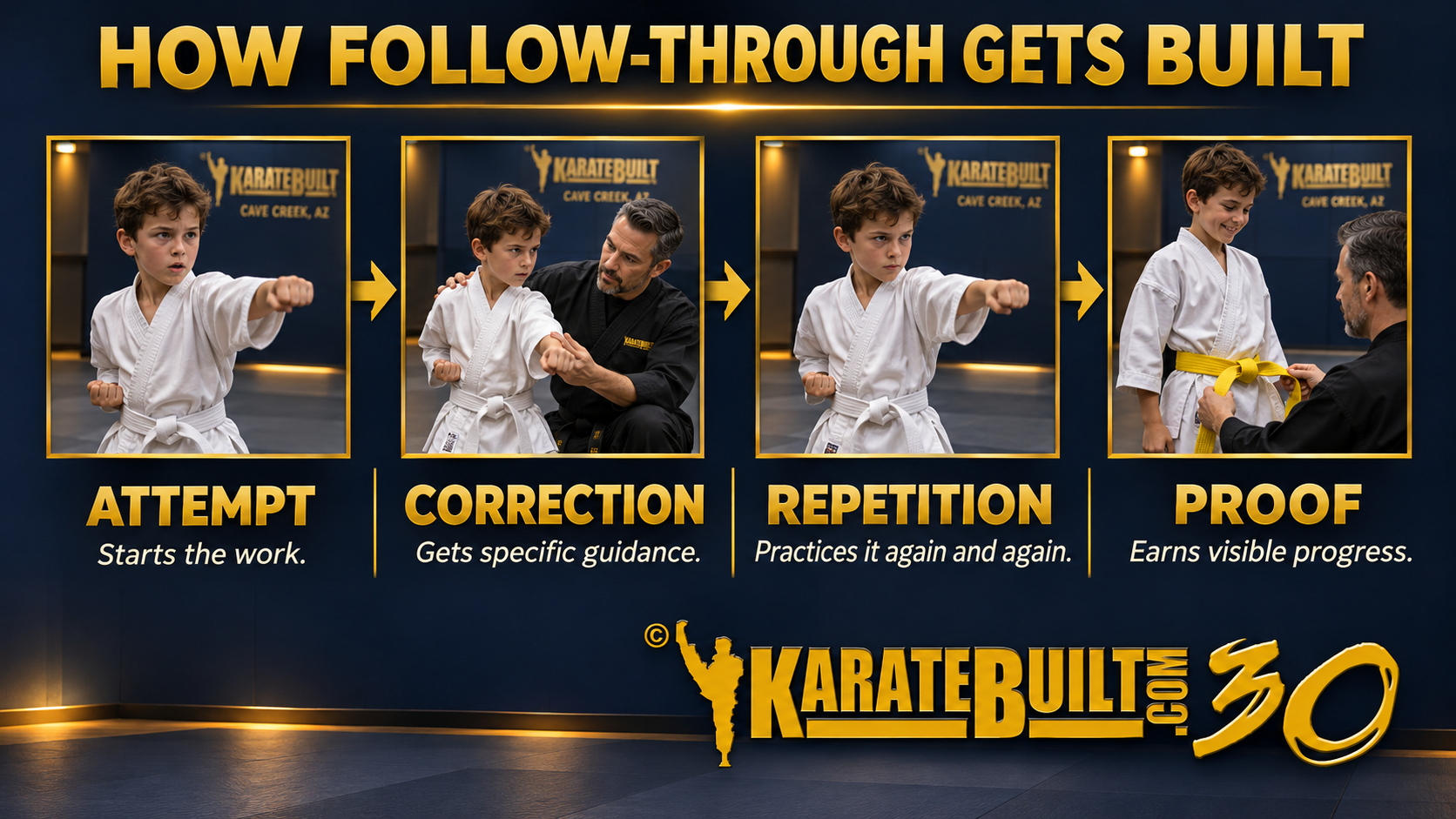
Each piece matters. A clear standard tells the child exactly what “done” looks like. Repetition with correction shows them that the tenth try is better than the first, which is the whole reason to keep going. The finish line in front of witnesses turns a private effort into a public fact. Once a child has stood up and shown a room full of people what they can do, they hold proof they can point back to.
At home, you can borrow all three. Name the finish line before the task starts, and check the work partway through and give one specific correction. Then let the child show the finished job to someone besides you.
Why does my child quit things halfway?
Children usually quit halfway because the middle of any task is the point where the work feels hardest, and the reward feels farthest away.
The start of something new is exciting, and the end is satisfying. But the middle is where the novelty is gone, and the skill still feels clumsy. Adults feel this too. The difference is that adults have finished enough hard things to know the middle passes.
A child without that history reads the middle as a sign they’ve chosen wrong. They ask to switch, and a kind parent often agrees. Do that enough times and the child learns that discomfort is a reason to stop. That lesson is the one worth changing.
What does martial arts training actually change about this?
Martial arts training gives a child hundreds of small finishes every month, each one checked by an instructor, until finishing becomes normal.
A single class holds dozens of finish lines. Hold the stance until the count ends. Complete the combination without stopping. Run the form start to finish while the instructor watches. When a hand drops or a foot turns, the instructor corrects it on the spot, and the child tries again right away.
Researchers have measured this effect. In a study of 207 children from kindergarten through fifth grade, Lakes and Hoyt (2004) compared three months of school-based taekwondo with regular physical education. The martial arts group improved more in cognitive and emotional self-regulation, classroom conduct, and prosocial behavior. Self-regulation is the engine of follow-through. It is the ability to keep doing the right thing when you’d rather stop.
Our Karate for Kids program is built around this kind of steady, corrected practice, with a belt at the end of each stretch of work.
Want to watch a class and see it for yourself? Two weeks FREE plus a free uniform ($199 value). Call or text (602) 737-2098.
How long before I see it at home?
Parents often notice small changes within the first couple of months, and the clearest change often shows up after the first belt test.
The early signs are quiet. Your child finishes getting dressed without three reminders. They stay with a hard page of homework a few minutes longer. They tell you about a combination they couldn’t do on Monday and could do on Thursday.
The belt test is the turning point. Your child prepares for weeks, stands up in front of family and instructors, and earns the next rank. I’ve written about what a belt test actually measures, and finishing is near the top of the list. After that day, “I can’t” carries less weight in your house, because your child has a fresh memory that says otherwise.
What should I stop doing as the parent?
Stop rescuing your child in the middle of a hard task and stop letting them quit on a bad day.
Rescue looks like love. You finish the poster board at 10 PM. You let them skip class because they’re grumpy. Each rescue teaches the child that someone else will close the gap. The kinder move is to stay close, stay calm and let them do the hard part themselves.
A simple family rule helps. Nobody quits on a bad day. If your child still wants to stop after a good day, at the end of a commitment, you talk about it together. I’ve shared that rule with parents in Carefree and Cave Creek for years, because it moves the decision away from the worst moment of the week.
What if my child is already in the habit of quitting?
A child in the habit of quitting can rebuild it, one short finish at a time, starting this week.
Pick something small with a clear end: a ten-minute chore, one page, or one class. Name the finish line, let them reach it, and say out loud what they did: “You said you’d finish and you finished.” Then lengthen the next commitment a little.
In training, every student hits a stretch where progress seems to stall. I call it the plateau, and it’s the exact spot where a former quitter learns to keep going. An instructor who has walked hundreds of children through that stretch knows how to keep your child moving until the next breakthrough arrives.
If your child starts strong and fades, come see us at KarateBuilt Martial Arts, 29850 N. Tatum Blvd., Suite 105, Cave Creek, AZ 85331. Start with two weeks FREE plus a free uniform ($199 value). Call or text (602) 737-2098.
Frequently asked questions
How old does a child need to be for this to work?
Children as young as three can start learning to finish short tasks in class. The habits described here show up clearly in children from about six to twelve, who can hold longer sequences and reach bigger goals.
What does a typical week of training look like?
A typical school-age student trains two classes a week. Each class includes a warm-up, technique drills with correction, forms practice and a short closing.
What is included in tuition at KarateBuilt?
Tuition includes uniforms, sparring gear, belts, belt tests, special events and Parent Nights Out. There are no belt testing fees at any rank.
What happens at a belt test?
Your child demonstrates the technique, forms and character skills required for the next rank in front of instructors and family. When they meet the standard, they earn the new belt.
References
Lakes, K. D., & Hoyt, W. T. (2004). Promoting self-regulation through school-based martial arts training. Journal of Applied Developmental Psychology, 25(3), 283-302. https://doi.org/10.1016/j.appdev.2004.04.002
Chief Master Greg Moody, Ph.D. holds a doctorate in Curriculum and Instruction, is a licensed psychotherapist (LAC), and is an 8th Degree Black Belt with over 30 years of experience teaching children. He has been recognized as the nation’s #1 martial arts school owner eight times.
P.S. Get Dr. Moody’s Book on Bullying – Click Here
KarateBuilt L.L.C. was founded in 1995 by Dr. Greg Moody, an 8th-degree Black Belt and Chief Master Instructor, KarateBuilt Martial Arts and Karate for Kids offer lessons for pre-school children ages 3-6 and elementary age kids ages 7 and up are designed to develop critical building blocks kids need – specialized for their age group – for school excellence and later success in life.
KarateBuilt Martial Arts Adult Karate training is a complete adult fitness and conditioning program for adults who want to lose weight, get (and stay in shape), or learn self-defense in a supportive environment.
Instructors can answer questions or be contacted 24 hours of the day, 7 days a week at 866-311-1032 for one of our nationwide locations. You can also visit our website at KarateBuilt.com.
About Dr. Greg Moody: Dr. Moody is an eighth-degree black belt and chief master instructor. He has a Ph.D. in Curriculum and Instruction from Arizona State University (along with a Master’s Degree in Counseling and a Bachelor’s Degree in Engineering – he actually is a rocket scientist). He has been teaching martial arts for over thirty years and has owned nine martial arts schools in Arizona, California and Virginia. Chief Master Moody is a motivational speaker and educator and teaches seminars in bullying, business, and martial arts training, around the world. See more at DrGregMoody.com.
Dr. Moody is also a licensed psychotherapist and maintains a practice at Sheade Therapywhere he specializes in couples therapy and men’s issues.
The KarateBuilt Martial Arts Headquarters at KarateBuilt LLC is in Cave Creek, Arizona at 29850 N. Tatum Blvd., Suite 105 & 106, Cave Creek AZ 85331. You can locate the Chief Instructor, Senior Master Laura Sanborn there directly at (602) 737-2098. KarateBuilt Martial Arts serves Cave Creek, Carefree, Scottsdale, and Paradise Valley Arizona as well as Grand Rapids, MI.


 Chief Master Greg Moody, Ph.D. holds a doctorate in Curriculum and Instruction, is a licensed psychotherapist (LAC), and is an 8th Degree Black Belt with over 30 years of experience teaching children. He has been recognized as the nation’s #1 martial arts school owner eight times.