Tumbling, Dance, or Martial Arts: Three Ways a Child Learns Body Control
October 17, 2026 by Chief Master Greg Moody, Ph.D.
By Chief Master Greg Moody, Ph.D., 8th Degree Black Belt, ATA Songahm Taekwondo
If you’re weighing tumbling or martial arts for kids, or dance, or some mix of all three, you’re asking a good question. Each one teaches a young body to move with control. Each one does it differently. And whether you live in Cave Creek or Desert Hills, you have real options in every category right now.
I run a martial arts school, so you know where I stand. I’ll still tell you plainly what tumbling and dance do better than martial arts, because a comparison only helps you if it’s honest.
What does a child actually learn in tumbling, dance and martial arts?
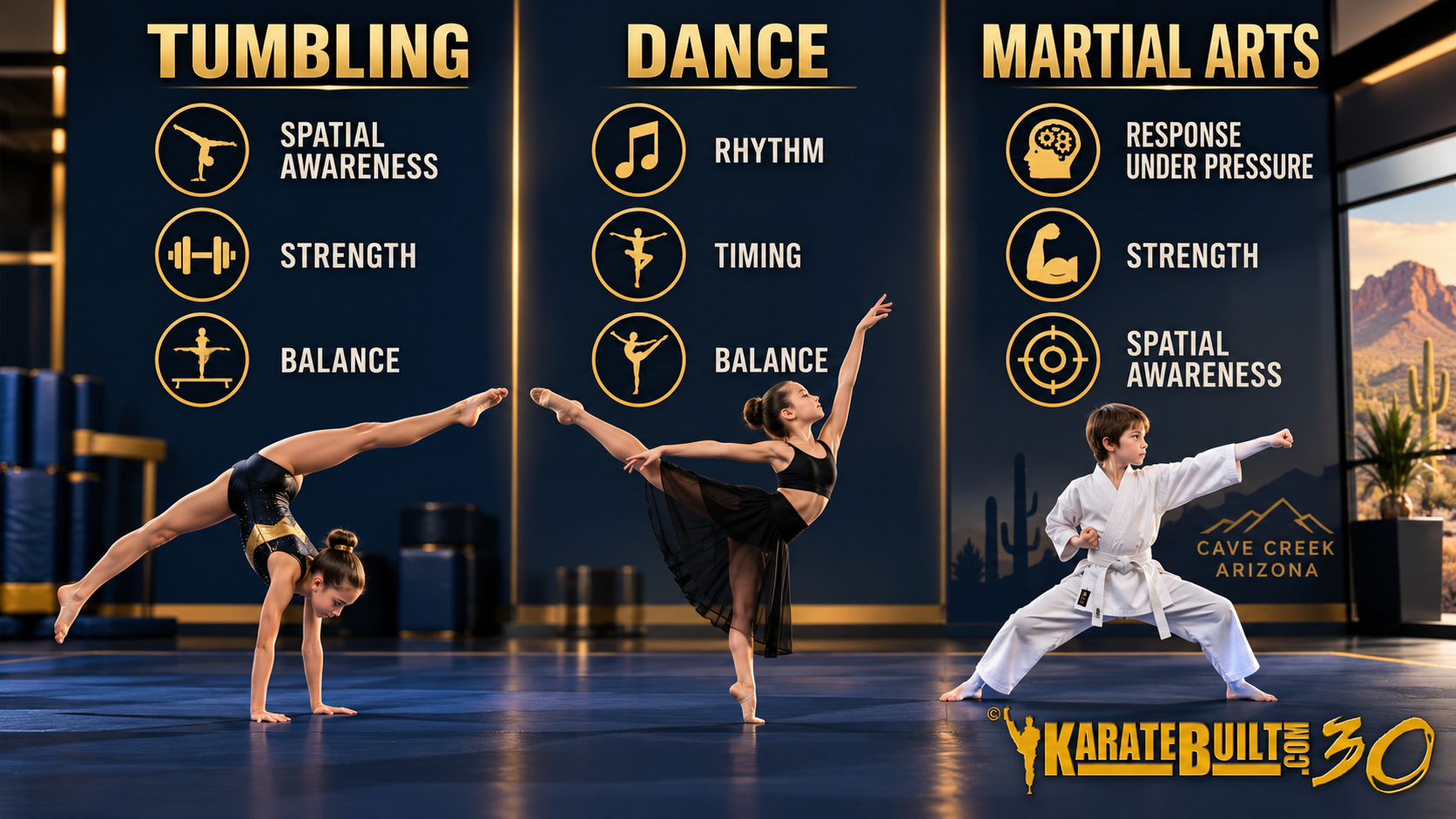
Tumbling teaches a child to control their body in the air and upside down, dance teaches them to move with rhythm and grace, and martial arts teaches them to control their body while responding to another person.
Tumbling builds spatial awareness, strength and confidence going upside down. A child who can cartwheel, round off and roll knows where their body is in space in a way few other kids do. Tumbling also builds real upper-body and core strength. It does both of those better than martial arts does.
Dance builds rhythm, musicality and sustained grace. A dancer learns to move on the beat, hold a line, and carry expression through their whole body for the length of a routine. Dance does that better than martial arts does.
Martial arts builds balance, coordination and precise control of force, all practiced with a partner and under a little pressure. A child learns to kick hard and stop short, to hold still on command, and to adjust to someone else’s movement.
All three are good for children. The question is which strengths matter most for your child right now.
Which one builds body control fastest?
Tumbling usually builds raw body awareness fastest, while martial arts builds controlled, responsive movement fastest.
“Body control” means a few different things, and that’s why the answer splits. If you mean knowing where your body is during a flip or a fall, tumbling wins. Kids get a lot of fast feedback, because the mat tells them right away whether they landed.
If you mean holding still when asked, stopping a movement on purpose and adjusting to what’s happening around them, martial arts tend to move faster. Every class asks a child to start, stop and change direction on command, over and over.
Dance sits between the two. It builds fine control and posture steadily, especially in the feet, hips and arms, and the gains show up in how a child carries themselves day to day.
What does each one teach that the others do not?
Tumbling and dance are mostly closed skills, while martial arts adds open skills, and that difference explains a lot of what parents notice.
A closed skill is performed the same way in a known setting. A tumbling pass or a dance routine follows a set sequence. The floor doesn’t move. The child’s job is to perform that sequence better each time, and that takes real discipline and precision.
An open skill happens in a changing setting. In martial arts, much of class involves a partner who moves, a drill that shifts, or an instructor who calls a technique the child has to choose and execute on the spot. Corrections come in the middle of the action, under mild pressure, and the child has to adjust right away.
That open-skill layer is what parents usually mean when they tell me martial arts “settled” their child. A child who practices responding, rather than only reciting, gets regular practice at staying calm and in control when something unexpected happens.
Research points the same way. In a study of children from kindergarten through fifth grade, those who took taekwondo classes at school for three months improved more in self-regulation and classroom behavior than classmates in standard physical education (Lakes & Hoyt, 2004). I’ve written more about why that kind of training helps attention in Why Your Child Cannot Sit Still.
To be fair, tumbling and dance teach things martial arts doesn’t. Tumbling teaches fearlessness with inversions and height. Dance teaches expression and performance in a way no belt test ever will.
Can a child do more than one?
Yes, a child can do more than one, as long as you sequence them so the child stays rested and the family calendar stays sane.
Here’s how I’d think about it.
Start with one. Give a young child a season to settle into one activity before adding a second. Two new things at once can overwhelm a five-year-old.
Keep the total manageable. For many kids, three to four activity sessions a week is plenty. Past that, you’ll often see tired kids and frayed evenings.
Pair them by strength. Tumbling and martial arts complement each other well, since one builds aerial awareness and the other builds control and responsiveness. Dance and martial arts pair well too, because rhythm helps with forms and martial arts adds partner work.
Watch the calendar. Back-to-back activities on the same night tend to wear out the whole family. Spread them across the week.
The skills carry over. A child who tumbles often picks up kicks faster. A child who dances often learns forms with better rhythm and timing.
How does a parent choose when the child likes all three?
Choose based on what your child needs most right now, then revisit the choice in six months.
Ask yourself one question: what would help my child most this year?
If your child needs confidence going upside down or wants to flip like their friends, start with tumbling. If your child lights up with music and loves to perform, start with dance. If your child needs help with focus, self-control, handling frustration or standing up for themselves, martial arts is usually the strongest fit.
Then let your child try. A trial week in each category will tell you more than any article can.
What should a parent watch for in the first month of any of them?
In the first month, watch whether your child wants to go back, whether the instructor knows them, and whether you can see one new skill.
Those three signs work for tumbling, dance and martial arts alike.
Your child asks to go. Excitement after the first few weeks is a strong signal.
The instructor knows your child. By week two or three, a good instructor knows your child’s name and one thing they’re working on.
You can see progress. A steadier balance, a cleaner cartwheel, a routine they can do without prompting. Something should be better than it was on day one.
Also watch how the instructor handles a mistake. A child who gets a short, clear correction and an immediate second try is in good hands, whatever the activity.
Frequently Asked Questions
Is tumbling or martial arts better for a five-year-old?
It depends on the child. Tumbling suits a five-year-old who loves to flip and climb, while martial arts suits one who needs help with focus, listening and self-control.
Can my child do dance and karate at the same time?
Yes. Start one first, add the second once your child has settled in, and spread the classes across the week.
What does martial arts teach that gymnastics does not?
Martial arts adds partner work and open skills, where a child has to respond to movement and correction in real time. That practice builds self-control under mild pressure.
Do you have students from Desert Hills?
Our school is in Cave Creek at 29850 N. Tatum Blvd., Suite 105, and children from Desert Hills are welcome in every kids class. Call us to find the right class for your child’s age.
The best way to choose between activities is to watch each one with your child beside you. Come see our Karate for Kids program at KarateBuilt Martial Arts, 29850 N. Tatum Blvd., Suite 105, Cave Creek, AZ 85331. Call or text (602) 737-2098 and come watch a class before you choose, then start with two weeks FREE plus a free uniform, a $199 value.
References
Lakes, K. D., & Hoyt, W. T. (2004). Promoting self-regulation through school-based martial arts training. Journal of Applied Developmental Psychology, 25(3), 283–302. https://doi.org/10.1016/j.appdev.2004.04.002
Sincerely,
Chief Master Greg Moody, Ph.D. holds a doctorate in Special Education, is a licensed psychotherapist (LAC), and is an 8th Degree Black Belt with over 30 years of experience teaching children. He’s taught over 18,000 students, over 1,800 of them Black Belts. He has been recognized as the nation’s #1 martial arts school owner eight times, and he’s a four-time #1 Amazon Bestselling Author.
P.S. Get Dr. Moody’s Book on Bullying – Click Here
KarateBuilt L.L.C. was founded in 1995 by Dr. Greg Moody, an 8th-degree Black Belt and Chief Master Instructor. KarateBuilt Martial Arts and Karate for Kids offer lessons for pre-school children ages 3-6 and elementary age kids ages 7 and up. These lessons are designed to develop critical building blocks kids need (specialized for their age group) for school excellence and later success in life.
KarateBuilt Martial Arts Adult Karate training is a complete adult fitness and conditioning program for adults who want to lose weight and stay in shape or learn self-defense in a supportive environment.
Instructors can answer questions or be contacted 24 hours of the day, 7 days a week at 866-311-1032 for one of our nationwide locations. You can also visit our website at KarateBuilt.com.
About Dr. Greg Moody: Dr. Moody is an eighth-degree Black Belt and Chief Master Instructor. He has a Ph.D. in Special Education from Arizona State University, along with a Master’s Degree in Counseling and a Bachelor’s Degree in Engineering (he actually is a rocket scientist). He has been teaching martial arts for over 30 years and has owned eight martial arts schools in Arizona and California. Chief Master Moody is a motivational speaker and educator and teaches seminars in bullying, business, and martial arts training around the world. See more at DrGregMoody.com.
The KarateBuilt Martial Arts Headquarters at KarateBuilt LLC is in Cave Creek, Arizona at 29850 N. Tatum Blvd., Suite 105, Cave Creek AZ 85331. You can locate the Chief Instructor, Master Laura Sanborn there directly at (480) 575-8171. KarateBuilt Martial Arts serves Cave Creek, Carefree, Scottsdale, and Paradise Valley Arizona as well as Grand Rapids, Michigan.