Why Your Child Cannot Sit Still, and What Actually Trains Attention
September 1, 2026 by Chief Master Greg Moody, Ph.D.
Your child is at the kitchen table with a math worksheet in front of them. Five minutes ago, they sat down ready to work. Now the pencil is tapping, the chair is rocking on two legs, and they’ve asked to use the bathroom twice. You’ve already said their name three times tonight in a tone you didn’t love hearing come out of your mouth.
Then the note comes home from the teacher: “Having trouble focusing in class.”
You’ve probably heard some version of that sentence before. Maybe you’re already wondering if something is wrong with your child, or with your parenting, or both. Before you go further down that road, it helps to understand what attention actually is and how it gets built. I’ve spent three decades teaching children to focus, most of them in a place that has nothing to do with school desks: a martial arts floor. The patterns I’ve watched repeat with thousands of kids apply just as much to homework at your kitchen table.
What Is Attention, Really?
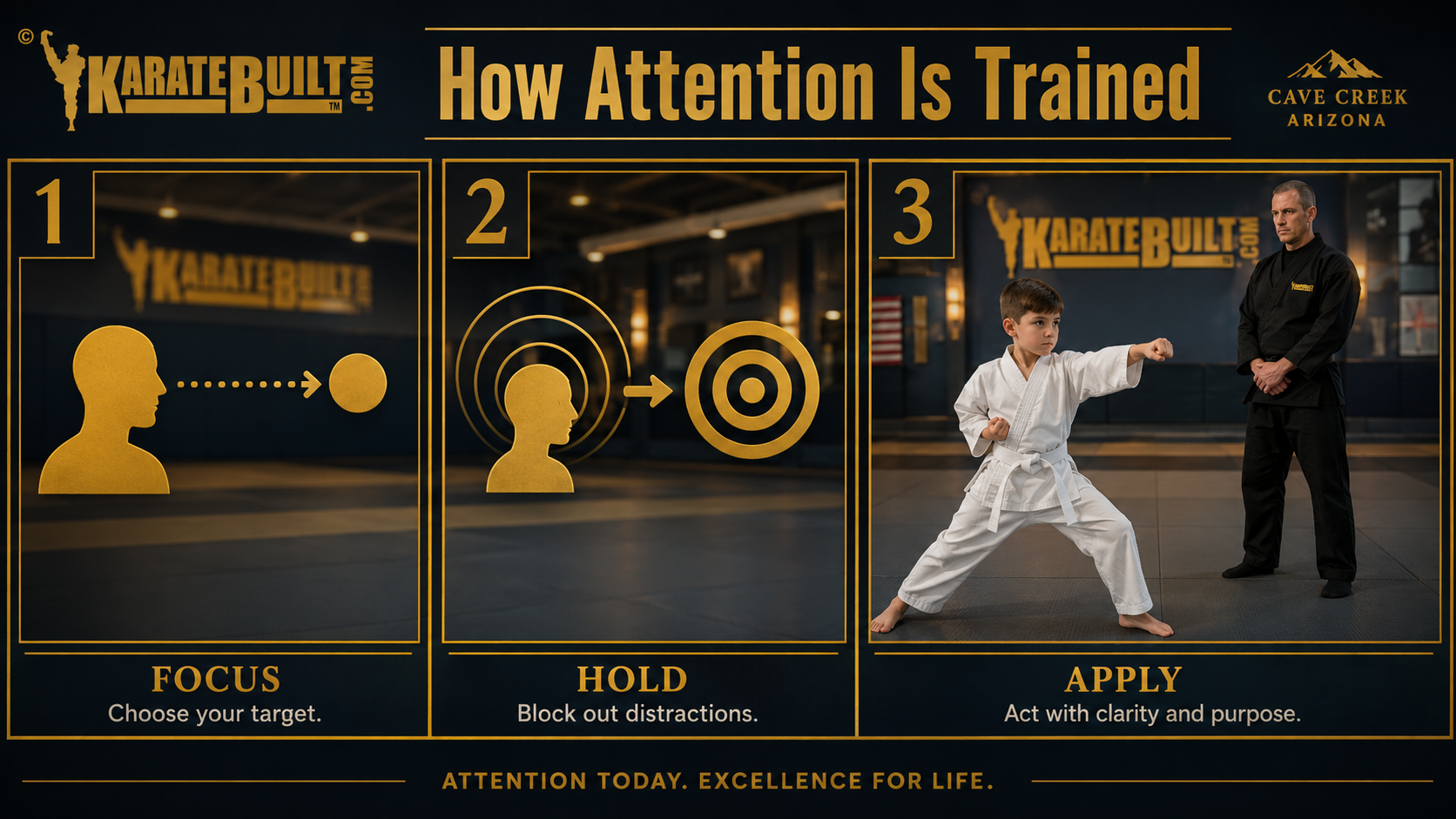
Attention is not a switch that flips on and stays on. It’s a skill made of small, repeatable actions: noticing when your focus has drifted, and then redirecting it back to the task.
Every child’s mind wanders. Adults’ minds wander too, constantly. The difference between a child who “focuses well” and one who doesn’t usually isn’t how often their attention drifts. It’s how quickly, and how independently, they catch the drift and come back.
That catching-and-returning motion is a trainable skill, in the same way a golf swing or a piano scale is trainable. It improves with structured repetition, clear feedback, and enough short-term success that the child’s brain starts to expect the return trip. It does not improve by asking a child to try harder, because “try harder” doesn’t give the brain a specific action to practice.
Why Is Sitting Still the Wrong Target?
Stillness is easy to measure, so it becomes the thing adults grade. A child in a chair, hands folded, eyes forward, looks focused to a teacher scanning the room, but stillness and attention are two different systems in the body.
Some children regulate their attention best while their body is moving a little: tapping a foot, shifting weight, doodling in the margin. Forcing full stillness on a child who needs some physical output often pulls resources away from the actual task, because now the brain is managing two jobs at once. One job is holding still. The other job is doing the math problem. For a lot of kids, the first job wins, and the worksheet loses.
This is why training attention through movement works so well for children this age. On a martial arts floor, a child practices holding a stance, following a sequence, and correcting a mistake, all while the body stays active. The stillness that eventually shows up in a classroom is a byproduct of a nervous system that has learned to organize itself. It’s rarely the direct result of being told to sit still more.
What Is a Task Cycle?
A task cycle is the smallest complete unit of focused work: receive instruction, attempt the task, get feedback, adjust, and finish. Children build attention one task cycle at a time, not in long unbroken stretches.
Here’s what that looks like on our floor. A student is asked to throw a specific combination of strikes. They attempt it. An instructor points out one thing to fix, just one. The student tries again with that single correction in mind. They finish the combination. That entire loop might take twenty seconds.
A child who completes short task cycles successfully, over and over, is building the same muscle a child needs to finish a worksheet. The worksheet is just a longer chain of smaller task cycles stacked together: read the problem, attempt it, check the work, move to the next line.
Here’s something you can use tonight. Instead of saying “finish your homework,” break it into a visible task cycle: “Do this one problem, then show me.” One problem, one check-in, then the next. You are not lowering the bar. You are matching the size of the task to the size of the attention span your child currently has and building from there.
How Does Corrective Feedback Build Self-Regulation?
Feedback that’s specific and immediate teaches a child’s brain what to do differently next time. Feedback that’s vague or delayed rarely changes behavior at all.
“Pay attention” tells a child nothing actionable. Their brain doesn’t know what to adjust. Compare that to “your eyes went to the window, bring them back to the page.” That is a specific, observable correction the child can actually act on in the next ten seconds.
On the floor, we correct immediately and specifically, every time. “Chamber your fist higher.” “Watch your target, not the mirror.” The correction is never about the child’s character or effort level. It’s about one observable detail of the physical action.
Over time, a child who receives this kind of feedback starts to generate it internally. They catch their own eyes drifting to the window before an adult has to say anything. That internal voice, the one that notices and redirects without outside prompting, is what we mean by self-regulation. It’s built entirely through repetition of specific, immediate, non-judgmental correction. It doesn’t appear on its own with age; it has to be practiced.
What Should a Parent Watch For in the First Eight Weeks?
If you start applying structured task cycles and specific feedback at home, here is a reasonable timeline for what to notice.
Weeks one and two: Look for slightly faster recovery after a distraction, not the absence of distraction. Your child will still wander. The gap between wandering and returning may shrink from minutes to under a minute.
Weeks three and four: Watch for the child starting to self-correct out loud, saying something like “wait, I got distracted” before you point it out. This is an early and genuinely encouraging sign.
Weeks five and six: Notice whether task cycles can lengthen slightly. Where two problems used to require a check-in, your child might now handle three or four before needing one.
Weeks seven and eight: Look for the skill showing up somewhere you didn’t train it directly, like at the dinner table or during a chore. That transfer is a sign the underlying skill is developing, not just the specific homework routine.
Progress in this area is rarely a straight line. Expect a good week followed by a rough one. That pattern is normal and does not mean the approach has stopped working.
What Changes, and What Does Not
What changes over consistent practice is the speed and independence of the catch-and-return cycle. Children get faster at noticing their own drift and correcting it without an adult prompt. Task cycles lengthen gradually. Feedback that once had to come from outside starts to come from the child.
What does not change, at least not quickly and not for every child, is temperament. A naturally high-energy child will likely always have more physical energy to manage than a naturally quiet one. The goal was never to change who your child is. The goal is to give them a trained skill for managing the mind they already have.
I won’t promise you a specific outcome by a specific date. Every child’s starting point is different, and so is the pace of progress. What I can tell you, from thirty years of watching this exact process unfold with thousands of students, is that the mechanism itself is reliable: structured task cycles plus specific, immediate feedback, repeated consistently, build the catch-and-return skill that most parents mean when they say “focus.”
One next step: Tonight, pick one task, homework or otherwise, and break it into a single visible task cycle. Ask for one small piece, check in, give one specific correction, and let your child finish that piece before moving to the next. That’s the whole method in miniature. Everything else is repetition.
Sincerely,
Chief Master Greg Moody, Ph.D. holds a doctorate in Special Education, is a licensed psychotherapist (LAC), and is an 8th Degree Black Belt with over 30 years of experience teaching children. He’s taught over 18,000 students, over 1,800 of them Black Belts. He has been recognized as the nation’s #1 martial arts school owner eight times, and he’s a four-time #1 Amazon Bestselling Author.
P.S. Get Dr. Moody’s Book on Bullying – Click Here
KarateBuilt L.L.C. was founded in 1995 by Dr. Greg Moody, an 8th-degree Black Belt and Chief Master Instructor, KarateBuilt Martial Arts and Karate for Kids offer lessons for pre-school children ages 3-6 and elementary age kids ages 7 and up are designed to develop critical building blocks kids need – specialized for their age group – for school excellence and later success in life.
KarateBuilt Martial Arts Adult Karate training is a complete adult fitness and conditioning program for adults who want to lose weight, get (and stay in shape), or learn self-defense in a supportive environment.
Instructors can answer questions or be contacted 24 hours of the day, 7 days a week at 866-311-1032 for one of our nationwide locations. You can also visit our website at KarateBuilt.com.
About Dr. Greg Moody: Dr. Moody is an eighth-degree black belt and chief master instructor. He has a Ph.D. in Special Education from Arizona State University (along with a Master’s Degree in Counseling and a Bachelor’s Degree in Engineering – he actually is a rocket scientist). He has been teaching martial arts for over 25 years and has owned eight martial arts schools in Arizona and California. Chief Master Moody is a motivational speaker and educator and teaches seminars in bullying, business, and martial arts training, around the world. See more at DrGregMoody.com.
The KarateBuilt Martial Arts Headquarters at KarateBuilt LLC is in Cave Creek, Arizona at 29850 N. Tatum Blvd., Suite 105, Cave Creek AZ 85331. You can locate the Chief Instructor, Master Laura Sanborn there directly at (480) 575-8171. KarateBuilt Martial Arts serves Cave Creek, Carefree, Scottsdale, and Paradise Valley Arizona as well as Grand Rapids, MI.