The Quiet Student Who Becomes the Leader: What Happens When a Child Starts Teaching Younger Belts
November 24, 2026 by Chief Master Greg Moody, Ph.D.
Your child has been training for a while. The uniform fits, the belt has changed color a few times, and you’re starting to wonder what comes next. Maybe you typed leadership program for kids’ martial arts into a search bar and found a lot of big promises. Here is what leadership looks like on a real training floor, and why the quiet kids are often the best at it.
I’ve taught children for more than thirty years. Some of the strongest leaders I’ve trained were the students who barely spoke during their first year.
If you’d like to see this in action, start with two weeks FREE plus a free uniform ($199 value). Call or text (602) 737-2098.
What is a leadership program in martial arts?
A leadership program in martial arts gives experienced students real responsibility for helping newer students learn.
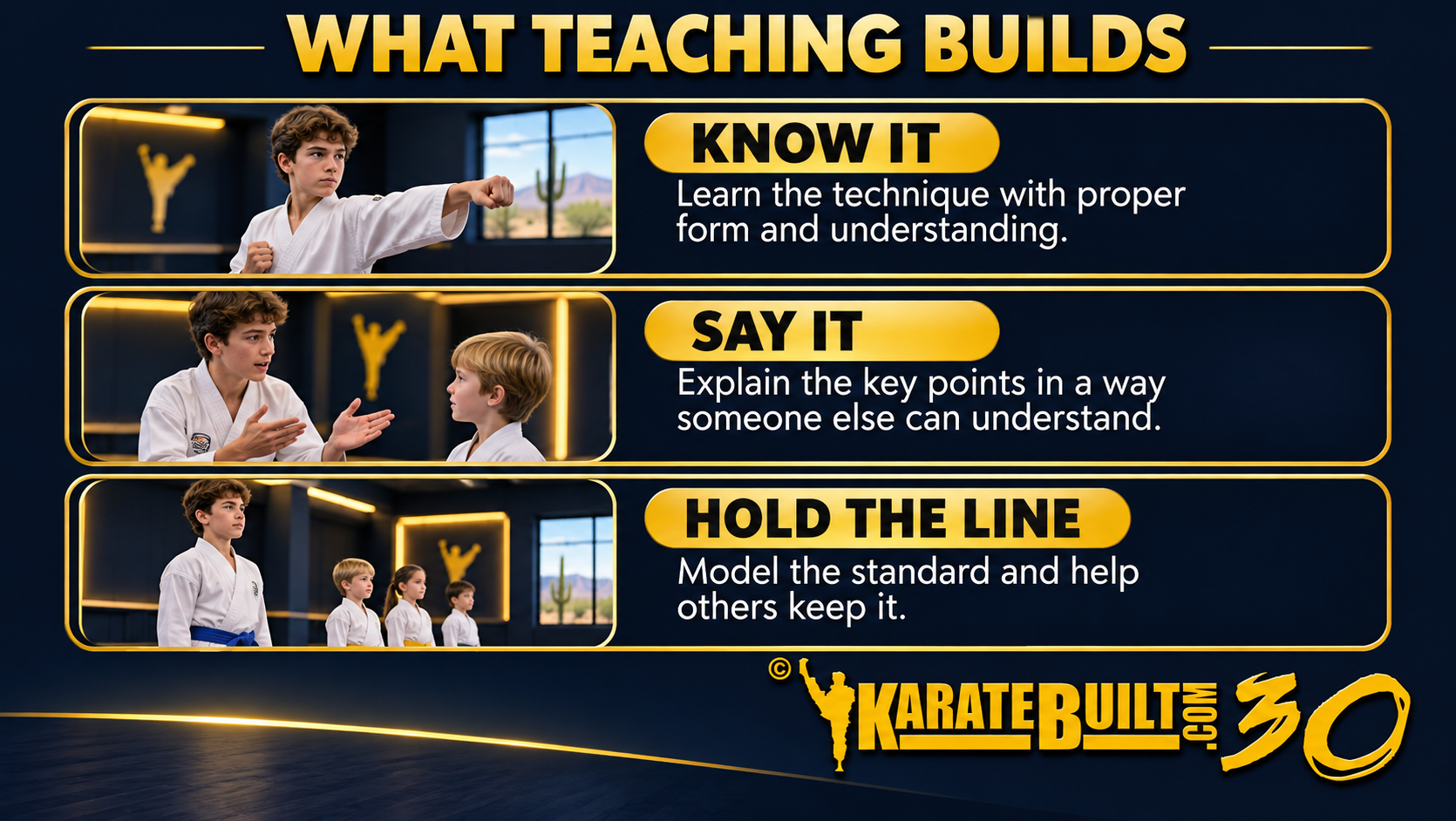
At KarateBuilt, our Leadership Skills for Children program works on three things: speaking clearly, making good decisions, and working with a team. The practice ground for all three is the training floor itself. An experienced student holds a target, demonstrates a stance, or walks a beginner through a block while an instructor supervises.
That responsibility grows with rank. What they get invited, students can enter the KarateBuilt Leadership Track, where they are trained in class to lead warm-ups and drills, practice speaking to a group and mentor specific younger students over a full training cycle. Does my quiet child belong in one?
Yes, and a quiet child often makes a better teacher than a loud one.
Teaching a beginner rewards patience, careful watching, and calm instructions. Quiet children tend to have those already. What they lack is practice using their voice in front of others, and helping a white belt gives them that practice in the smallest, safest form. They speak to one child, about one technique, with an instructor nearby.
We also ask every student to answer out loud in class from the very beginning. I explain the reasons in Why We Make Kids Speak Up in Class. By the time a quiet student starts helping teach, they’ve already answered out loud hundreds of times in front of a room.
What does a student actually do when they help teach?
A student who helps teach demonstrates a technique, watches a beginner try it, and gives one clear correction.
That sounds simple. It asks a lot. The student has to slow down a move they now do without thinking. They have to put it into words a six-year-old can follow. Then comes the hardest part: they have to watch the beginner get it wrong, and wrong again, and keep their hands to themselves while the beginner works it out.
Children who do this start to understand their own instructors differently. They see why a correction comes in short, specific words. They learn that patience is a skill you practice. Most of all, they feel responsible for another person’s progress, often for the first time in their lives. You’ll see it in how they stand when they walk off the floor.
How does teaching make my child better at their own training?
Teaching forces a child to understand a technique well enough to explain it, and that deeper understanding shows up in their own performance.
Researchers have studied this in classrooms for decades. A meta-analysis of peer-assisted learning in elementary schools by Rohrbeck and colleagues (2003) found positive effects on achievement, with an unweighted mean effect size of 0.59. Programs that gave students structured roles and more autonomy tended to show larger effects. A child who has to explain long division learns long division better. The same holds for a front kick.
Want to watch an advanced student help a beginner? Two weeks FREE plus a free uniform ($199 value). Call or text (602) 737-2098.
At what age and rank does this start?
Helping starts small, once an instructor sees that a student knows the basics well and can stay focused while someone else trains.
The first jobs are modest: hold a target steady, show a new student where to stand, count a set of kicks out loud. As a student moves up in rank, the jobs grow to demonstrating techniques, leading a short warm-up and helping a beginner practice a form.
Age matters less than readiness. A focused nine-year-old can help a five-year-old line up. A thirteen-year-old can run a short drill. Whether you live in Cave Creek or North Phoenix, watch for the day your child comes home talking about “my student.” That’s the moment the change has started.
What does this build that school does not?
Helping teach builds responsibility for someone else’s progress, which a school day rarely asks of a child.
At school, a child’s job is to learn their own material and turn in their own work. That matters. On the training floor, a student helper is accountable for a younger child getting better. If the beginner struggles, the helper adjusts. If the beginner improves, the helper shares in the win.
That responsibility changes how children carry themselves. They walk into a room expecting to be useful. They speak up because someone is counting on them. Years later, those same students lead group projects, coach younger siblings and step up at their first jobs. The habit started with one white belt and one block.
If your child is ready for the next step, come see us at KarateBuilt Martial Arts, 29850 N. Tatum Blvd., Suite 105 & 106, Cave Creek, AZ 85331. Start with two weeks FREE plus a free uniform ($199 value). Call or text (602) 737-2098.
Frequently asked questions
What rank does my child need before helping teach?
Helping begins once an instructor sees a student has solid basics and steady focus. The formal KarateBuilt Leadership Track starts with an invitation from an instructor.
Does helping teach slow down their own progress?
Helping tends to sharpen a student’s progress, because explaining a technique sharpens a student’s own understanding. Helpers still train and test on the same rank requirements as every other student.
Is this extra tuition?
Helping in class is part of training at KarateBuilt.
What if my child is too shy to speak in front of a group?
Shy children start by helping one beginner at a time, with an instructor close by. Their voice grows as their confidence does.
References
Rohrbeck, C. A., Ginsburg-Block, M. D., Fantuzzo, J. W., & Miller, T. R. (2003). Peer-assisted learning interventions with elementary school students: A meta-analytic review. Journal of Educational Psychology, 95(2), 240-257. https://doi.org/10.1037/0022-0663.95.2.240
Chief Master Greg Moody, Ph.D. holds a doctorate in Curriculum and Instruction, is a licensed psychotherapist (LAC), and is an 8th Degree Black Belt with over 30 years of experience teaching children. He has been recognized as the nation’s #1 martial arts school owner eight times.
P.S. Get Dr. Moody’s Book on Bullying – Click Here
KarateBuilt L.L.C. was founded in 1995 by Dr. Greg Moody, an 8th-degree Black Belt and Chief Master Instructor, KarateBuilt Martial Arts and Karate for Kids offer lessons for pre-school children ages 3-6 and elementary age kids ages 7 and up are designed to develop critical building blocks kids need – specialized for their age group – for school excellence and later success in life.
KarateBuilt Martial Arts Adult Karate training is a complete adult fitness and conditioning program for adults who want to lose weight, get (and stay in shape), or learn self-defense in a supportive environment.
Instructors can answer questions or be contacted 24 hours of the day, 7 days a week at 866-311-1032 for one of our nationwide locations. You can also visit our website at KarateBuilt.com.
About Dr. Greg Moody: Dr. Moody is an eighth-degree black belt and chief master instructor. He has a Ph.D. in Curriculum and Instruction from Arizona State University (along with a Master’s Degree in Counseling and a Bachelor’s Degree in Engineering – he actually is a rocket scientist). He has been teaching martial arts for over thirty years and has owned nine martial arts schools in Arizona, California and Virginia. Chief Master Moody is a motivational speaker and educator and teaches seminars in bullying, business, and martial arts training, around the world. See more at DrGregMoody.com.
Dr. Moody is also a licensed psychotherapist and maintains a practice at Sheade Therapywhere he specializes in couples therapy and men’s issues.
The KarateBuilt Martial Arts Headquarters at KarateBuilt LLC is in Cave Creek, Arizona at 29850 N. Tatum Blvd., Suite 105 & 106, Cave Creek AZ 85331. You can locate the Chief Instructor, Senior Master Laura Sanborn there directly at (602) 737-2098. KarateBuilt Martial Arts serves Cave Creek, Carefree, Scottsdale, and Paradise Valley Arizona as well as Grand Rapids, MI.


 Chief Master Greg Moody, Ph.D. holds a doctorate in Curriculum and Instruction, is a licensed psychotherapist (LAC), and is an 8th Degree Black Belt with over 30 years of experience teaching children. He has been recognized as the nation’s #1 martial arts school owner eight times.