The Child Who Worries: What Martial Arts Training Does for an Anxious Kid
October 16, 2026 by KarateBuilt Staff
By Chief Master Greg Moody, Ph.D., 8th Degree Black Belt, ATA Songahm Taekwondo
If you’ve been reading about martial arts for kids with anxiety, you’ve probably run into some big promises. I’m an 8th degree Black Belt and a licensed associate counselor, so I’ll give you the careful version. A well-run class can help a worried child feel steadier, through a mechanism you can watch with your own eyes. It also has limits, and I’ll tell you exactly where they sit.
What does martial arts do for a child who worries?
Martial arts gives a worried child a predictable place to practice being a little uncomfortable, in small steps, with a trusted adult close by.
An anxious child spends a great deal of energy scanning for what might go wrong. Who will be there? What will they ask me to do? What happens if I mess up? That scanning is exhausting, and it leaves very little room for learning anything new.
A good class answers those questions before the child has to ask them. Once the uncertainty drops, the energy it was using becomes available for the work in front of them. Then, week by week, the child takes on slightly harder challenges at a pace they can handle.
I want to be clear about what that adds up to. Martial arts is training. Therapy is a separate thing, and for some children it’s the right first step. I’ll come back to that.
Why does a predictable class help an anxious child?
A predictable class removes the uncertainty an anxious child would otherwise spend the whole hour bracing against.
At our school, class runs the same way every time. Students bow in, warm up, drill, practice forms and bow out. The order holds from week to week. A worried child can picture the next fifteen minutes before they happen, and that alone lowers the temperature.
The expectations are known, too. Your child knows where to stand, when to listen, and what the instructor will ask. The people are known. The same instructors teach the same classes, so the faces at the front of the room become familiar fast.
Corrections matter more than parents realize. When an instructor says, “Turn your back foot out,” the child hears a fact about their foot. The correction is about the stance, and the child stays out of it. For an anxious kid who reads every comment as a verdict on their worth, that difference is huge.
What happens in the first three classes for a nervous child?
In the first three classes, a nervous child sets the pace, and every step forward counts, including the very small ones.
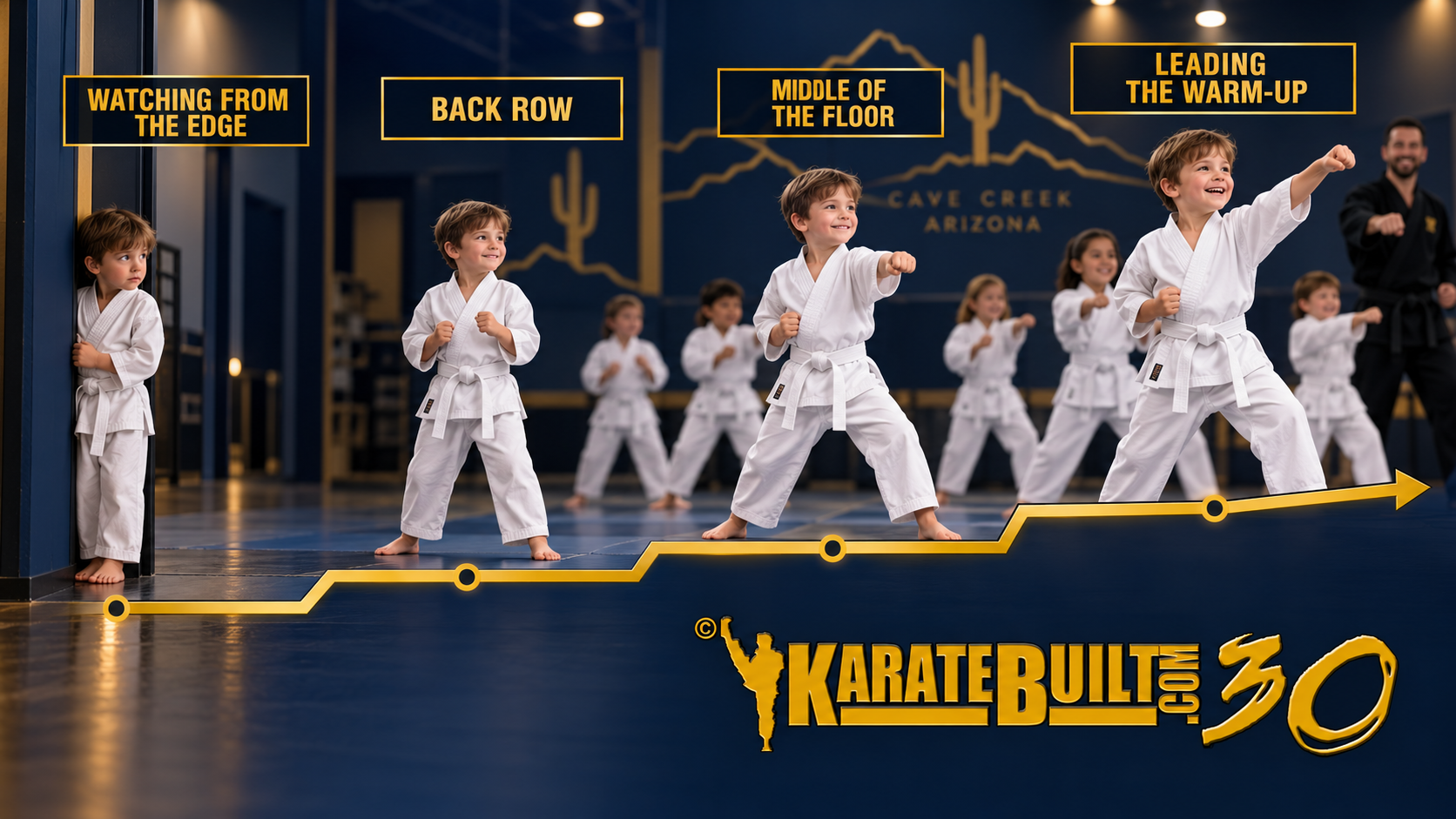
In counseling, we call this graded exposure. A person grows braver by facing what they fear in doses they can handle, starting small and building. In class, it tends to look like this:
Class one. Your child may only watch from the edge of the floor, with you nearby. That counts as a full class.
Class two. They join the warm-up from the back row and step out when they need to.
Class three. They stay in the back row for drills.
Over the following weeks, the back row becomes the middle. Later, your child might count out loud for the class or show a technique alone in front of the group. That’s the last step, and it comes when they’re ready for it.
Nobody forces a step along the way. An instructor invites, waits and invites again. If you’re in Carefree or Cave Creek and want to see this before you decide anything, sit along the wall during a beginner class and watch how the newest student gets brought in.
Will the pressure of testing make the anxiety worse?
Usually it doesn’t, because your child rehearses every part of a belt test in class long before test day.
A belt test is pressure. I won’t pretend otherwise, and the pressure is part of what makes it useful. The key is that it’s familiar pressure. Your child practices the exact form, the exact entrance and the exact routine many times in regular class. By test day, nothing on the floor is new.
We also invite a child to test only when they’re ready, and we talk with you first. If testing seems to be pushing your child’s worry too high, we can slow down. The belt will wait.
What children usually take from a test is evidence. They were nervous, they did it anyway, and it went fine. A worried mind has a hard time arguing with that.
How do instructors handle a child who freezes?
When a child freezes, nobody drags them forward and nobody leaves them standing there alone.
An instructor steps beside the child, lowers their voice and offers one small next step. “Just show me your ready stance.” Sometimes the instructor does the move alongside them. Sometimes the child steps back into line and tries again later in the class.
The goal is to end on a small success, even a tiny one. A child who froze and then managed one technique goes home with a better memory than a child who was pushed through the whole form in tears.
What should a parent do differently at home while this is working?
Keep the routine steady, praise the step your child took, and let the instructor handle the doorway.
Keep class on the same days. Predictability at home supports predictability in class.
Describe class ahead of time. “You’ll bow in, warm up, and then practice your form.”
Praise the step. “You stood in the back row today.” Specific beats general.
Keep goodbyes short. A long goodbye at the door can feed the worry. Hand off warmly and step back.
Watch your own face. Children borrow calm from their parents.
Martial arts is the wrong first step when worry is getting in the way of your child’s daily life.
Talk to your pediatrician or a licensed child therapist first if you’re seeing any of these: refusing school, panic attacks, stomachaches or headaches before school most days, trouble sleeping most nights, pulling away from friends, or worry that seems to take over the house. If your child says anything about hurting themselves, call your pediatrician right away, and in a crisis call or text 988.
Childhood anxiety is very treatable. In a large clinical trial of children and teens with anxiety disorders, about 60 percent improved with cognitive behavioral therapy alone, and about 81 percent improved with therapy combined with medication (Walkup et al., 2008). That’s the help a child with an anxiety disorder needs first.
Martial arts can sit alongside treatment. If your child already sees a therapist, ask whether a class fits the plan. A good therapist will have an opinion, and it’s worth hearing.
Frequently Asked Questions
Is martial arts good for an anxious child?
It can be, especially for a child whose worry is mild to moderate. If anxiety is getting in the way of school, sleep or friendships, start with your pediatrician.
What if my child is too nervous to join the class?
Then they watch. Watching counts as the first step, and we’ll invite them in a little more each visit without forcing anything.
Do you work with children who have anxiety in Carefree as well as Cave Creek?
Yes. Our school is at 29850 N. Tatum Blvd., Suite 105, in Cave Creek, and children from Carefree are welcome in our Karate for Kids classes.
Will belt testing make my child’s anxiety worse?
Testing is pressure, and we prepare children for it. Your child rehearses every part of the test in class first, and we only invite a child to test when they’re ready.
The first step can be as small as a seat along the wall. Call or text (602) 737-2098 and come watch one class at KarateBuilt Martial Arts, 29850 N. Tatum Blvd., Suite 105, Cave Creek, AZ 85331, before you decide anything. If it feels right, your child can start with two weeks FREE plus a free uniform, a $199 value.
References
Walkup, J. T., Albano, A. M., Piacentini, J., Birmaher, B., Compton, S. N., Sherrill, J. T., Ginsburg, G. S., Rynn, M. A., McCracken, J., Waslick, B., Iyengar, S., March, J. S., & Kendall, P. C. (2008). Cognitive behavioral therapy, sertraline, or a combination in childhood anxiety. New England Journal of Medicine, 359(26), 2753–2766. https://doi.org/10.1056/NEJMoa0804633
Sincerely,
Chief Master Greg Moody, Ph.D. holds a doctorate in Special Education, is a licensed psychotherapist (LAC), and is an 8th Degree Black Belt with over 30 years of experience teaching children. He’s taught over 18,000 students, over 1,800 of them Black Belts. He has been recognized as the nation’s #1 martial arts school owner eight times, and he’s a four-time #1 Amazon Bestselling Author.
P.S. Get Dr. Moody’s Book on Bullying – Click Here
KarateBuilt L.L.C. was founded in 1995 by Dr. Greg Moody, an 8th-degree Black Belt and Chief Master Instructor, KarateBuilt Martial Arts and Karate for Kids offer lessons for pre-school children ages 3-6 and elementary age kids ages 7 and up are designed to develop critical building blocks kids need – specialized for their age group – for school excellence and later success in life.
KarateBuilt Martial Arts Adult Karate training is a complete adult fitness and conditioning program for adults who want to lose weight, get (and stay in shape), or learn self-defense in a supportive environment.
Instructors can answer questions or be contacted 24 hours of the day, 7 days a week at 866-311-1032 for one of our nationwide locations. You can also visit our website at KarateBuilt.com.
About Dr. Greg Moody: Dr. Moody is an eighth-degree Black Belt and chief master instructor. He has a Ph.D. in Special Education from Arizona State University (along with a Master’s Degree in Counseling and a Bachelor’s Degree in Engineering – he actually is a rocket scientist). He has been teaching martial arts for over 25 years and has owned eight martial arts schools in Arizona and California. Chief Master Moody is a motivational speaker and educator and teaches seminars in bullying, business, and martial arts training, around the world. See more at DrGregMoody.com.
The KarateBuilt Martial Arts Headquarters at KarateBuilt LLC is in Cave Creek, Arizona at 29850 N. Tatum Blvd., Suite 105, Cave Creek AZ 85331. You can locate the Chief Instructor, Master Laura Sanborn there directly at (480) 575-8171. KarateBuilt Martial Arts serves Cave Creek, Carefree, Scottsdale, and Paradise Valley Arizona as well as Grand Rapids, MI.