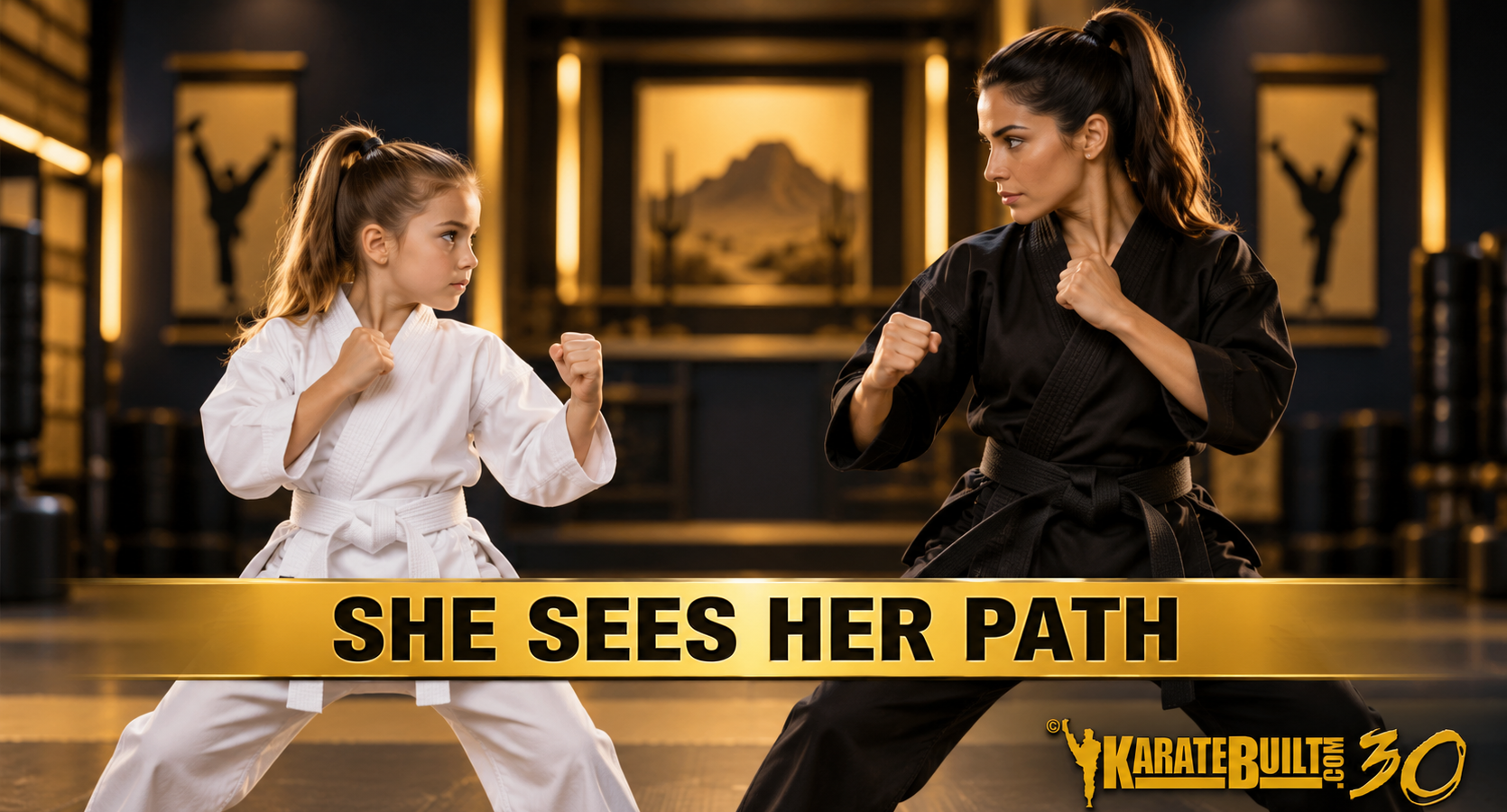
Is Karate Good for Girls? Girls on the Training Floor: What Changes When She Is One of Four
October 22, 2026 by Chief Master Greg Moody, Ph.D.
Your daughter stood at the edge of the floor during a trial class and counted. Four girls. Eleven boys. She didn’t say anything, but you saw her do the math. On the drive home, you started asking yourself a question plenty of parents type into a search bar late at night: is karate good for girls, or is this room built for somebody else?
I’ll answer that plainly, including the part some schools skip. In many mixed kids’ classes, girls are outnumbered. That’s a real fact of the room, and your daughter will notice it before you do.
What matters is what a school does about it, what you should watch for, and what she gains from training in that room. Let’s go through each one.
Is karate good for girls?
Yes. Karate is good for girls because it builds strength, coordination, a strong voice, and the confidence that comes from knowing she can protect herself.
Those benefits show up for every child who trains. For girls, a few of them land with extra weight. She learns to stand her ground physically. She learns to yell “stop” from the gut and mean it. She learns that her body is something she can use and trust, and that matters a great deal during the years when the world starts telling her how her body should look.
Our kids karate program in Cave Creek teaches self-defense, courtesy, and character together, and girls get every bit of that curriculum. Nothing is watered down, and nothing is added just for show.
What changes when my daughter is one of only a few girls in the class?
When your daughter is one of only a few girls, the main thing that changes is how visible she feels, and a good school works to make her feel like a full member of the room.
Being one of four can feel like being on display. Every mistake feels louder. Some girls shrug that off in a week. Others need a little more help to settle in.
Here is what a well-run school does about it.
Treats her exactly like everyone else. Same drills, same standards, same corrections. Lower expectations send a message, and girls hear it clearly.
Puts girls in visible roles. A girl leading the warm-up count or demonstrating a technique for the class changes how every child in the room sees her.
Shows her women who lead. At KarateBuilt, our Chief Instructor is Master Laura Sanborn. A girl who sees a woman running the floor stops wondering whether she belongs on it.
Stays alert to the small stuff. A joke at a girl’s expense or a boy who won’t partner with her gets handled on the spot, calmly and every time.
My doctorate is in special education, and I spent years working with kids who felt like the odd one out. The fix is always the same: full membership, high standards, and adults who notice. Kindness without standards feels like pity, and kids can smell pity a mile away.
Will she be paired against bigger boys?
She will sometimes train with boys, and a well-run school matches partners by size, rank, and control so every pairing is fair and safe. KarateBuilt’s partnering policy, e.g., partners matched by size and rank, with an instructor making every pairing.
Most partner work in a kids’ class is cooperative. One child holds a pad, the other kicks it. One attacks slowly, the other practices a block. Size matters very little there, and training with different body types is part of learning.
When contact gets more serious, matching gets stricter. An instructor should pair a 60-pound nine-year-old with someone close to her size and skill, and the instructor should make that choice, leaving nothing to chance or to who happens to be standing nearby.
I’ll add one more thing. Training with boys at a controlled, safe level teaches a girl something valuable: that she can hold her position with someone bigger, and that technique and composure count for a lot. Before I opened a school, I worked as an aerospace engineer, and we never confused size with strength. A smaller part designed well will outperform a bigger part designed poorly.
What should I watch for when I observe a class?
Watch how instructors treat the girls compared with the boys, because that tells you more about the school than any brochure.
Bring this list and spend twenty minutes along the wall.
Who gets called on? Count how often girls demonstrate, answer questions, or lead a drill.
How are corrections given? Girls should get the same direct, specific corrections as boys, at the same level of challenge.
Who makes the pairings? An instructor should choose partners. “Find a partner” leaves the outnumbered kids standing alone.
What happens with teasing? Notice whether an instructor steps in quickly when a comment crosses a line.
Who leads the room? Look for women among the instructors and the senior students.
How does your daughter look? Watch her face more than the class. Curious and engaged is a great sign, even if she’s nervous.
Ten minutes into the class, you’ll know whether the room feels open to her.
Does martial arts help with confidence differently for girls?
Martial arts often helps girls with a specific kind of confidence: the willingness to be loud, take up space, and say no without apologizing.
Many girls arrive already polite, careful, and eager to get things right. Those are good qualities. Training adds a few that some girls get less practice with: a full-volume kiyap, a stance that owns its ground, and the habit of looking a partner in the eye.
As a licensed clinician with a master’s in counseling, I see how those habits travel. A girl who has practiced saying “stop” with a firm voice a few hundred times has that response ready when she needs it, at recess, at a sleepover, or later in life. We wrote more about building that voice in Why We Make Kids Speak Up in Class.
A mixed room adds something girls-only activities often can’t. Girls-only programs have real value, and some girls thrive in them. A mixed room, though, looks more like her classroom, her future workplace, and the world. Practicing confidence alongside boys gives her a rehearsal for all of it.
What happens as she gets to the teen years?
As she reaches the teen years, the pull to quit organized activities gets stronger, so the best thing a school can do is give her a bigger role to grow into.
That pattern shows up across youth sport. A large study of sport participation records found that participation peaked around ages 10 to 11 and declined rapidly through adolescence (Eime et al., 2016). That data covered organized sport in general, and it gives parents a clear warning about timing.
At KarateBuilt, students who reach black belt can move into our Beyond Black Belt leadership track, where they learn to teach and lead younger kids. For a teenage girl, standing in front of a class of seven-year-olds and running the warm-up is a powerful reason to stay.
Families from Desert Hills and Cave Creek train with us, and the girls who stay through their teens usually have one thing in common, in my experience. Somewhere around age twelve, someone handed them responsibility, and they grew into it.
Frequently Asked Questions
How many girls are in your kids’ classes?
The number of girls varies by class and night. Come watch the class your daughter would join and count for yourself.
Will my daughter be partnered with boys?
Sometimes, yes. Instructors make every pairing and match partners by size and rank, and girls are paired together when the numbers allow.
Do you have female instructors?
Yes. Our Chief Instructor is Master Laura Sanborn, and in addition to her, we have an additional two female instructors.
At what age do girls tend to stop, and what do you do about it?
Across youth sport, participation tends to drop through the early teens. We answer that by giving older students leadership roles, and families from Cave Creek and Desert Hills are welcome to ask about our Beyond Black Belt leadership track.
Here is your next step. Bring your daughter to watch a class at KarateBuilt Martial Arts, 29850 N. Tatum Blvd., Suite 105, Cave Creek, AZ 85331, and see who is on the floor. Count the girls, watch who leads, and then watch her face. New students start with two weeks FREE plus a free uniform, a $199 value. Call or text (602) 737-2098 to pick a class.
References
Eime, R. M., Harvey, J. T., Charity, M. J., Casey, M. M., Westerbeek, H., & Payne, W. R. (2016). Age profiles of sport participants. BMC Sports Science, Medicine and Rehabilitation, 8, Article 6. https://doi.org/10.1186/s13102-016-0031-3
Chief Master Greg Moody, Ph.D. holds a doctorate in Special Education, is a licensed psychotherapist (LAC), and is an 8th Degree Black Belt with over 30 years of experience teaching children. He has been recognized as the nation’s #1 martial arts school owner eight times.
Sincerely,
Ch. Master Greg Moody, Ph.D.
P.S. Get Dr. Moody’s Book on Bullying – Click Here
KarateBuilt L.L.C. was founded in 1995 by Dr. Greg Moody, an 8th-degree Black Belt and Chief Master Instructor, KarateBuilt Martial Arts and Karate for Kids offer lessons for pre-school children ages 3-6 and elementary age kids ages 7 and up are designed to develop critical building blocks kids need – specialized for their age group – for school excellence and later success in life.
KarateBuilt Martial Arts Adult Karate training is a complete adult fitness and conditioning program for adults who want to lose weight, get (and stay in shape), or learn self-defense in a supportive environment.
Instructors can answer questions or be contacted 24 hours of the day, 7 days a week at 866-311-1032 for one of our nationwide locations. You can also visit our website at KarateBuilt.com.
About Dr. Greg Moody: Dr. Moody is an eighth-degree black belt and chief master instructor. He has a Ph.D. in Special Education from Arizona State University (along with a Master’s Degree in Counseling and a Bachelor’s Degree in Engineering – he actually is a rocket scientist). He has been teaching martial arts for over 25 years and has owned eight martial arts schools in Arizona and California. Chief Master Moody is a motivational speaker and educator and teaches seminars in bullying, business, and martial arts training, around the world. See more at DrGregMoody.com.
Dr. Moody is also a licensed psychotherapist and maintains a practice at Sheade Therapywhere he specializes in couples therapy and men’s issues.
The KarateBuilt Martial Arts Headquarters at KarateBuilt LLC is in Cave Creek, Arizona at 29850 N. Tatum Blvd., Suite 105, Cave Creek AZ 85331. You can locate the Chief Instructor, Master Laura Sanborn there directly at (480) 575-8171. KarateBuilt Martial Arts serves Cave Creek, Carefree, Scottsdale, and Paradise Valley Arizona as well as Grand Rapids, MI.