Beyond Black Belt: The KarateBuilt Leadership Track
July 23, 2026 by KarateBuilt Staff
Turning Black Belts into Instructors and Mentors
The KarateBuilt Leadership Track is a structured, multi-year curriculum stage for students who’ve earned Black Belt. It moves them through an instructor pathway, a public-speaking module, and a mentorship rotation, building the students who eventually run our classes.
What Happens After a Child Earns Their Black Belt?
Black Belt marks the point where the curriculum changes shape.
Everything before Black Belt is built around personal development: technique, discipline, focus, physical skill. Everything after Black Belt is built around applying that development to other people. That’s a different skill set, and it doesn’t happen automatically just because a student can perform the material well. It has to be taught, in stages, the same way the material leading up to Black Belt was taught.
I built the Leadership Track for this exact gap. Thirty years of running this school taught me that the students who stuck around, the ones who became the adults I’m proudest to have trained, weren’t just the best performers on the mat. They were the ones we gave a next stage to. Students who hit Black Belt and find nothing waiting past it tend to drift, not because they lost interest in martial arts, but because they’ve run out of curriculum.
That observation didn’t come from a single class or a single year. It came from three decades of watching what happened to students after they earned their Black Belt, tracking which ones stayed, which ones drifted, and why. The Leadership Track is the result of adjusting the curriculum against that data, year after year, until the post-Black Belt path was as deliberately built as everything that came before it.
What Is the KarateBuilt Leadership Track?
It’s a three-phase program that runs after Black Belt, each phase building a specific capability:
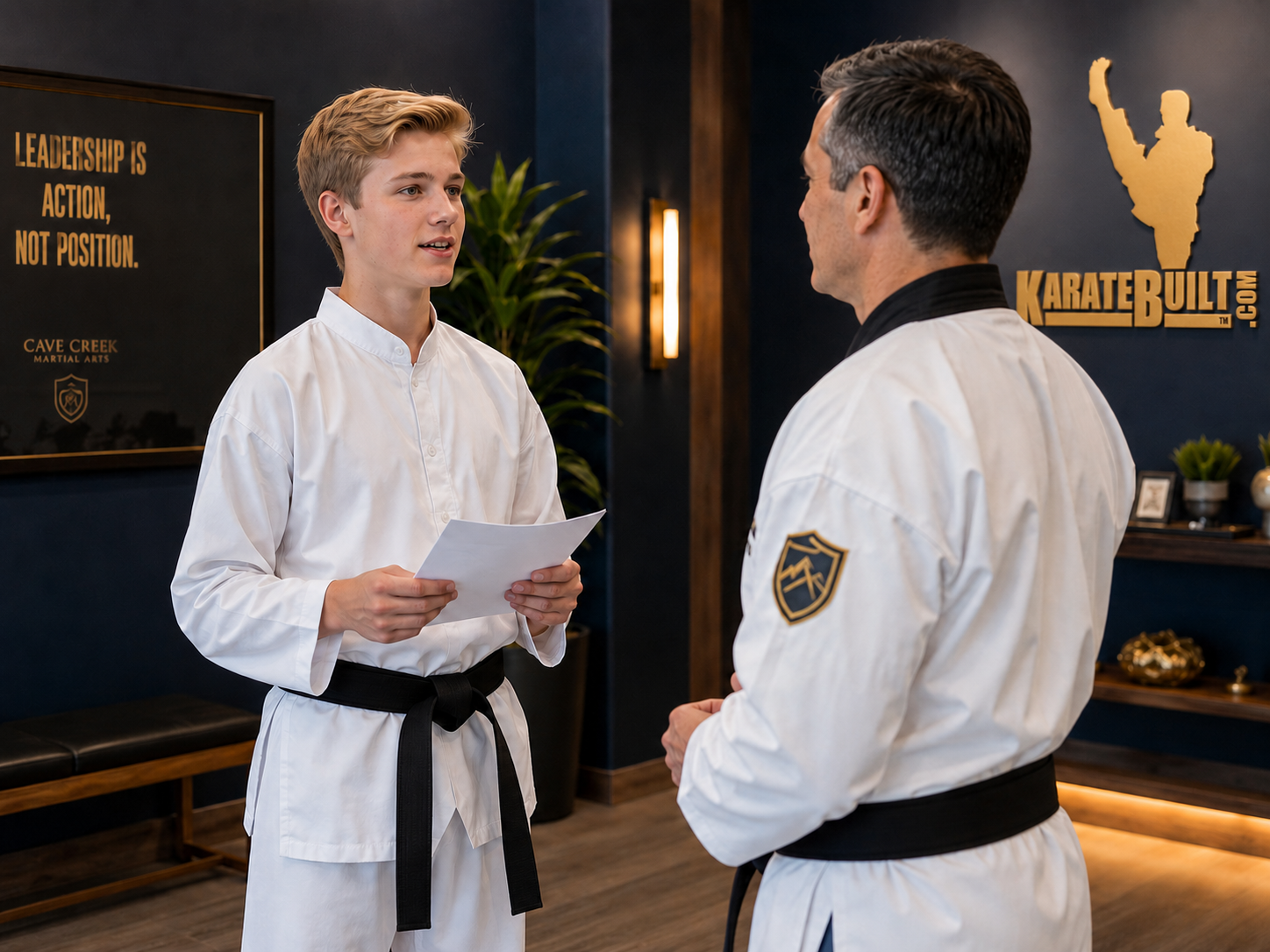
Instructor Pathway. Students learn to break down technique for someone else, not just perform it themselves. They start by assisting with warm-ups and basic drills for lower belts, then progress to leading full segments of class under direct supervision. By the end of this phase, a student can run a technical drill from start to finish without an instructor prompting them.
Public-Speaking Module. Structured practice in front of a group: giving instructions clearly, correcting a peer without embarrassing them, and speaking to a room without hedging or rushing. This is taught the same way we teach a kick, through repetition and direct feedback, not through a single workshop. Students present short segments repeatedly across several months until the discomfort of speaking to a group wears off through exposure, not through a pep talk.
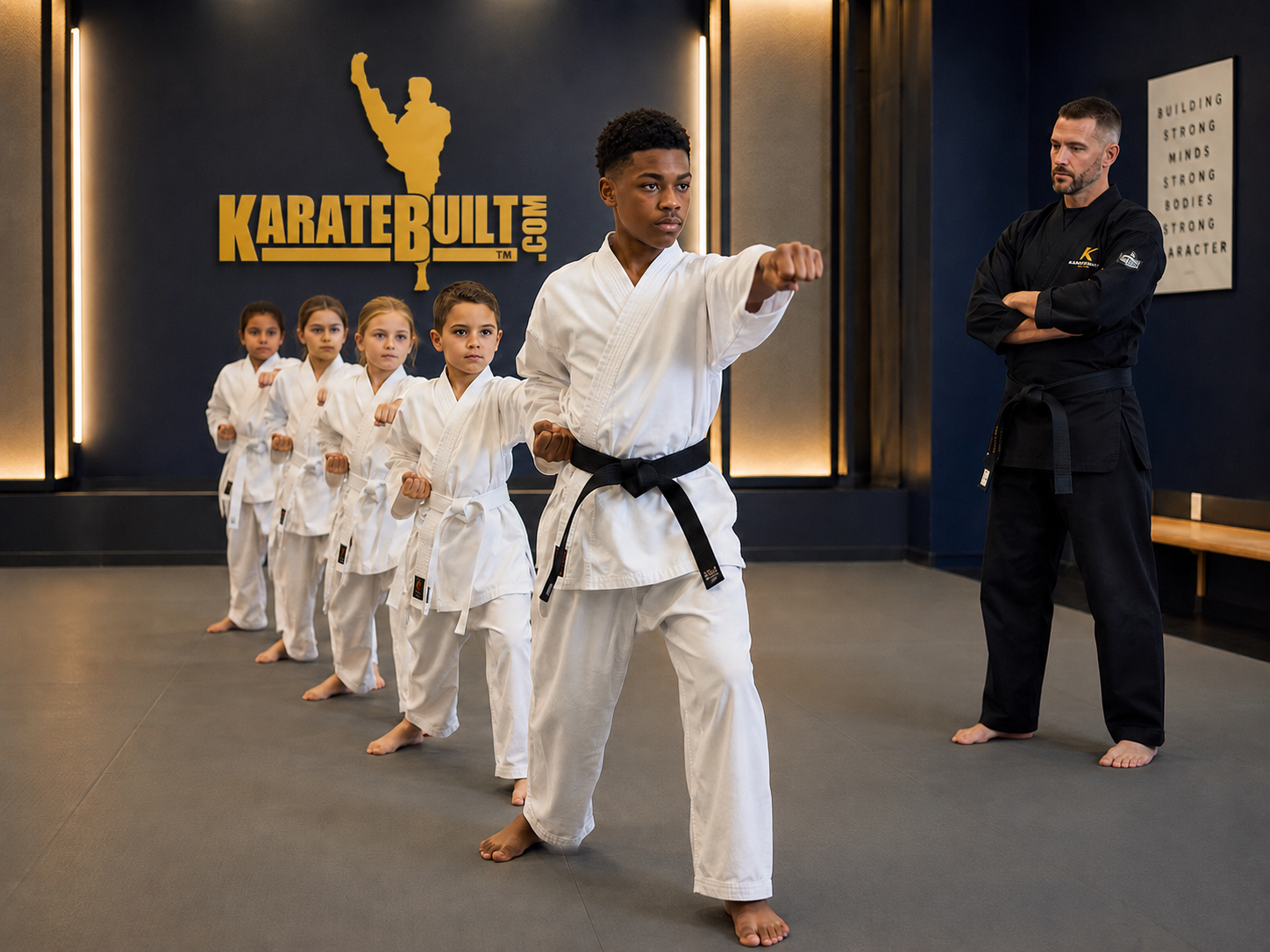
Mentorship Rotation. Each Leadership Track student is assigned specific younger students to track over a full training cycle. They’re accountable for that student’s attendance, effort, and progress, and they report on it the way an instructor would.
These phases build on each other. A student doesn’t move to mentorship until they can teach clearly, and they don’t move to independent teaching until they can speak to a group without falling apart. The sequence is deliberate.
How Long Does the Leadership Track Take?
Most students move through the three phases over one to three years, depending on age, consistency, and how quickly each skill develops. Advancement follows demonstrated readiness at each phase, and pace varies student to student.
Here’s roughly what the timeline looks like:
Months 1 to 6: Instructor Pathway begins. Assisting with drills, learning to observe technique in other students, first attempts at leading a warm-up.
Months 6 to 14: Public-Speaking Module runs alongside continued instructor work. Students present material to the class, answer questions on the spot, and practice correcting a peer’s form out loud.
Year 2 onward: Mentorship Rotation. A Leadership Track student is paired with specific students below them and held accountable for that student’s development over a training cycle, typically three to six months per rotation.
A student can repeat a phase if they’re not ready to advance. Advancement runs on demonstrated capability, the same standard that got them to Black Belt in the first place.
What Do Students Actually Get Out of This?
This is where I’d rather show you the mechanism than the marketing.
They learn to teach, which is a harder skill than performing. Explaining a technique clearly, watching for what’s actually wrong in someone else’s form, and adjusting your explanation when the first one doesn’t land: none of that is covered by being good at the technique yourself.
They learn to speak in front of a group without flinching. By the time a Leadership Track student finishes the public-speaking module, they’ve given dozens of short presentations to a room full of peers and younger students. That repetition is what builds the skill. One class on public speaking doesn’t.
They learn what it means to be responsible for someone else’s progress. Mentorship Rotation puts a teenager in a position where a younger student’s improvement is partly on them. That’s a level of responsibility most fifteen-year-olds don’t get handed anywhere else.
They build a track record, not just a rank. A student who completes all three phases has a documented history of teaching, speaking, and mentoring, which is a different thing to put on a resume or a college application than a belt certificate alone.
They learn to hold a standard for someone else, not just themselves. Correcting a younger student’s form means deciding, in real time, what’s good enough to build on and what needs to be fixed now. That judgment call is a leadership skill on its own, separate from anything technical.
Our program has been recognized as the number-one martial arts program in the Valley eight times over the past three decades. That recognition tracks back to this structure specifically, not to any single class or instructor. A curriculum that keeps developing students past Black Belt is why the results keep showing up year after year instead of in one strong class or one standout student.
Is This Worth It Compared to a Twelve-Week Class?
Compare the two structures directly, because the real difference sits in what happens after the material ends.
A twelve-week in-school semester teaches a fixed set of techniques over a fixed number of weeks, and then it stops. There’s no phase two built into it, because there’s no phase two to build. The program was designed to fit a semester calendar, not to develop a student over years. A child who loves that twelve-week unit has nowhere to go with that interest once week twelve ends, other than starting over somewhere else.
The Leadership Track exists because we built the curriculum to keep going. Black Belt sits at roughly the halfway point, structurally, between where a student starts and where a student who stays with us for years ends up: teaching, speaking, and mentoring students of their own. That outcome is the reason the curriculum was built with a longer horizon in the first place, designed in from the start rather than added on later.
Parents researching long-term value for their child’s activity dollars should ask this question of any program: what does this look like in year five? For a twelve-week class, the honest answer is a repeated year one, over and over, because the program was never built to have a year five. For the Leadership Track, year five is a young adult with a documented history of teaching younger students, speaking in front of groups, and being accountable for someone else’s growth.
Find Out Where Your Child Fits on This Path
Whether your child is approaching Black Belt or you’re researching what a martial arts program actually builds toward over years, the Leadership Track is easier to understand in a direct conversation than in a list of bullet points.
Schedule a KarateBuilt Family Conference. We’ll walk through where your child stands right now, what the path to Black Belt and beyond actually looks like for them specifically, and how the Leadership Track fits into your family’s longer-term goals. Call our Cave Creek school or use the scheduling link on our site to reserve a time.
Sincerely,
Ch. Master Greg Moody, Ph.D.
Chief Master Greg Moody, Ph.D. holds a doctorate in Special Education, is a licensed psychotherapist (LAC), and is an 8th Degree Black Belt with over 30 years of experience teaching children. He has been recognized as the nation’s #1 martial arts school owner eight times.
P.S. Get Dr. Moody’s Book on Bullying – Click Here
KarateBuilt L.L.C. was founded in 1995 by Dr. Greg Moody, an 8th-degree Black Belt and Chief Master Instructor, KarateBuilt Martial Arts and Karate for Kids offer lessons for pre-school children ages 3-6 and elementary age kids ages 7 and up are designed to develop critical building blocks kids need – specialized for their age group – for school excellence and later success in life.
KarateBuilt Martial Arts Adult Karate training is a complete adult fitness and conditioning program for adults who want to lose weight, get (and stay in shape), or learn self-defense in a supportive environment.
Instructors can answer questions or be contacted 24 hours of the day, 7 days a week at 866-311-1032 for one of our nationwide locations. You can also visit our website at KarateBuilt.com.
About Dr. Greg Moody: Dr. Moody is an eighth-degree black belt and chief master instructor. He has a Ph.D. in Special Education from Arizona State University (along with a Master’s Degree in Counseling and a Bachelor’s Degree in Engineering – he actually is a rocket scientist). He has been teaching martial arts for over 25 years and has owned eight martial arts schools in Arizona and California. Chief Master Moody is a motivational speaker and educator and teaches seminars in bullying, business, and martial arts training, around the world. See more at DrGregMoody.com.
The KarateBuilt Martial Arts Headquarters at KarateBuilt LLC is in Cave Creek, Arizona at 29850 N. Tatum Blvd., Suite 105, Cave Creek AZ 85331. You can locate the Chief Instructor, Master Laura Sanborn there directly at (480) 575-8171. KarateBuilt Martial Arts serves Cave Creek, Carefree, Scottsdale, and Paradise Valley Arizona as well as Grand Rapids, MI.