Bowing, Belts, and Lining Up: What Martial Arts Ritual Teaches a Child About Respect
October 26, 2026 by Chief Master Greg Moody, Ph.D.
You’ve watched it from the bench more times than you can count. Twenty kids bow at the door, bow to the instructor, line up by belt color, and stand in silence until someone calls their name. If you’ve ever sat there wondering why do kids bow in karate, and whether any of it matters, you’re asking a fair question.
Plenty of parents quietly suspect the formality is theater. A little costume, a little ceremony, a nice photo for the grandparents.
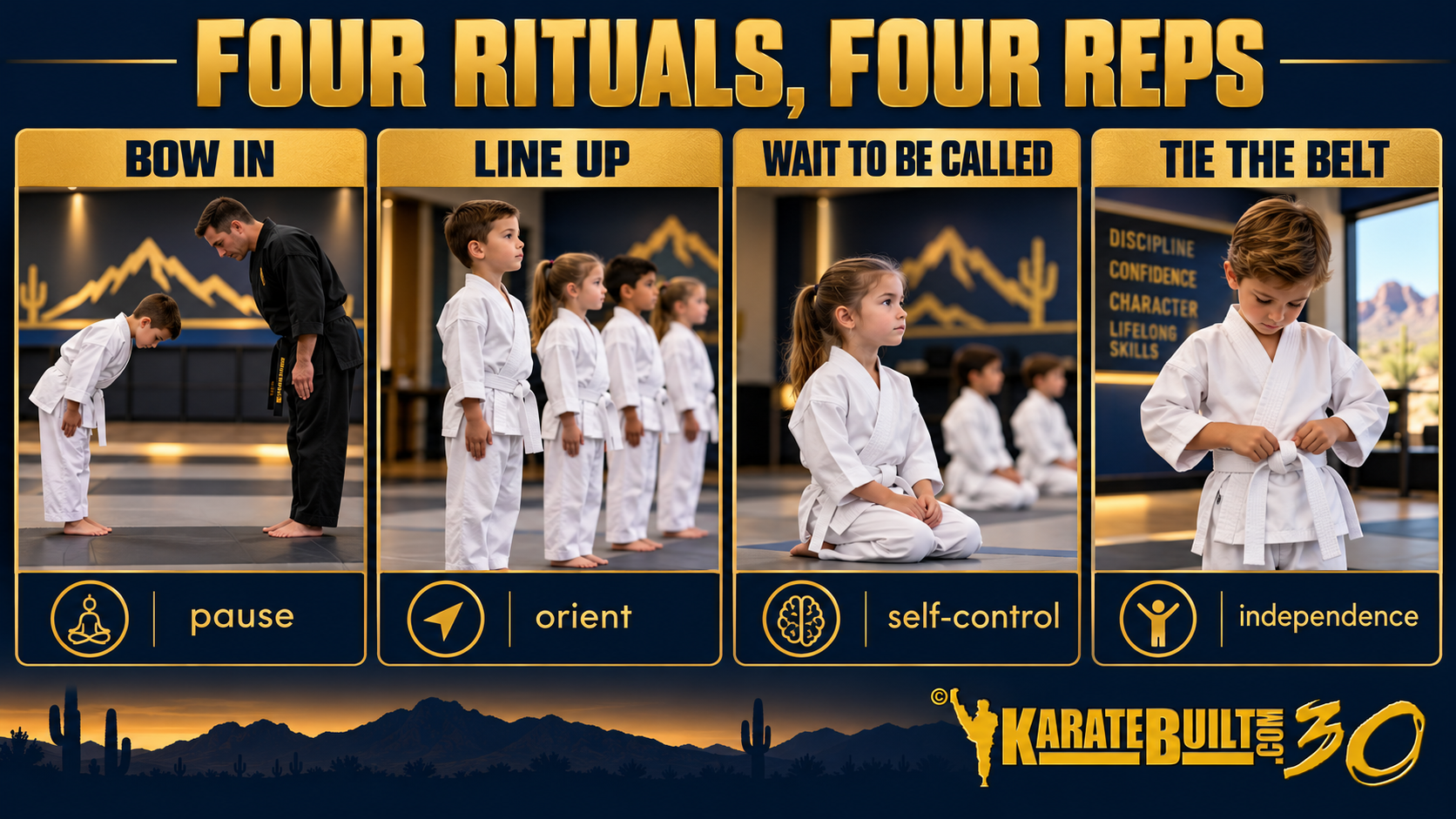
I’ve taught more than 18,000 students over three decades, and my doctorate is in special education. So here is my answer, plainly. Every one of those rituals is a repetition. Each one asks a child to pause, take stock of the room, and choose a behavior while other people are watching, and a child who does that dozens of times a week is building self-control the same way a gymnast builds balance.
Why do kids bow in karate?
Kids bow in karate because the bow puts a full stop between whatever they were doing and whatever comes next.
Think about how a seven-year-old enters a room. They are still carrying the car ride, the argument with a sibling, and the snack they didn’t get. The bow at the door asks them to set all of that down. Feet together, hands at the sides, eyes forward, bend, rise.
It takes about two seconds. In those two seconds, the child has to stop moving, notice where they are, and choose a slow, deliberate motion over the urge to sprint onto the floor.
We call it respect, and the respect is real. Underneath it sits a simpler mechanism. The bow works like a brake, and children get better at using a brake the more often they press it.
What is actually happening in a child’s brain during the opening ritual?
During the opening ritual, a child practices the same three mental skills a teacher asks for when the morning bell rings: stopping, remembering, and switching.
Psychologists group these skills under the name executive function. Inhibition is the ability to hold back an impulse. Working memory keeps a set of instructions in mind long enough to follow them. Cognitive flexibility lets a child shift from one kind of activity to another without falling apart.
Our opening sequence uses all three in under a minute. Students hold still, remember the order of the bows, and switch from free play to formal attention on a single command.
The audience matters too. Doing all of this in front of classmates adds a little social pressure, enough to make the repetition count and small enough that a five-year-old can still succeed. That balance is deliberate. Too little pressure and nothing gets trained; too much and the child freezes.
Researchers have tested this. In one well-known study, children who trained in a school-based martial arts program showed larger gains in self-regulation than classmates who took a standard physical education class (Lakes & Hoyt, 2004, verify before use). The program in that study built in focus, self-monitoring, and reflection, which are the same ingredients you see in a well-run opening ritual.
If you’d like to watch this happen with your own child on the floor, our offer is simple: two weeks FREE plus a free uniform ($199 value). Call or text (602) 737-2098.
Why do students line up by rank instead of by age?
Students line up by rank because rank reflects what a child has earned, and finding their place in that line teaches a child to read the room on their own.
Age arrives for free. Rank comes from work. When a nine-year-old yellow belt lines up behind a seven-year-old green belt, the older child learns that effort carries more weight than birthdays, and the younger child learns that their effort has been seen.
The line also asks every student to orient. Before class starts, each child scans the floor, finds the belts around them, and moves to the right spot without an adult pointing. New students watch the senior students and copy them. Senior students know the little ones are watching, which nudges them toward their best behavior.
Then comes the wait. In our classes, students stay in place until an instructor calls them forward by name. Standing still while every muscle wants to move is self-control in its rawest form. Five-year-olds find it genuinely hard. By nine, most of them can do it without visible strain, and that change happens one name call at a time.
Does making a child tie their own belt matter?
Yes, because tying the belt gives a young child a daily task that belongs entirely to them, done the same way every time, with a result they can see.
The knot is fiddly. Six-year-olds get it wrong for weeks. Parents want to step in, and I understand the urge, especially at 4:52 when class starts at 5:00.
Hold off anyway. The belt is one of the few routines in a young child’s day that they own from start to finish. When the knot sits flat and the tails hang even, the child knows they did it, and nobody has to tell them.
The sameness matters as much as the ownership. A fixed sequence calms a lot of kids, especially children who struggle with transitions. After a few months, the belt becomes a signal to the body: I’m getting ready, and I know exactly how.
Is the formality just tradition, or does it transfer outside the school?
The formality transfers when the adults in a child’s life connect the dots, and it tends to show up at the classroom door, the dinner table, and the moment before a test.
Transfer needs a little help from the adults. A child who bows beautifully at our school will still need a reminder to sit still through a long church service. Here is what that child brings to the pew: a practiced routine of pause, look, choose. Once the routine exists, a parent or teacher can call on it by name.
I hear it in the stories parents bring me after class. A mom tells me her son now takes a breath before he talks back. A dad says his daughter lines up her shoes by the front door without being asked. These are small things, and small things repeated for a year become character.
Traditions survive for a reason. The rituals in martial arts lasted through centuries of teaching young people because they work on young people.
What should a parent say at home to reinforce it?
Name the skill when you see it at home, using the same short words your child hears in class.
Try lines like these:
“That was a good pause.”
“You found your spot without me telling you.”
“You waited for your turn to talk. That’s a black belt habit.”
Keep it to one sentence and move on. A lecture turns a win into a lesson, and kids tune out lessons.
Ask your child to teach you the bow or the belt knot. Children who teach a skill tend to take ownership of it. Some families even borrow the bow for homework time: stand at the desk, bow, sit, begin. It sounds silly, and it works for the same reason it works on the training floor.
How long before a parent sees the change?
In my experience, parents notice something small within the first few weeks and something they would call real change after a few months of steady attendance.
The early signs are easy to miss. A quicker transition from the car to the door. A calmer goodbye. A child who waits a beat before grabbing the last cookie.
Two things speed it up. The first is attendance, because a child who trains twice a week gets twice the repetitions of a child who trains once. The second is your language at home, because every time you name the skill, you add a repetition outside the school.
Come see the first five minutes of a class for yourself. Watch the bow, the line, and the wait, and then picture your child in that line. KarateBuilt Martial Arts offers two weeks FREE plus a free uniform ($199 value). Call or text (602) 737-2098, or stop by 29850 N. Tatum Blvd., Suite 105, Cave Creek, AZ 85331, and we’ll save your child a spot on the floor.
Frequently asked questions
Does the bow have religious meaning? At our school, the bow is a gesture of respect, much like a handshake. If you have any concerns, talk with us before class and we’ll make sure your family feels comfortable.
What if my child refuses to bow at first? That’s common in the first week, and we never force it. Most children join in once they see the rest of the class doing it and realize nobody is singling them out.
At what age can a child tie their own belt? Many five- and six-year-olds can learn the knot with a few weeks of practice. Instructors teach it in class, and you can practice at home with an old belt or a bathrobe tie.
Why is the start of class so quiet? The quiet gives children a clear signal that play time has ended and focused time has begun. Over time, kids learn to settle themselves without an adult asking.
Chief Master Greg Moody, Ph.D. holds a doctorate in Special Education, is a licensed psychotherapist (LAC), and is an 8th Degree Black Belt with over 30 years of experience teaching children. He has been recognized as the nation’s #1 martial arts school owner eight times.
Sincerely,
Ch. Master Greg Moody, Ph.D.
P.S. Get Dr. Moody’s Book on Bullying – Click Here
KarateBuilt L.L.C. was founded in 1995 by Dr. Greg Moody, an 8th-degree Black Belt and Chief Master Instructor, KarateBuilt Martial Arts and Karate for Kids offer lessons for pre-school children ages 3-6 and elementary age kids ages 7 and up are designed to develop critical building blocks kids need – specialized for their age group – for school excellence and later success in life.
KarateBuilt Martial Arts Adult Karate training is a complete adult fitness and conditioning program for adults who want to lose weight, get (and stay in shape), or learn self-defense in a supportive environment.
Instructors can answer questions or be contacted 24 hours of the day, 7 days a week at 866-311-1032 for one of our nationwide locations. You can also visit our website at KarateBuilt.com.
About Dr. Greg Moody: Dr. Moody is an eighth-degree black belt and chief master instructor. He has a Ph.D. in Special Education from Arizona State University (along with a Master’s Degree in Counseling and a Bachelor’s Degree in Engineering – he actually is a rocket scientist). He has been teaching martial arts for over 25 years and has owned eight martial arts schools in Arizona and California. Chief Master Moody is a motivational speaker and educator and teaches seminars in bullying, business, and martial arts training, around the world. See more at DrGregMoody.com.
Dr. Moody is also a licensed psychotherapist and maintains a practice at Sheade Therapywhere he specializes in couples therapy and men’s issues.
The KarateBuilt Martial Arts Headquarters at KarateBuilt LLC is in Cave Creek, Arizona at 29850 N. Tatum Blvd., Suite 105, Cave Creek AZ 85331. You can locate the Chief Instructor, Master Laura Sanborn there directly at (480) 575-8171. KarateBuilt Martial Arts serves Cave Creek, Carefree, Scottsdale, and Paradise Valley Arizona as well as Grand Rapids, MI.