What Two Weeks Off Over Winter Break Does to a Child’s Training, and How to Come Back
October 6, 2026 by KarateBuilt Staff
By Chief Master Greg Moody, Ph.D., 8th Degree Black Belt, ATA Songahm Taekwondo
It’s the last class before winter break. Your child bows out, grabs their shoes, and you both know what the next two weeks look like: cousins, cookies, late nights, and no karate. Later that night, after the kids are in bed, you type “kids martial arts winter break how to keep practicing” into a search bar and wonder what all that time off will cost.
The short answer is that your child won’t forget their forms in two weeks. Their legs and lungs will lose a little, and they’ll get it back fast.
The significant piece that breaks is the habit, the steady rhythm of walking into the school twice a week. You can protect that piece with five minutes a day.
I’ve trained more than 18,000 students over thirty-plus years, and every January I watch the same pattern. Families who planned the return in December are back on the floor the first week. Families who waited to decide are still negotiating in February.
Does taking two weeks off set my child back?
Two weeks off sets your child back a little in conditioning and almost nothing in skill.
A form your child has practiced for months has been repeated hundreds of times. That kind of movement memory holds on the way riding a bike does, and a couple of weeks on the couch can’t wipe out hundreds of repetitions.
Expect your child to feel a bit winded and wobbly the first night back. In my experience, that passes within a class or two.
What actually gets lost during a break, and what does not?
The habit gets lost, the conditioning dips, and the skill stays.
Here’s how I’d rank them, from sturdiest to most fragile.
Technique holds. Stances, blocks, kicks, and forms your child knows well will still be there in January. The newest material, anything learned in the last week or two before break, is the shakiest, so that’s what deserves review.
Conditioning dips. Leg strength, balance, and wind slide some. Balance tends to go first, which is why a one-legged chamber feels harder after time off (Faigenbaum et al., 2013).
The habit breaks easily. For months, Tuesday and Thursday afternoons have meant class. Your child’s week has a shape, and karate holds part of it up. Two weeks of sleeping in and staying up late wipes that shape clean.
That last one is where I see families lose kids. A child who stops for two weeks often stops for two months, and the cause is almost always a broken rhythm that nobody rebuilt.
How much practice at home is enough?
Five minutes a day is enough to keep the habit alive over break.
Five minutes won’t build new skill, and it doesn’t need to. Its job is to keep karate in your child’s day, so January feels like a continuation instead of a fresh start.
My doctorate is in special education, and one of the first lessons in that field is that any skill needs a maintenance plan. The plan can be small. It just has to be steady.
Read that as permission. Skip Christmas morning. Skip the day you drive up to Flagstaff. Pick it back up the next day. One missed day is fine, but five in a row is how a habit ends.
What does a five-minute daily routine look like at home?
A five-minute routine is a short sequence done in the same spot at the same time every day.
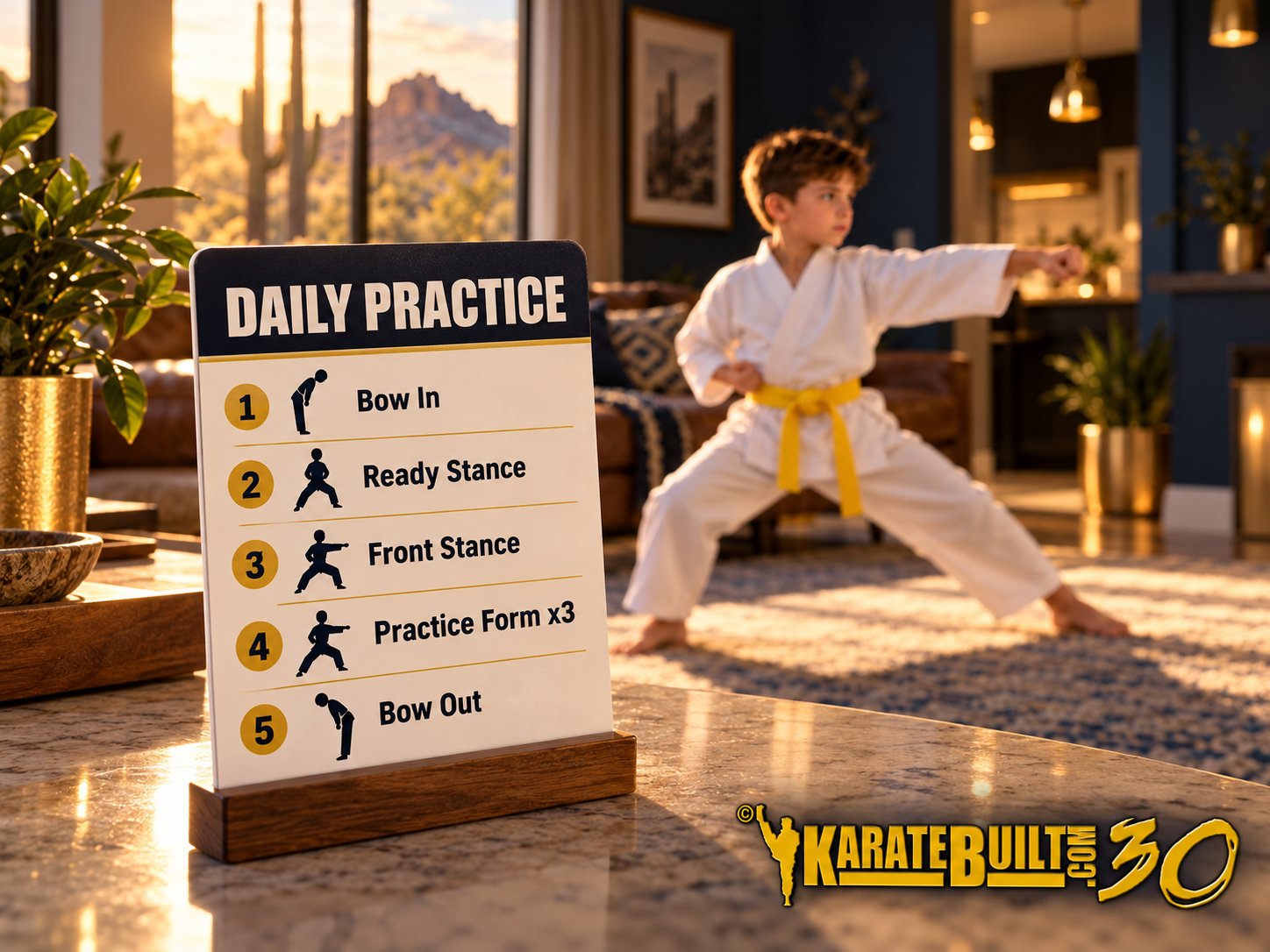
Clear a patch of living room big enough for a front kick. Tie the routine to something that already happens every day, like right after breakfast or right before bath. Then run this:
Minute one: Bow in and hold stances. Your child bows to the spot, then holds a front stance on each side for 20 seconds while you count out loud.
Minutes two and three: The newest form. One run at half speed, one at full speed. The newest material fades first, so it gets the most time.
Minute four: Ten front kicks on each leg. Slow and controlled, with a high chamber. That’s the balance work.
Minute five: Teach you one thing. Your child shows you one technique and explains how it works. Then they bow out.
That last minute does more than it looks like it does. To teach something, a child has to remember it, and for one minute they get to be the expert in the house.
Let them grade you, too. Few things make a seven-year-old happier than telling a parent, “Your knee’s supposed to be bent.”
Why is the first class back the hard one?
The first class back is hard because your child has to restart a routine, and restarting takes more effort than continuing.
Putting on the uniform, getting in the car, and walking through the door after two weeks away can feel bigger than it should. Some kids worry they’ve forgotten everything. Others simply like the pajama schedule and don’t want it to end.
Expect a little pushback on that first afternoon. You might hear, “Can I skip just today?”
Have your answer ready and keep it short: “We decided in December. Shoes on.”
Once they’re on the floor, the hard part usually lasts about ten minutes. The warm-up ends, the first drill starts, and the kid who didn’t want to come is kiyapping with everyone else. I’ve watched that turnaround every January for three decades.
How do I keep the habit alive without turning the break into work?
Keep it small, keep it playful, and tie it to things your child already enjoys about the holidays.
Here are a few ideas families have told me work well:
Family judges night. Once during break, your child performs their form for the whole family, and everyone holds up a score written on a paper plate.
Teach a cousin. Visiting relatives make a great audience. Let your child teach a younger cousin how to bow and throw a front kick.
A fourteen-box chart. Tape it to the fridge and let your child check off each day they do the routine. Fourteen checks earns a treat they pick.
Train beside them. Do the five minutes together. Your child will correct your stance, and you’ll both laugh about it.
Another option is to keep coming to class. Plenty of families from Carefree and Desert Hills train with us right through the holidays, and their kids walk into January without missing a beat.
Whatever you choose, keep the tone light. The goal over break is to keep karate feeling like something your child gets to do.
What should we do the week before classes start again?
The week before classes start, rebuild the routine on purpose and make the first class back a settled fact.
Here’s the order I suggest.
Decide in December. Before break even starts, sit down as a family and choose the date and time of the first class back. Write it on the calendar. When January arrives, nobody has to decide anything, because the decision has already been made.
Move bedtime back. Three or four days before school and class resume, shift bedtime earlier by fifteen minutes a night. A tired child pushes back on everything.
Wash and hang the uniform. Get the dobok clean and hang it, belt included, where your child will see it every day. A visible uniform reminds the whole house what’s coming.
Move the routine to class time. For the last couple of days, run the five-minute routine at the hour class usually starts. It reminds your child’s body when it’s supposed to be training.
Say it out loud. Mention it at dinner, plainly and with some excitement: “Thursday’s our first class back. I can’t wait to see that new form.”
If your child isn’t training with us yet, the new year is a natural place to begin. New students start with two weeks FREE plus a free uniform, a $199 value, at KarateBuilt Martial Arts, 29850 N. Tatum Blvd., Suite 105, Cave Creek, AZ 85331.
Tonight, write that first January class on the family calendar. Then call or text (602) 737-2098 to save your child’s spot.
Frequently Asked Questions
Does KarateBuilt hold classes over winter break?
Yes. We keep classes on the schedule through most of winter break and close only on a few holiday dates. Call or text (602) 737-2098 for this year’s holiday schedule.
How many days off before my child notices?
Most kids feel a little stiff and winded after about a week off. Their technique holds much longer, and the stiffness usually fades within their first class or two back.
My child wants a break. Should I let them take one?
A few days of rest is healthy, especially after a busy fall. Keep the five-minute routine going and set the date of the first class back before the break begins, so the rest has a clear end.
What if we are traveling the entire two weeks?
The five-minute routine fits in a hotel room or a relative’s living room. Tie it to breakfast, and put the first class back on the calendar for your first week home.
References
Faigenbaum, A. D., Farrell, A. C., Fabiano, M., Radler, T. A., Naclerio, F., Ratamess, N. A., Kang, J., & Myer, G. D. (2013). Effects of detraining on fitness performance in 7-year-old children. Journal of Strength and Conditioning Research, 27(2), 323–330. https://doi.org/10.1519/JSC.0b013e31827e135b
Lally, P., van Jaarsveld, C. H. M., Potts, H. W. W., & Wardle, J. (2010). How are habits formed: Modelling habit formation in the real world. European Journal of Social Psychology, 40(6), 998–1009. https://doi.org/10.1002/ejsp.674
Sincerely,
Chief Master Greg Moody, Ph.D. holds a doctorate in Special Education, is a licensed psychotherapist (LAC), and is an 8th Degree Black Belt with over 30 years of experience teaching children. He’s taught over 18,000 students, over 1,800 of them Black Belts. He has been recognized as the nation’s #1 martial arts school owner eight times, and he’s a four-time #1 Amazon Bestselling Author.
P.S. Get Dr. Moody’s Book on Bullying – Click Here
KarateBuilt L.L.C. was founded in 1995 by Dr. Greg Moody, an 8th-degree Black Belt and Chief Master Instructor, KarateBuilt Martial Arts and Karate for Kids offer lessons for pre-school children ages 3-6 and elementary age kids ages 7 and up are designed to develop critical building blocks kids need – specialized for their age group – for school excellence and later success in life.
KarateBuilt Martial Arts Adult Karate training is a complete adult fitness and conditioning program for adults who want to lose weight, get (and stay in shape), or learn self-defense in a supportive environment.
Instructors can answer questions or be contacted 24 hours of the day, 7 days a week at 866-311-1032 for one of our nationwide locations. You can also visit our website at KarateBuilt.com.
About Dr. Greg Moody: Dr. Moody is an eighth-degree black belt and chief master instructor. He has a Ph.D. in Special Education from Arizona State University (along with a Master’s Degree in Counseling and a Bachelor’s Degree in Engineering – he actually is a rocket scientist). He has been teaching martial arts for over 25 years and has owned eight martial arts schools in Arizona and California. Chief Master Moody is a motivational speaker and educator and teaches seminars in bullying, business, and martial arts training, around the world. See more at DrGregMoody.com.
The KarateBuilt Martial Arts Headquarters at KarateBuilt LLC is in Cave Creek, Arizona at 29850 N. Tatum Blvd., Suite 105, Cave Creek AZ 85331. You can locate the Chief Instructor, Master Laura Sanborn there directly at (480) 575-8171. KarateBuilt Martial Arts serves Cave Creek, Carefree, Scottsdale, and Paradise Valley Arizona as well as Grand Rapids, MI.