When Your Child Wants to Spar: What Controlled Contact Teaches and How We Keep It Safe
October 20, 2026 by Chief Master Greg Moody, Ph.D.
Your child came home from class, dropped their bag by the door, and said the word out loud: sparring. They probably said it with a grin, and you probably went quiet. Later that night you typed the question every martial arts parent types sooner or later: is sparring safe for kids?
It’s a fair question. You deserve a full answer, and a reassuring smile at the front desk falls short of one.
So here it is. I’ll walk you through when sparring starts, what your child wears, what the rules are, what the instructor does during every round, and what your child gains that no drill can give them.
Is sparring safe for kids?
Yes. Sparring is safe for kids when it is introduced in stages, run under strict rules, and supervised by an instructor who watches every exchange.
The research backs that up. Zetaruk et al. (2005) followed 263 martial artists across five styles for a year. Students 18 and older had higher odds of injury than younger students, and the authors concluded that martial arts appear safe for young athletes, particularly at beginner and intermediate levels.
A second study looked at children treated in U.S. emergency rooms for martial arts injuries. The most common causes were being kicked, falling, and kicking, and the body parts hurt most often were the lower leg and foot and the hand and wrist (Yard et al., 2007).
Put those two findings side by side and you get a useful map. The risk lives where hands and feet meet a target, and where a child loses balance. Every safety layer below is aimed at those exact spots.
I’ll be straight with you, because you’d see through anything else. No contact activity carries zero risk. A bruise or a stubbed toe will happen at some point. The goal is to keep serious injury rare and to teach your child to protect themselves the entire time they’re on the floor.
At what point does a child start sparring?
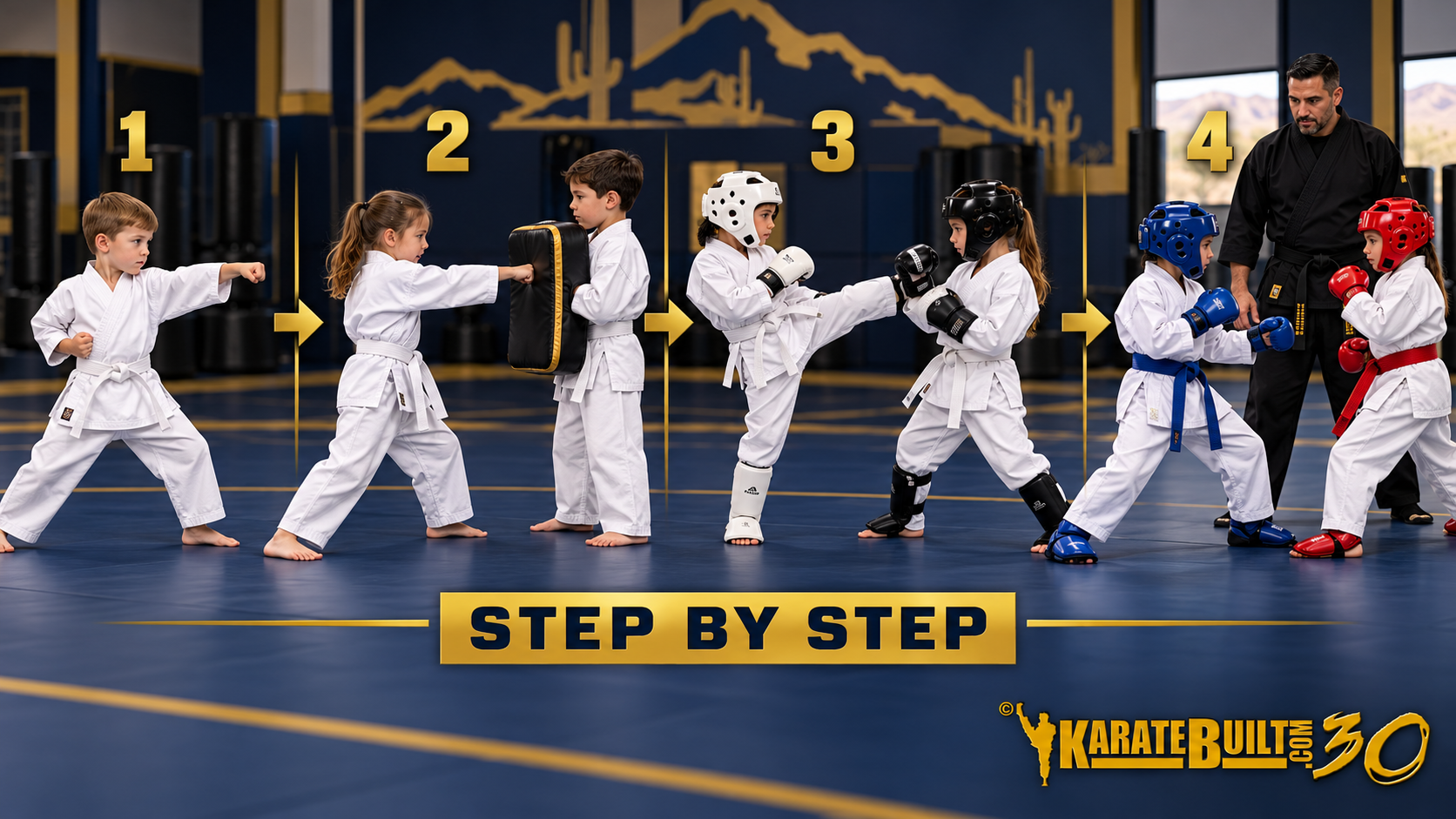
A child starts sparring once they can control their own techniques, stop instantly on command, and fall safely, which takes a few months of steady training. At KarateBuilt, sparring can open at white belt range, but the associated age range largely depends on the level of maturity in the child.
Sparring sits at the top of a ladder, and each rung has to look solid first.
Solo technique. Kicks and punches into the air and onto pads. This is where control gets built.
Partner drills. Set patterns. One student attacks, the other blocks, and both know exactly what’s coming.
Step sparring. A limited menu of techniques at a slow pace, with the instructor counting each move.
Light free sparring. Short rounds, full gear, light contact, and an instructor at the edge of the ring.
A child who still throws a kick they can’t stop stays on the rung below. Belt color matters less than control, and I would rather hold a child back a month than rush them into a round they aren’t ready for.
What protective gear does my child wear?
Your child wears padding on every surface that strikes or gets struck most often: hands, feet, shins, head, and mouth. KarateBuilt requires headgear, a mouthguard, hand pads, foot pads, shin guards, and a groin cup for boys. Shin guards and forearm guards are optional but not mandatory.
That list lines up with the emergency room data. Hands and feet are where kids get hurt most in martial arts, so hands and feet get covered first.
Gear only works if it fits. Headgear that slides down over the eyes does more harm than good. Before your child’s first round, an instructor checks every piece: headgear snug, mouthguard molded to their teeth, pads that stay put through a kick.
One more practical note. A mouthguard left in the gear bag protects exactly nothing, so we check for it at the start of every round.
What are the actual rules during a sparring round?
The rules come down to three things: control your contact, hit only legal targets, and stop the instant you hear the word stop.
Here is how a junior round works.
Light, controlled contact. A point comes from clean technique that touches the target. Force earns nothing extra.
Legal targets only. For juniors, legal targets are the front of the torso; no strikes to the face, throat, knees, groin, or back.
Bow in, bow out. Every round starts and ends with a bow to your partner.
Stop means stop. When the instructor calls it, both students freeze and lower their hands.
Short rounds. Short rounds keep kids sharp, and a tired child gets sloppy.
The instructor runs the whole thing. Before a round, they match partners by size, rank, and temperament. During the round, they stand close enough to step in within a second. They call stop for contact that lands too hard, gear that slips, a child who turns their back, or a child who starts to get flustered.
What does sparring teach that drills cannot?
Sparring teaches a child to stay calm and make good decisions while someone is moving at them, and drills can only take that lesson so far.
In a drill, your child knows what’s coming. In sparring, they don’t. Their partner might kick, might wait, might slide left. Your child has to read the moment, choose, and act in about a second, and then do it again.
I hold a master’s in counseling, and in that field, we talk about exposure: facing something a little scary in doses a person can handle. A short round with pads, rules, and an instructor three feet away is about as well-measured as a dose gets.
Here is what children carry out of the ring.
A racing heart and a clear head can exist at the same time. Kids learn that by feeling it.
Landing a kick lightly takes more skill than landing it hard. Restraint becomes a physical habit.
Reading people. A child who has learned to watch a partner’s shoulders and feet starts noticing body language everywhere, including on the playground. That awareness is a big part of how kids avoid trouble, which we covered in What Bullying Really Looks Like, and What Actually Stops It.
Before I opened a school, I worked as an aerospace engineer. A part that only gets tested on the bench tells you very little about how it behaves under load. Drills are the bench. Sparring is the load test, scaled down to fit a nine-year-old.
What if my child does not want to spar?
If your child does not want to spar yet, that’s fine, and their training keeps moving forward. Sparring is optional at KarateBuilt and is not required for promotion through camo belt.
Some kids walk up to their first-round grinning. Others need to watch a dozen rounds from the side before they’ll put the gear on. Both kinds of kids turn into excellent martial artists.
My doctorate is in special education, and one lesson from that field applies here: readiness is built, and pressure rarely builds it. Let your child watch. Let them do more partner drills. Ask the instructor to pair them with a calm, patient partner when the day comes.
Avoid the two easy mistakes. Pushing a scared child into the ring teaches them to dread class. Pulling them out of class entirely teaches them that fear gets to make the decision. The middle path is slower, and it works.
Whether you live in Cave Creek or North Phoenix, the best first step is the same for every family: watch a sparring class yourself before your child ever steps into one. Our Karate for Kids program in Cave Creek covers how sparring fits into the larger curriculum.
Frequently Asked Questions
At what age and belt does sparring start at KarateBuilt?
Sparring can open at white belt range, but the associated age range largely depends on the level of maturity in the child. An instructor also has to see that your child can control techniques and stop on command first.
Does my child have to spar?
No. Sparring is optional, and your child can keep training and advancing while they build up to it. Many kids start by watching, and that’s a perfectly good beginning.
What gear do you require and do we have to buy it?
Headgear, a mouthguard, hand pads, foot pads, and a groin cup for boys are required. Shin guards and forearm guards are optional but not mandatory. Ask at the front desk before you buy anything online so every piece matches what instructors expect.
How do instructors stop a round that gets too intense?
The instructor calls stop, both students freeze and step back, and the instructor either resets the pair or ends the round. Parents from Cave Creek and North Phoenix are welcome to watch exactly how this works before their child spars.
Here is your next step. Before your child ever steps into a sparring round, call or text (602) 737-2098 and ask to watch a sparring class at KarateBuilt Martial Arts, 29850 N. Tatum Blvd., Suite 105, Cave Creek, AZ 85331. Watch the gear check, the bow, and the first time an instructor calls stop. New students start with two weeks FREE plus a free uniform, a $199 value.
References
Yard, E. E., Knox, C. L., Smith, G. A., & Comstock, R. D. (2007). Pediatric martial arts injuries presenting to emergency departments, United States 1990–2003. Journal of Science and Medicine in Sport, 10(4), 219–226. https://doi.org/10.1016/j.jsams.2006.06.016
Zetaruk, M. N., Violan, M. A., Zurakowski, D., & Micheli, L. J. (2005). Injuries in martial arts: A comparison of five styles. British Journal of Sports Medicine, 39(1), 29–33. https://doi.org/10.1136/bjsm.2003.010322
Chief Master Greg Moody, Ph.D. holds a doctorate in Special Education, is a licensed psychotherapist (LAC), and is an 8th Degree Black Belt with over 30 years of experience teaching children. He has been recognized as the nation’s #1 martial arts school owner eight times.
Sincerely,
Ch. Master Greg Moody, Ph.D.
P.S. Get Dr. Moody’s Book on Bullying – Click Here
KarateBuilt L.L.C. was founded in 1995 by Dr. Greg Moody, an 8th-degree Black Belt and Chief Master Instructor, KarateBuilt Martial Arts and Karate for Kids offer lessons for pre-school children ages 3-6 and elementary age kids ages 7 and up are designed to develop critical building blocks kids need – specialized for their age group – for school excellence and later success in life.
KarateBuilt Martial Arts Adult Karate training is a complete adult fitness and conditioning program for adults who want to lose weight, get (and stay in shape), or learn self-defense in a supportive environment.
Instructors can answer questions or be contacted 24 hours of the day, 7 days a week at 866-311-1032 for one of our nationwide locations. You can also visit our website at KarateBuilt.com.
About Dr. Greg Moody: Dr. Moody is an eighth-degree black belt and chief master instructor. He has a Ph.D. in Special Education from Arizona State University (along with a Master’s Degree in Counseling and a Bachelor’s Degree in Engineering – he actually is a rocket scientist). He has been teaching martial arts for over 25 years and has owned eight martial arts schools in Arizona and California. Chief Master Moody is a motivational speaker and educator and teaches seminars in bullying, business, and martial arts training, around the world. See more at DrGregMoody.com.
Dr. Moody is also a licensed psychotherapist and maintains a practice at Sheade Therapywhere he specializes in couples therapy and men’s issues.
The KarateBuilt Martial Arts Headquarters at KarateBuilt LLC is in Cave Creek, Arizona at 29850 N. Tatum Blvd., Suite 105, Cave Creek AZ 85331. You can locate the Chief Instructor, Master Laura Sanborn there directly at (480) 575-8171. KarateBuilt Martial Arts serves Cave Creek, Carefree, Scottsdale, and Paradise Valley Arizona as well as Grand Rapids, MI.