Why Your Child Should Compete: What a Tournament Does That a Regular Class Cannot
September 30, 2026 by Chief Master Greg Moody, Ph.D.
Your child has been training for a year, maybe a little longer. They know their forms. They bow in without a reminder, and on a good night they walk out of class standing taller than when they walked in.
And every time a tournament flyer goes up at the school, the two of you walk right past it.
I understand why. Things are going well, and a tournament looks like a risk you don’t need. Your child might freeze. They might cry. They might lose in the first round to a kid from Scottsdale they have never met.
That risk is the reason to go. I have spent decades as a martial artist and years as a counselor, and I will tell you plainly: a tournament gives your child something I cannot give them in class, no matter how well I teach.
What does a kids martial arts tournament actually do for a child?
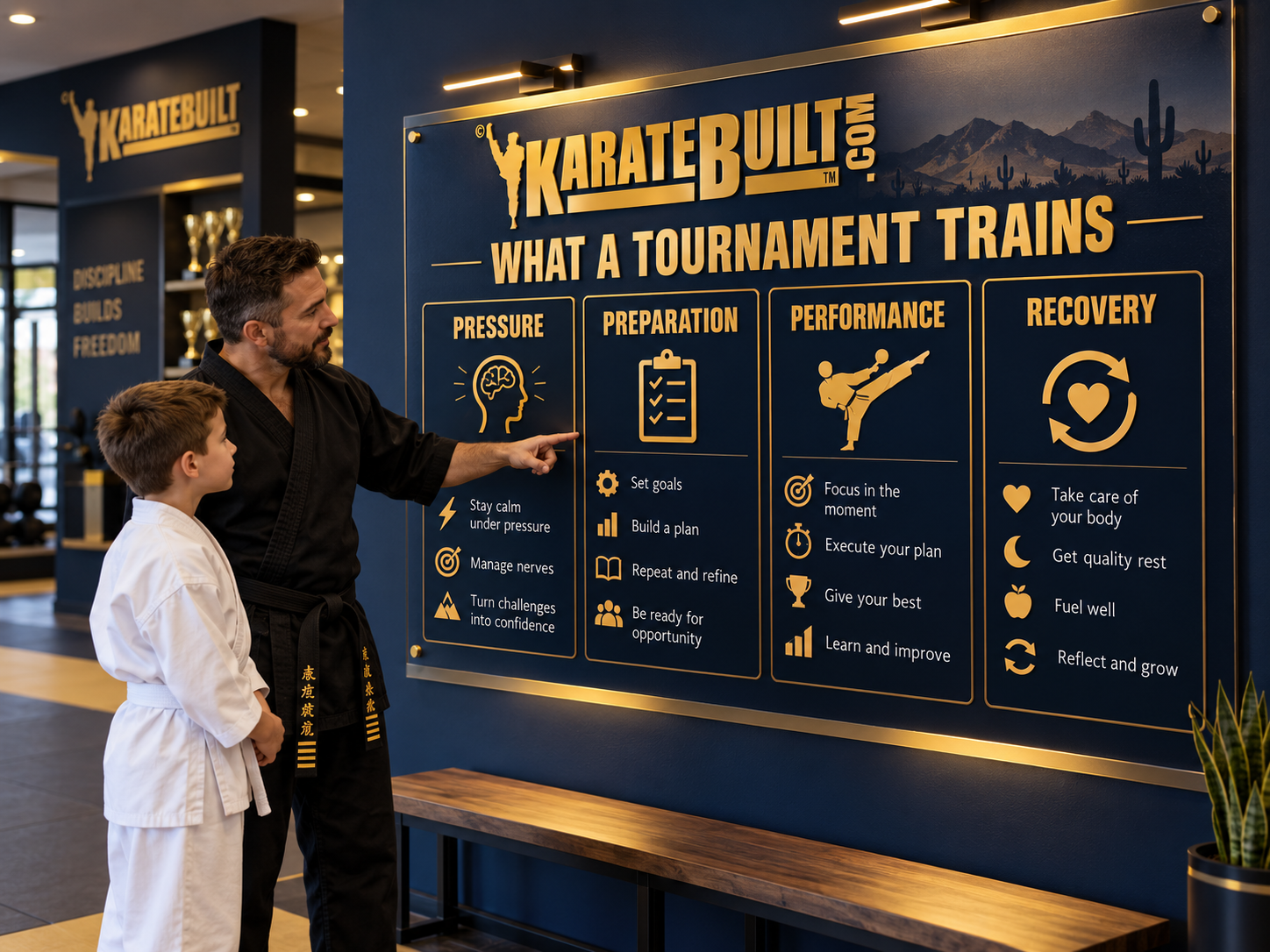
A tournament is a controlled dose of pressure with a hard stop.
Your child steps into the ring, bows to judges they have never seen before, and performs one time. Nobody offers a second attempt. Nobody pauses to coach them through the hard part. When the form ends, it ends, and they bow out and walk back to you.
Look at what that really is. It is a small, safe rehearsal for every high-stakes moment in the next twenty years: the audition, the tryout, the job interview, the hard conversation with a friend or a boss. Every one of those asks the same question. Can you show what you know, once, in front of people who owe you nothing?
Most kids face that question for the first time as teenagers, when the stakes are real. A tournament lets your child face it at eight, with a ribbon on the line and a parent in the stands.
Why can’t a regular class give my child the same experience?
Class is built for learning, and learning needs a place where mistakes cost almost nothing.
Everyone at the school knows your child’s name. I know it. The kid on the next mat knows it. When your child stumbles halfway through a form, the instructor steps in, corrects the stance, and has them run it again. That cycle of try, fix, repeat is how skill gets built, and I would not change it.
Over the years I have worked hard to recreate tournament pressure inside class. We run mock rings. We bring in guest judges. We have the whole class sit and watch. It helps, and it still falls short. Your child knows the mat, the instructors, and the voices at our school. Somewhere deep down, their nervous system knows it too, and it relaxes.
A tournament is loud, bright, and full of strangers. The judges hold scorecards and keep their faces still. Your child’s body notices every bit of it: the heart speeds up, the hands go cold, the mouth goes dry. That physical reaction is the whole lesson, and it only shows up when the moment feels real to the child.
What does my child learn from performing under pressure?
Your child learns that they can do hard things while scared, which is a skill plenty of adults are still working on.
In counseling we talk about exposure. People grow braver by facing what they fear in doses they can handle. A dose that is too small changes nothing, and a dose that is too large can make the fear worse. A tournament lands in the useful middle: big enough to feel real, short enough to survive.
Here is what I see children take home from their first event.
The alarm is survivable. A racing heart and shaky knees can come along for the ride while your child still performs the form. Once they have felt that, the next scary thing gets a little smaller.
Some outcomes are out of their hands. The judges decide. Your child cannot argue a score, charm a judge, or negotiate a do-over. They learn to pour everything into what they control, which is the performance, and then accept the result with their head up. Grown adults spend years learning that.
They can recover in public. If they blank on a move, they have to keep going. Finishing a form after a mistake, with strangers watching, teaches more than a hundred clean runs in class.
Before I ever opened a school, I worked as an aerospace engineer. We never trusted a part until it had been tested under load. A part could look perfect on the bench and still crack in flight. Your child’s confidence works the same way. Class builds it. A tournament puts weight on it, and a tested thing is a trusted thing.
What happens if my child loses at a karate competition?
If your child loses, they find out that losing is survivable, and that discovery is worth the entry fee.
Most children do not place at their first karate competition. I tell parents this ahead of time so nobody is caught off guard. The medal count at the end of the day tells you very little.
What I watch is the walk back. A child who loses, bows, shakes hands with the winner, and walks back to their parent with their chin up has just done something hard. They have met the worst case, and it turned out to be a Saturday afternoon and a sandwich.
In my experience, the kids who lose their first tournament and sign up for a second one often grow the most. They have already seen what they were afraid of, and it has lost its grip.
If your child cries, let them. Tears after a hard effort are normal, and they usually dry up by the parking lot.
Your job in that moment is simple. Tell them one thing you saw them do well. Ask what they want to work on next time. Then go get lunch.
Should my child compete in karate after only six months of training?
Yes, in most cases. Six months of steady training is usually enough for a first event.
Your child needs three things. They should know one form well enough to perform it without prompting. They should be able to follow directions from an adult they don’t know. And they should want to try, even a little. Nervous and willing is a perfectly good place to start.
Preparation predicts readiness better than belt color does. I have watched a yellow belt carry herself in the ring better than some brown belts, because she had practiced her entrance and knew what the day would feel like.
Where parents get stuck is waiting for the child to feel zero fear. That day never arrives, for kids or for adults. The goal is to act while the fear is present.
How do I prepare my child for their first tournament?
Start small, rehearse the routine, and tell them exactly what the day will look like.
Choose one division. For a first event, most of our students enter forms only. Sparring can wait for the second or third tournament.
Practice the ring routine at home. Walk in, bow, say your name and your form, perform, bow, wait for the score. Run it in the living room with the family as judges. A routine gives a nervous brain something solid to hold.
Describe the day ahead of time. Tell them it will be loud. Tell them there will be long waits. Tell them the judges keep serious faces with every competitor, so a straight face says nothing about them.
Pack the uniform the night before. A clean dobok, a belt they can tie themselves, water, and a snack. Rushing in the morning puts stress on everyone.
Set one goal your child controls. “Finish your form even if you make a mistake.” “Kiai loud enough for the back row to hear.” Goals like these can be met regardless of what the judges decide.
Watch your own face. Children read their parents constantly. If you are calm in the stands, your child borrows that calm.
How do I find the right tournament for my child?
Ask your instructor which upcoming event fits your child’s belt level. We know the local events, the divisions, and which ones are friendly for first-timers. We also know your child.
If you’d rather talk it through, call the school. We will tell you straight whether this is your child’s season. If it is, we’ll help you get them ready. If they need a few more months, we’ll tell you what to work on so they are ready for the next one.
Here is your next step. At your child’s next class, catch the instructor for thirty seconds after the bow-out and ask one question: “Which event fits my kid?” Then write that date on the refrigerator where your child can see it.
Sincerely,
Chief Master Greg Moody, Ph.D. holds a doctorate in Special Education, is a licensed psychotherapist (LAC), and is an 8th Degree Black Belt with over 30 years of experience teaching children. He’s taught over 18,000 students, over 1,800 of them Black Belts. He has been recognized as the nation’s #1 martial arts school owner eight times, and he’s a four-time #1 Amazon Bestselling Author.
P.S. Get Dr. Moody’s Book on Bullying – Click Here
KarateBuilt L.L.C. was founded in 1995 by Dr. Greg Moody, an 8th-degree Black Belt and Chief Master Instructor, KarateBuilt Martial Arts and Karate for Kids offer lessons for pre-school children ages 3-6 and elementary age kids ages 7 and up are designed to develop critical building blocks kids need – specialized for their age group – for school excellence and later success in life.
KarateBuilt Martial Arts Adult Karate training is a complete adult fitness and conditioning program for adults who want to lose weight, get (and stay in shape), or learn self-defense in a supportive environment.
Instructors can answer questions or be contacted 24 hours of the day, 7 days a week at 866-311-1032 for one of our nationwide locations. You can also visit our website at KarateBuilt.com.
About Dr. Greg Moody: Dr. Moody is an eighth-degree black belt and chief master instructor. He has a Ph.D. in Special Education from Arizona State University (along with a Master’s Degree in Counseling and a Bachelor’s Degree in Engineering – he actually is a rocket scientist). He has been teaching martial arts for over 25 years and has owned eight martial arts schools in Arizona and California. Chief Master Moody is a motivational speaker and educator and teaches seminars in bullying, business, and martial arts training, around the world. See more at DrGregMoody.com.
The KarateBuilt Martial Arts Headquarters at KarateBuilt LLC is in Cave Creek, Arizona at 29850 N. Tatum Blvd., Suite 105, Cave Creek AZ 85331. You can locate the Chief Instructor, Master Laura Sanborn there directly at (480) 575-8171. KarateBuilt Martial Arts serves Cave Creek, Carefree, Scottsdale, and Paradise Valley Arizona as well as Grand Rapids, MI.


 Chief Master Greg Moody, Ph.D. holds a doctorate in Special Education, is a licensed psychotherapist (LAC), and is an 8th Degree Black Belt with over 30 years of experience teaching children. He’s taught over 18,000 students, over 1,800 of them Black Belts. He has been recognized as the nation’s #1 martial arts school owner eight times, and he’s a four-time #1 Amazon Bestselling Author.