The Bully on the Bus: What We Teach a Child to Do Before It Becomes a Fight
November 12, 2026 by Chief Master Greg Moody, Ph.D.
Your child climbed into the car at pickup and mentioned a kid on the bus. Maybe it was a shove or maybe it was a name, said every morning for two weeks. If you’re looking for a bully prevention program in Cave Creek, AZ, you want to know what your child should do tomorrow morning, and you want an answer that keeps them out of the principal’s office.
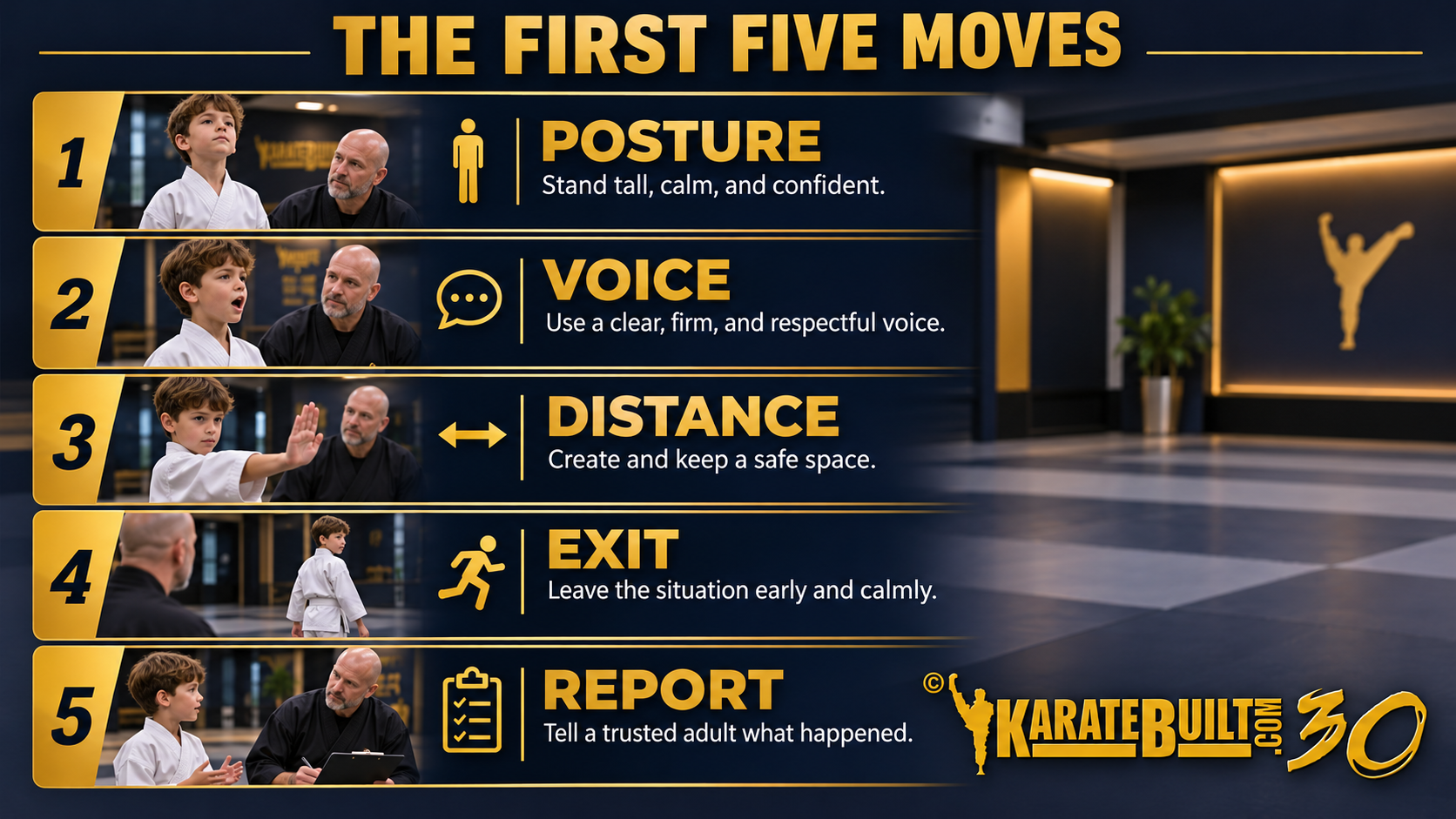
Here it is. The first move is always a stance and a voice. At KarateBuilt Martial Arts we teach a five-step sequence: posture, voice, distance, exit, report. A child who practices it rarely needs anything more.
Start with two weeks FREE plus a free uniform ($199 value). Call or text (602) 737-2098 and tell us what your child is dealing with.
What should my child do in the first ten seconds?
In the first ten seconds, your child stands tall, looks the other kid in the eye, and says one short sentence in a strong voice.
Kids who bully are looking for a reaction. Slumped shoulders, eyes on the floor, and a mumbled “stop it” tells them the plan is working. A straight back and a calm, loud “Back off. I’m done with this” tells them the opposite.
That’s posture and voice. Three steps follow fast.
Distance. Your child steps back, out of arm’s reach. Space buys time to think.
Exit. They move toward an adult or a group. On a bus, that means a seat near the driver.
Report. They tell an adult the same day, every time.
In my experience, these moments are usually decided by how the target looks and sounds before anyone touches anyone.
We rehearse the sequence in class until it comes out on its own. Under stress, a child does what they’ve practiced, in the order they practiced it. I’ve written more about that order in What Self-Defense Actually Means for a Nine-Year-Old.
Does martial arts training make a child more likely to fight, or less?
Less. Both my own research and what I’ve seen on the floor point the same way. It’s a fair worry as no parent wants to hand a frustrated kid a new set of weapons.
My doctoral research at Arizona State University looked at this exact question. I surveyed 223 children training in the Karate for Kids program across seventeen states, along with their parents. Students with more training reported being bullied less often, and the data pointed toward a lower tendency to bully others (Moody, 2012). A 2024 study of 336 schoolchildren in Portugal found something similar: children who trained in karate reported being victims of aggression less often than classmates who didn’t (Simões et al., 2024).
Both studies compared groups at a single point in time, so they show a pattern and fall short of proof. Still, the pattern matches thirty years of watching children train.
The reason is simple. A child who knows what they’re capable of stops needing to prove it. The kid with nothing to prove is usually the first one to walk away.
What does a bully prevention program actually teach?
A good bully prevention program teaches a child to spot trouble early, shut it down with their body and voice, and get an adult involved. Physical skills come last and get used least.
At our school, this work runs through our Karate for Kids classes every week. Here’s what your child practices.
Awareness. Who’s nearby, where the adults are, and which seat on the bus is safest.
Body language. Standing tall, making eye contact, hands up and open.
Words that end things. Short and firm, with no insults to fire the other kid up.
Telling. Who to tell, what to say, and why telling is the strong choice.
Control. Blocks, escapes from grabs, and stopping a technique short of a partner.
Whether you live in Cave Creek or Carefree, these are the same skills your child needs at the bus stop, at recess, and at the park.
Want to see it for yourself? Bring your child for two weeks FREE plus a free uniform. Call or text (602) 737-2098 and we’ll find a class that fits.
When is my child allowed to defend themselves physically?
Your child may defend themselves physically only when someone is hurting them, or about to, and they can’t get away.
Even then, the goal is to get free and get to an adult. A block, an escape from a grab, enough room to leave. Then report it right away.
We give every family three rules on day one.
You never start it.
You walk away whenever you can.
You tell an adult every time, even when nothing happened.
Talk these through at home before your child ever needs them. Read your school’s handbook too, because schools handle fights in their own ways, and a child who knows the rules makes better choices under pressure.
How do I know my child is being bullied if they will not tell me?
Watch for changes, because plenty of children who are bullied never say it out loud.
StopBullying.gov, run by the U.S. Department of Health and Human Services, lists warning signs worth knowing (U.S. Department of Health and Human Services, n.d.).
Injuries nobody can explain.
Belongings that go missing or come home broken.
Headaches or stomachaches, especially on school mornings.
Changes in eating or sleeping.
Falling grades, or a sudden wish to skip school or the bus.
Friends who disappear, or a child who seems helpless or down on themselves.
Kids keep quiet because they’re embarrassed or afraid it will get worse. So ask sideways. “Who do you sit with on the bus?” gets you further than “Is anyone bullying you?” The car helps, because nobody has to make eye contact.
These signs can point to other problems too, so keep talking, and bring in your pediatrician if something seems off.
What should I say to the school?
Tell the school exactly what happened, in writing, and ask what the plan is.
Arizona law requires public school districts to have policies for reporting and investigating bullying (Arizona Department of Education, n.d.). That process already exists. Your job is to start it with clear facts.
Bring these with you.
Dates, times, and places, down to the bus number and the stop.
The names of the kids involved and anyone who saw it.
What was said or done, in your child’s own words.
Any photos, messages, or damaged belongings.
Then ask three questions. Who is looking into this? What changes on the bus this week? When will you follow up with me?
Stay calm in the meeting. A calm, organized parent gets taken seriously. Keep copies of everything, follow up in writing, and tell your child what you did, so they learn that telling works.
Frequently Asked Questions
Does KarateBuilt teach bully prevention to every student?
Yes. Bully awareness is part of the Karate for Kids curriculum, and our instructors complete bullying prevention training as part of their certification.
At what age does this training start?
We teach children from age three. Preschoolers learn the voice and posture basics, and kids seven and up practice the full sequence.
Will my child get hurt learning this?
Drills are controlled and supervised, and partners learn to stop short. Sparring gear is included in tuition when your child starts contact training.
What if my child is the one being aggressive?
Bring them in. Clear rules, steady structure, and an adult who expects self-control help an aggressive child, and we’ll build the plan with you.
Here’s your next step. Tonight, practice the first ten seconds in your living room: stand tall, say the sentence, step back, walk to you. Then call or text (602) 737-2098 to start two weeks FREE plus a free uniform ($199 value) at KarateBuilt Martial Arts, 29850 N. Tatum Blvd., Suite 105, Cave Creek, AZ 85331.
References
Arizona Department of Education. (n.d.). Bullying. https://www.azed.gov/wellness/bullying
Moody, G. (2012). The effects of martial arts on bullying in children [Doctoral dissertation, Arizona State University]. ASU KEEP. https://keep.lib.asu.edu/items/150974
U.S. Department of Health and Human Services. (n.d.). Warning signs for bullying. StopBullying.gov. https://www.stopbullying.gov/bullying/warning-signs
Chief Master Greg Moody, Ph.D. holds a doctorate in Curriculum and Instruction, is a licensed psychotherapist (LAC), and is an 8th Degree Black Belt with over 30 years of experience teaching children. He has been recognized as the nation’s #1 martial arts school owner eight times.
Sincerely,
Ch. Master Greg Moody, Ph.D.
P.S. Get Dr. Moody’s Book on Bullying – Click Here
KarateBuilt L.L.C. was founded in 1995 by Dr. Greg Moody, an 8th-degree Black Belt and Chief Master Instructor, KarateBuilt Martial Arts and Karate for Kids offer lessons for pre-school children ages 3-6 and elementary age kids ages 7 and up are designed to develop critical building blocks kids need – specialized for their age group – for school excellence and later success in life.
KarateBuilt Martial Arts Adult Karate training is a complete adult fitness and conditioning program for adults who want to lose weight, get (and stay in shape), or learn self-defense in a supportive environment.
Instructors can answer questions or be contacted 24 hours of the day, 7 days a week at 866-311-1032 for one of our nationwide locations. You can also visit our website at KarateBuilt.com.
About Dr. Greg Moody: Dr. Moody is an eighth-degree black belt and chief master instructor. He has a Ph.D. in Curriculum and Instruction from Arizona State University (along with a Master’s Degree in Counseling and a Bachelor’s Degree in Engineering – he actually is a rocket scientist). He has been teaching martial arts for over thirty years and has owned nine martial arts schools in Arizona, California and Virginia. Chief Master Moody is a motivational speaker and educator and teaches seminars in bullying, business, and martial arts training, around the world. See more at DrGregMoody.com.
Dr. Moody is also a licensed psychotherapist and maintains a practice at Sheade Therapywhere he specializes in couples therapy and men’s issues.
The KarateBuilt Martial Arts Headquarters at KarateBuilt LLC is in Cave Creek, Arizona at 29850 N. Tatum Blvd., Suite 105 & 106, Cave Creek AZ 85331. You can locate the Chief Instructor, Senior Master Laura Sanborn there directly at (480) 575-8171. KarateBuilt Martial Arts serves Cave Creek, Carefree, Scottsdale, and Paradise Valley Arizona as well as Grand Rapids, MI.