Searching Piano Lessons in Cave Creek? Two Kinds of Practice and What Each One Builds in a Child
November 28, 2026 by Chief Master Greg Moody, Ph.D.
You want your child in something with real structure. A teacher, a standard, steady progress, and a moment where they show what they’ve learned. Piano fits that picture, so you’ve searched piano lessons Cave Creek AZ and started reading teacher bios. Martial arts fit it too. The two have more in common than most parents expect, and the differences between them can help you choose.
I’ve taught children for more than thirty years. Many of our students play an instrument, and I’ve watched music make them better martial artists.
If you’d like to see our side of the comparison in person, start with two weeks FREE plus a free uniform ($199 value). Call or text (602) 737-2098.
What should I know before signing up for piano lessons in Cave Creek?
Know that piano asks for daily practice at home and that your child’s progress will depend heavily on that practice.
A typical setup is one lesson a week with a teacher, followed by six days of practice on their own. The teacher sets the assignment, listens to the result next week and adjusts. In between, the work belongs to your child and, often, to you as the one who reminds them to sit down at the keys.
Ask a prospective teacher how they assign practice, how they check it, and how often students perform. Ask what happens when a child hits a stretch where they don’t want to play. Good teachers have clear answers to all of these.
Then look honestly at your own week. Daily practice needs a quiet time and a quiet place, and in many homes, it needs a parent nearby for the first year or two. If your evenings already run tight, plan where those fifteen or twenty minutes will come from before the first lesson.
What does music practice build in a child?
Music practice builds patience, fine motor control, careful listening, and the ability to work alone toward a long goal.
A child learning piano breaks a hard passage into small pieces, plays it slowly, then speeds it up. They train their ears to hear mistakes. They learn to read a new language on the page. When a recital comes, they perform something they’ve worked on for months.
Research supports the mental benefits. In a study of children ages four to six, Moreno and colleagues (2011) found that 20 days of an interactive, computer-based music listening program improved verbal intelligence, with 90 percent of the music group showing gains. A comparison group trained in visual art did not show the same improvement. That study used listening training for preschoolers, so it’s a hint of what music does for a young brain, and lessons build on the same foundation.
How is martial arts practice different?
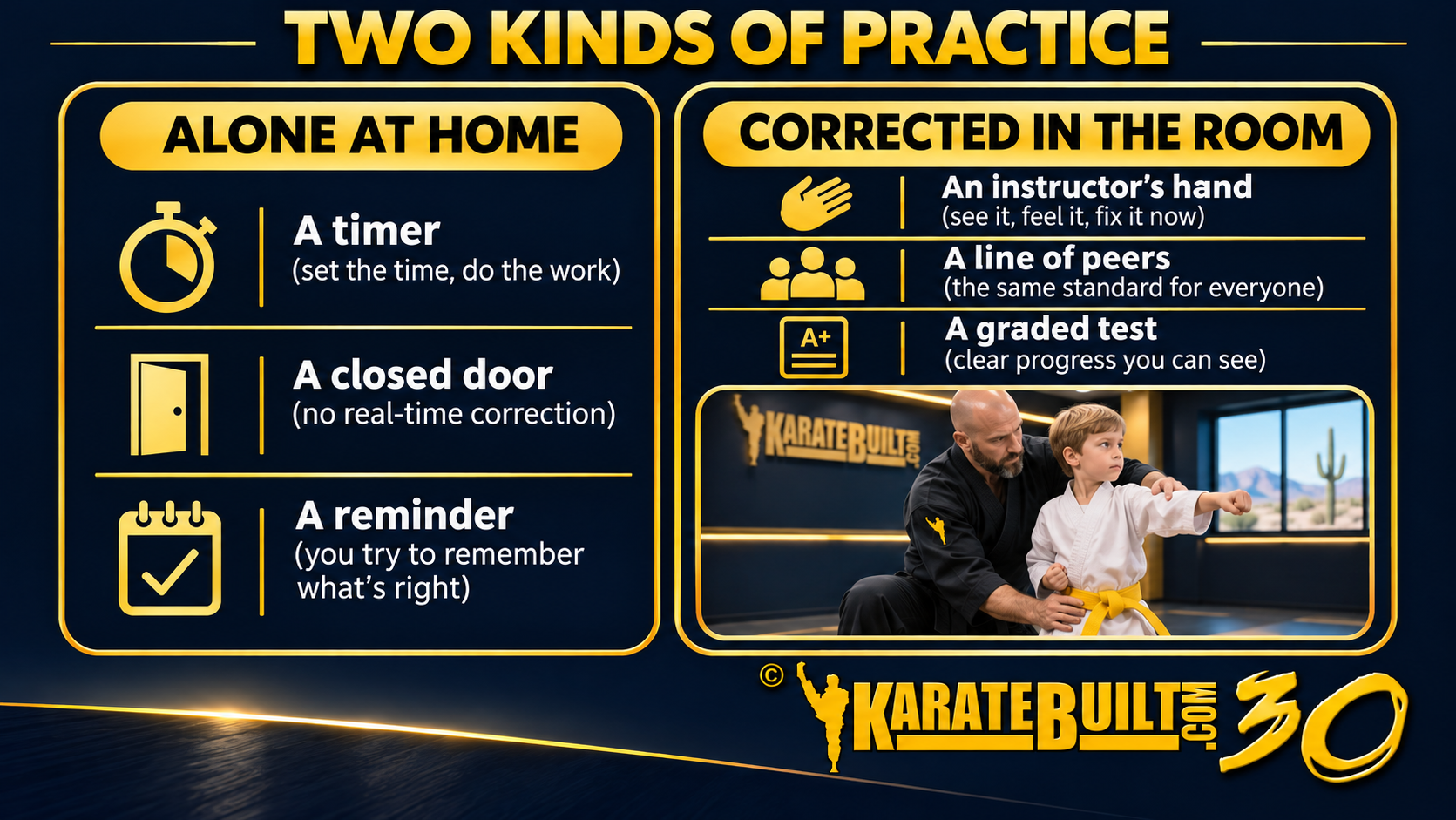
Martial arts practice happens in a room with an instructor who corrects your child on the spot, in front of peers, with the whole body involved.
Both disciplines are graded, and both are built on repetition. The difference is where the repetition happens and who is watching. In piano, most repetitions happen alone at home, and the teacher hears the result a week later. In martial arts, the repetitions happen in class, and an instructor catches a dropped hand or a turned foot within seconds.
That fast feedback suits a lot of children. They try, get a correction, try again, and feel the improvement right away. Our Karate for Kids program runs on that cycle in every class. Diamond and Lee (2011) listed martial arts among the activities shown to improve children’s executive functions, the mental skills behind focus and self-control.
Curious what that looks like in a real class? Two weeks FREE plus a free uniform ($199 value). Call or text (602) 737-2098.
My child will not practice at home, what then?
If your child won’t practice alone, look for an activity where most of the practice happens with a teacher in the room.
Practicing alone is a skill of its own. Some children have it early. Many don’t yet, and that’s normal for their age. A seven-year-old sitting by themselves at a keyboard has to motivate, guide, and correct themselves all at once. That’s a big ask for kids that age.
In martial arts, the instructor carries much of that load during class. Your child still benefits from home practice, but the core work happens on the floor with help. Over time, that guided practice builds the habit of working through hard stretches. I wrote about those stretches in the plateau, and how instructors help a child push through them.
Which one is better for a restless child?
For a restless child, martial arts is often the easier starting point, because it puts their energy to work.
A child who can’t sit still at a piano bench can kick, block, move, and sweat for an hour, all while learning to control their body on command. Class gives them structure and movement at the same time. Over months, that control shows up in their ability to sit and focus elsewhere.
Both paths include a performance moment. In piano, it’s the recital. In martial arts, it’s the belt test, where your child performs in front of family and classmates. I’ve written about what a belt test actually measures, and much of it overlaps with what a recital teaches: preparation, nerves, and finishing under pressure.
Can a child do both without burning out?
Yes, a child can do both, as long as the weekly schedule leaves room to rest.
Music and martial arts complement each other well. Piano sharpens fine motor control and listening. Martial arts build strength, balance and physical confidence. Both teach a child that steady practice leads to visible progress.
Plan the week with care. One piano lesson plus daily practice, and two martial arts classes, fits many families. Watch for signs of strain, such as dread before either activity or trouble sleeping. Parents in Carefree and Cave Creek can choose class nights that leave a quiet evening or two for practice at the keys.
If your child wants structure and needs to move, come see us at KarateBuilt Martial Arts, 29850 N. Tatum Blvd., Suite 105, Cave Creek, AZ 85331. Start with two weeks FREE plus a free uniform ($199 value). Call or text (602) 737-2098.
Frequently asked questions
How much practice does martial arts need at home?
A few minutes a day helps, especially before a belt test. The main practice happens in class with an instructor.
What does a beginner’s first month look like?
A beginner starts with a private first lesson, then learns stances, blocks, basic kicks, and how class runs. By the end of the month, they know the routine and feel their first progress.
Can my child do music and martial arts in the same week?
Yes. Classes run weekdays and Saturdays, so your child can train on nights that leave time for music practice.
What is included in tuition?
Tuition includes uniforms, sparring gear, belts, belt tests, special events and Parent Nights Out. There are no belt testing fees at any rank.
References
Diamond, A., & Lee, K. (2011). Interventions shown to aid executive function development in children 4 to 12 years old. Science, 333(6045), 959-964. https://doi.org/10.1126/science.1204529
Moreno, S., Bialystok, E., Barac, R., Schellenberg, E. G., Cepeda, N. J., & Chau, T. (2011). Short-term music training enhances verbal intelligence and executive function. Psychological Science, 22(11), 1425-1433. https://doi.org/10.1177/0956797611416999
Chief Master Greg Moody, Ph.D. holds a doctorate in Curriculum and Instruction, is a licensed psychotherapist (LAC), and is an 8th Degree Black Belt with over 30 years of experience teaching children. He has been recognized as the nation’s #1 martial arts school owner eight times.
P.S. Get Dr. Moody’s Book on Bullying – Click Here
KarateBuilt L.L.C. was founded in 1995 by Dr. Greg Moody, an 8th-degree Black Belt and Chief Master Instructor, KarateBuilt Martial Arts and Karate for Kids offer lessons for pre-school children ages 3-6 and elementary age kids ages 7 and up are designed to develop critical building blocks kids need – specialized for their age group – for school excellence and later success in life.
KarateBuilt Martial Arts Adult Karate training is a complete adult fitness and conditioning program for adults who want to lose weight, get (and stay in shape), or learn self-defense in a supportive environment.
Instructors can answer questions or be contacted 24 hours of the day, 7 days a week at 866-311-1032 for one of our nationwide locations. You can also visit our website at KarateBuilt.com.
About Dr. Greg Moody: Dr. Moody is an eighth-degree black belt and chief master instructor. He has a Ph.D. in Curriculum and Instruction from Arizona State University (along with a Master’s Degree in Counseling and a Bachelor’s Degree in Engineering – he actually is a rocket scientist). He has been teaching martial arts for over thirty years and has owned nine martial arts schools in Arizona, California and Virginia. Chief Master Moody is a motivational speaker and educator and teaches seminars in bullying, business, and martial arts training, around the world. See more at DrGregMoody.com.
Dr. Moody is also a licensed psychotherapist and maintains a practice at Sheade Therapywhere he specializes in couples therapy and men’s issues.
The KarateBuilt Martial Arts Headquarters at KarateBuilt LLC is in Cave Creek, Arizona at 29850 N. Tatum Blvd., Suite 105 & 106, Cave Creek AZ 85331. You can locate the Chief Instructor, Senior Master Laura Sanborn there directly at (602) 737-2098. KarateBuilt Martial Arts serves Cave Creek, Carefree, Scottsdale, and Paradise Valley Arizona as well as Grand Rapids, MI.


 Chief Master Greg Moody, Ph.D. holds a doctorate in Curriculum and Instruction, is a licensed psychotherapist (LAC), and is an 8th Degree Black Belt with over 30 years of experience teaching children. He has been recognized as the nation’s #1 martial arts school owner eight times.