Kids Karate in North Phoenix: What Separates a Program From a Drop-In Class
October 16, 2026 by KarateBuilt Staff
By Chief Master Greg Moody, Ph.D., 8th Degree Black Belt, ATA Songahm Taekwondo
Search kids’ karate North Phoenix and you’ll find plenty of options, several of them with Phoenix addresses and Scottsdale names. You’re probably less worried about the map than about a simpler question. Is any of this worth the commitment, or is one class as good as another?
I can answer that. I’ve taught children for more than three decades, and I run KarateBuilt Martial Arts in Cave Creek. The answer comes down to one distinction: a drop-in class gives your child an activity hour, while a program gives your child a sequence.
What is available for kids’ karate in North Phoenix?
North Phoenix families can choose from structured martial arts programs, drop-in or punch-card classes, and session-based recreation offerings.
A structured program enrolls your child in regular classes with a set curriculum and belt ranks. A drop-in class lets you show up when it suits you and pay per visit. Recreation sessions fall in between, with a fixed number of weeks and then a stop.
Any of these can give a child a good hour. If your child tried a drop-in class and loved it, that’s a great sign. The question now is what you want the next year to look like.
What is the difference between a program and a drop-in class?
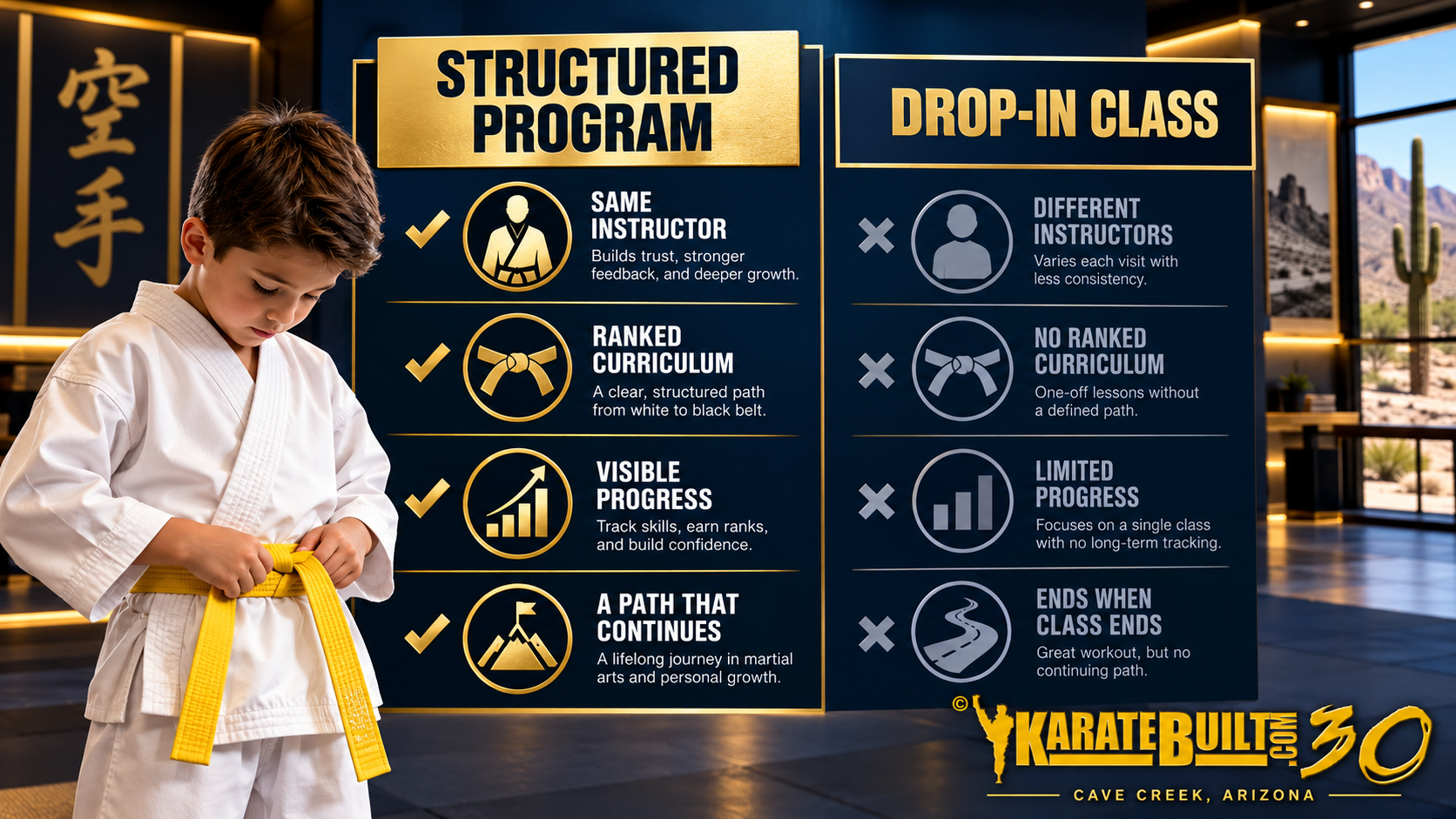
A program builds each class on the one before it, while a drop-in class stands on its own.
In a drop-in class, the instructor has to teach to whoever walks in. That could be a first-timer, a returning student or a kid who trained somewhere else. The lesson has to work for all of them, so it usually covers general skills and a good workout.
In a program, the instructor knows who will be in the room. Tuesday’s lesson picks up where Thursday’s left off. Skills stack. A child who learned a stance in week two uses it in a combination by week six and in a form by week ten.
Both can be well taught. One builds toward something, and the other repeats a good hour. For a child, that difference adds up fast.
Why does the same instructor every week matter?
The same instructor knows what your child did badly last Tuesday and corrects it this Tuesday.
That sounds small, and over a few months it adds up to a great deal. A child who keeps dropping their guard during a drill needs someone who noticed it last week and watches for it this week. A child who finally landed a kick needs someone who remembers how long it took and says so.
My doctorate is in special education, and one thing that field makes very clear is that correction works best when it builds over time. A stranger can give your child a good tip. Someone who knows your child can give the right tip, at the right moment, in a way your child will actually hear.
There’s an emotional side, too. Children open up to adults they know. A shy kid will try something hard in front of an instructor who has seen them succeed before. That trust takes weeks to build, and rotating staff can’t build it, however skilled each one is.
At our school, your child sees the same instructors week after week. By the second or third class, they know your child’s name, their strengths and the one thing to work on next.
What should a parent expect in the first month?
In the first month, expect your child to learn the class routine, a handful of basic techniques and how to take a correction.
The early weeks focus on the basics: how to bow in, where to stand, how to listen for the count and how to hold a few stances. Your child will be corrected often. A good instructor keeps each correction short and specific, then lets the child try again right away.
By the end of the month, look for three things. Your child should move through the start and end of class without being told what comes next. They should hold a basic stance more steadily than they did on day one. And they should recover from a mistake a little faster than they did in week one.
Expect a dip, too. Somewhere around week three, the novelty wears off and the work gets real. That’s normal, and it’s often the point where a child starts actually learning.
How do belt ranks work, and why do they matter?
Belt ranks break the long path into clear steps, so your child can see the next goal and tell when they’ve reached it.
At KarateBuilt, our curriculum follows ATA Songahm Taekwondo. Each color belt comes with its own set of skills. When a child can show those skills, they test, and passing earns the next belt. If you’d like to know more about the affiliation, I’ve written about what the ATA means for a school in the Phoenix area.
Ranks matter for two reasons.
Your child can see progress. “Get better at karate” is too big for an eight-year-old to hold onto. “Learn this form to earn your next belt” is a goal a child can work toward and finish.
You can see progress. A belt is a record that your child learned something specific. You don’t have to guess whether the classes are working.
A drop-in class has no such ladder. Your child might improve, but neither of you will have a clear way to tell.
What happens when a child wants to stop?
When a child wants to stop, a good school slows down, finds out why, and helps your family decide what’s best for your child.
Every child hits this moment. It might come after a hard test, during a plateau, or when another activity starts competing for their time. How a school responds tells you a lot about it.
Here’s what we do. First, we talk with your child. Often the reason is specific and fixable. They’re stuck on one form, a class time conflicts with something, or a friend stopped coming. An instructor can work on those directly.
Then we talk with you. I’m a licensed associate counselor, and I’ve seen how much a child learns from pushing through a rough stretch. I’ve also seen times when a break or a change is the right call. We’ll tell you plainly which one we think it is.
What you shouldn’t get is pressure, guilt or a sales pitch. If a school makes you feel trapped at this moment, take that seriously. Before you enroll anywhere, ask what happens if your child wants to stop. It belongs on any parent’s list, alongside the seven questions I’d ask before enrolling anywhere.
Frequently Asked Questions
Do you have North Phoenix families at KarateBuilt?
Our school is in Cave Creek at 29850 N. Tatum Blvd., Suite 105, and children from North Phoenix are welcome in every kids’ class. Call us and we’ll help you find a class that fits your week.
What is the difference between a program and a drop-in class?
A program builds each class on the last one, with the same instructors and belt ranks. A drop-in class is a standalone hour that has to work for whoever shows up.
Will my child have the same instructor each week?
Yes. Your child sees the same instructors week after week, so they get to know your child’s strengths and what to work on next.
What ages are your kids’ classes for?
We run a preschool program for ages 3 to 6 and a program for kids 7 and up. Each one is built for how children learn at that age.
A drop-in class can show you whether your child likes karate, and a program shows you what they can become. Come see our Karate for Kids program at KarateBuilt Martial Arts, 29850 N. Tatum Blvd., Suite 105, Cave Creek, AZ 85331. Call or text (602) 737-2098 and start with two weeks FREE plus a free uniform, a $199 value.
Sincerely,
Chief Master Greg Moody, Ph.D. holds a doctorate in Special Education, is a licensed psychotherapist (LAC), and is an 8th Degree Black Belt with over 30 years of experience teaching children. He’s taught over 18,000 students, over 1,800 of them Black Belts. He has been recognized as the nation’s #1 martial arts school owner eight times, and he’s a four-time #1 Amazon Bestselling Author.
P.S. Get Dr. Moody’s Book on Bullying – Click Here
KarateBuilt L.L.C. was founded in 1995 by Dr. Greg Moody, an 8th-degree Black Belt and Chief Master Instructor, KarateBuilt Martial Arts and Karate for Kids offer lessons for pre-school children ages 3-6 and elementary age kids ages 7 and up are designed to develop critical building blocks kids need – specialized for their age group – for school excellence and later success in life.
KarateBuilt Martial Arts Adult Karate training is a complete adult fitness and conditioning program for adults who want to lose weight, get (and stay in shape), or learn self-defense in a supportive environment.
Instructors can answer questions or be contacted 24 hours of the day, 7 days a week at 866-311-1032 for one of our nationwide locations. You can also visit our website at KarateBuilt.com.
About Dr. Greg Moody: Dr. Moody is an eighth-degree Black Belt and chief master instructor. He has a Ph.D. in Special Education from Arizona State University (along with a Master’s Degree in Counseling and a Bachelor’s Degree in Engineering – he actually is a rocket scientist). He has been teaching martial arts for over 25 years and has owned eight martial arts schools in Arizona and California. Chief Master Moody is a motivational speaker and educator and teaches seminars in bullying, business, and martial arts training, around the world. See more at DrGregMoody.com.
The KarateBuilt Martial Arts Headquarters at KarateBuilt LLC is in Cave Creek, Arizona at 29850 N. Tatum Blvd., Suite 105, Cave Creek AZ 85331. You can locate the Chief Instructor, Master Laura Sanborn there directly at (480) 575-8171. KarateBuilt Martial Arts serves Cave Creek, Carefree, Scottsdale, and Paradise Valley Arizona as well as Grand Rapids, MI.