How Long Does It Really Take to Earn a Black Belt?
October 13, 2026 by KarateBuilt Staff
By Chief Master Greg Moody, Ph.D., 8th Degree Black Belt, ATA Songahm Taekwondo
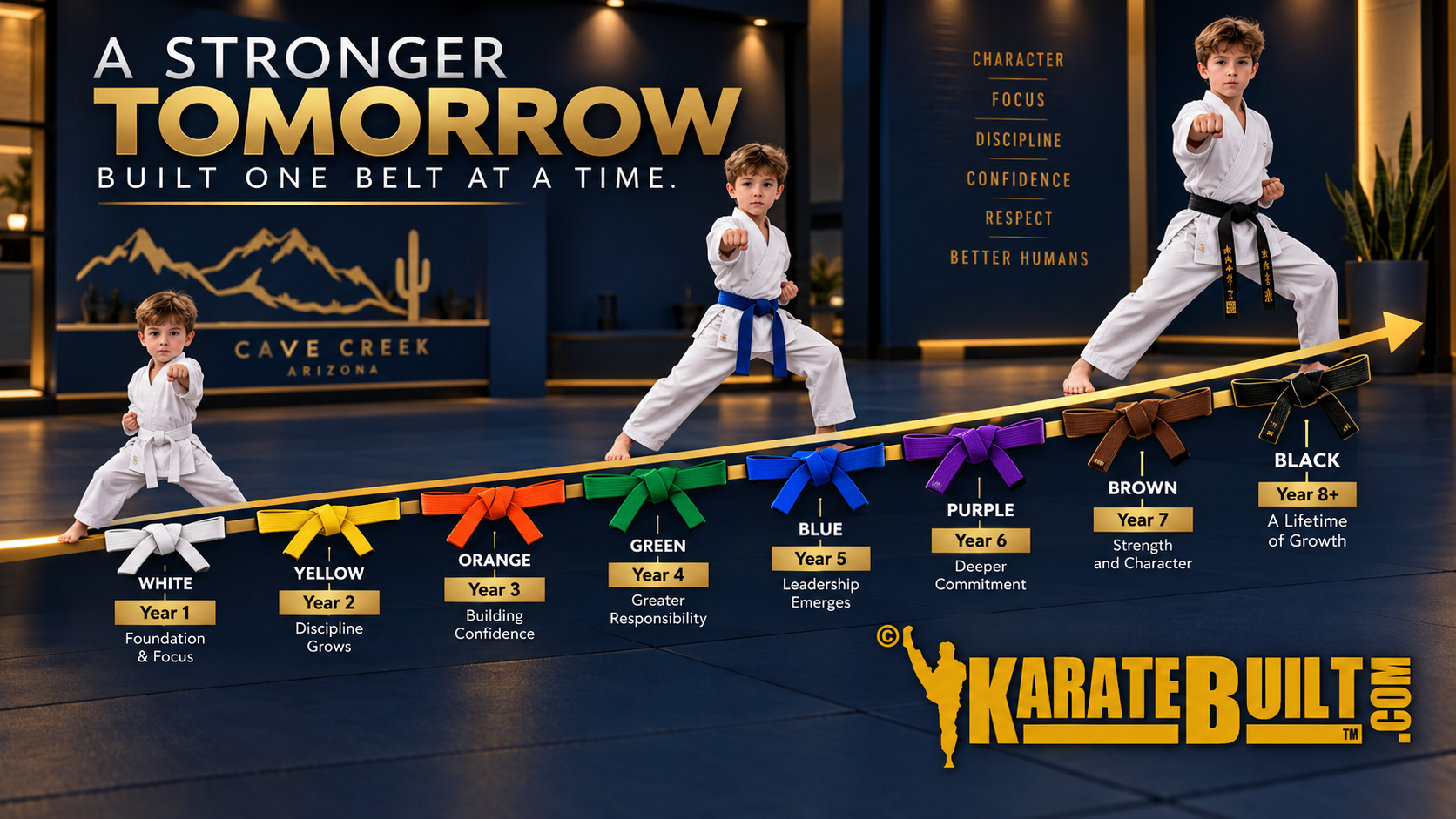
How long does it take to get a black belt? For a child who trains two to three times a week without long breaks, the answer at our school is about three to four years, and some students take five or six.
Very few schools put that number on their website. I’d rather you hear it on day one, standing in the lobby, than find out in year two.
You’re asking because you want to know what you’re signing up for. That’s fair. Here is everything that moves the number, and why I think the years matter more than the belt waiting at the end of them.
How long does it take to get a black belt?
At KarateBuilt, a child who trains steadily usually earns a first-degree black belt in three to four years.
Between white belt and black belt sits a series of color belts. Each one carries its own forms, techniques and standards, and each one ends with a test. Your child moves up by passing that test. The calendar plays a much smaller role than parents expect.
Our curriculum follows ATA Songahm Taekwondo, and if you want to understand what that affiliation means for your child, I’ve written about the ATA and what it means for a school.
So the timeline really answers a different question: how many classes will it take your child to show black belt skill? For a child who trains steadily, that lands in the three-to-four-year window. For some children it takes longer, and I’ll explain why below.
What actually determines the timeline: age, attendance or ability?
Attendance matters most, then starting age, then natural ability.
Attendance. A child who trains three times a week will usually move faster than a child who trains once. Martial arts skill builds through repetition, and repetition needs time on the floor. Researchers who study how people build skill have found that the amount of focused, guided practice predicts progress better than raw talent does (Ericsson et al., 1993). Years on the enrollment list mean very little when the classes don’t happen.
Starting age. A five-year-old and a ten-year-old can both start at white belt, and they will move at different speeds. Younger children need more time with balance, memory and attention. They catch up. They simply need a longer runway.
Ability. Natural athleticism helps a little at the start. By the middle belts, the child who keeps showing up passes the gifted child who skipped class. I have watched that happen more times than I can count.
Rank at our school is earned by showing the skill. A child who has been enrolled for two years tests when they can perform the material, and a child who learns it quickly tests as soon as they’re ready.
What does a child learn between white belt and black belt?
A child learns to keep going after a bad class, to take correction without falling apart, and to finish something that took longer than they expected.
Those three skills are what the years produce. The length of the path is the thing I’m actually offering your family.
Think about what three or four years holds. There will be a night your child forgets their form in front of the whole class. There will be a test they need a second try to pass. Somewhere around the middle belts there will be a plateau, when the novelty is gone and progress feels slow. And there will be a Thursday when they don’t want to come, and they come anyway.
My doctorate is in special education, and my master’s is in counseling. In both fields we know that a child builds persistence by practicing it, again and again, in a setting where the stakes stay manageable. Each belt test is a small, safe version of the hard things coming later in life. By black belt, your child has rehearsed persistence a dozen times or more.
A black belt handed over in a few months would skip every bit of that. The years are where the character work happens.
Why do some students take six years and others take three?
Students who finish in three years usually trained often, started a little older and rarely took long breaks. Students who take six usually started very young, trained once a week, or stepped away for a season or two.
Neither group did anything wrong. A child who starts at four and earns black belt at ten has spent six years practicing respect, focus and recovery from mistakes. Those were six good years.
What I watch for is the pattern behind the pace. Some families hit a busy stretch, drop to one class a week, and the belts slow down. That’s normal. For other kids, adding a second or third weekly class is the difference between feeling stuck and feeling momentum. If your child seems stalled, ask us, and we’ll tell you plainly what we see.
What happens if we miss a few months?
Your child comes back, reviews, and picks up where they left off. A few missed months costs those months plus some review time.
Life happens. Kids get sick, sports seasons overlap, families travel or move. When a student returns after a break, the instructor checks their forms and techniques and works them back to test-ready. The rank they earned stays theirs.
Momentum is what takes the hit. Coming back after three months feels harder than coming back after three days, and the first week back is usually the toughest. Expect some grumbling, and bring them anyway. By the second week, the rhythm tends to return.
Is a fast black belt a real black belt?
A black belt earned in a year or less is usually a certificate, because the skill and the character behind a real one take years to build.
You will see programs promising a black belt on a short timeline, sometimes with a contract to match. I won’t name anyone, and I don’t need to. Ask any school that makes that promise one question: what does a child have to show to earn each belt, and what happens if they can’t show it yet? A school that tests on skill will give you a specific answer. A school that promotes on a schedule will talk about the calendar.
A belt is a record of something your child can do. When the belt shows up before the ability, the record is false, and children can tell. The child who earned it slowly knows exactly what it cost, and that knowledge outlasts the belt.
What happens after black belt?
Black belt is the point where a student starts to get really good, and at our school the training keeps going well past it.
Most parents assume the story ends at black belt. After first degree, students continue in Black Belt Training and work toward second degree and beyond. Each higher degree takes longer than the last, because the material gets deeper and the standards climb.
Many students also join our Leadership track, where they learn to help teach. They assist with younger classes, lead warm-ups and learn how to correct a white belt kindly and clearly. Teaching a technique to a nervous six-year-old shows a teenager exactly what they know and what they only thought they knew.
For students who want to go further, the instructor pathway comes next. Some of the instructors on our floor started as children in this school. They know every step of the path because they walked it themselves.
Whatever school you’re considering, ask what happens after black belt. It’s one of the seven questions I’d ask before enrolling anywhere, and the answer tells you whether a school plans to keep teaching your child once the belt is tied.
Frequently asked questions
How long does a black belt take at KarateBuilt?
For a child training two to three times a week, about three to four years. Some children take five or six, depending on starting age, attendance and time away.
How often does my child need to train to stay on track?
Two classes a week keeps progress steady for a typical child. Three a week usually moves faster, and once a week still works at a slower pace.
What age can a child earn a black belt?
Age matters less than skill and maturity. We test each child on what they can show, and we’ll talk with you about a realistic timeline for your child’s age.
Does a missed month set my child back a year?
No. A missed month usually means a few weeks of review, and the rank your child already earned stays theirs.
The fastest way to understand the path to black belt is to watch the first step of it. Bring your child to our Karate for Kids program at KarateBuilt Martial Arts, 29850 N. Tatum Blvd., Suite 105, Cave Creek, AZ 85331, and start with two weeks FREE plus a free uniform, a $199 value. Call or text (602) 737-2098 today and ask which class fits your child. White belt is waiting.
References
Ericsson, K. A., Krampe, R. T., & Tesch-Römer, C. (1993). The role of deliberate practice in the acquisition of expert performance. Psychological Review, 100(3), 363–406. https://doi.org/10.1037/0033-295X.100.3.363
Sincerely,
Chief Master Greg Moody, Ph.D. holds a doctorate in Special Education, is a licensed psychotherapist (LAC), and is an 8th Degree Black Belt with over 30 years of experience teaching children. He’s taught over 18,000 students, over 1,800 of them Black Belts. He has been recognized as the nation’s #1 martial arts school owner eight times, and he’s a four-time #1 Amazon Bestselling Author.
P.S. Get Dr. Moody’s Book on Bullying – Click Here
KarateBuilt L.L.C. was founded in 1995 by Dr. Greg Moody, an 8th-degree Black Belt and Chief Master Instructor, KarateBuilt Martial Arts and Karate for Kids offer lessons for pre-school children ages 3-6 and elementary age kids ages 7 and up are designed to develop critical building blocks kids need – specialized for their age group – for school excellence and later success in life.
KarateBuilt Martial Arts Adult Karate training is a complete adult fitness and conditioning program for adults who want to lose weight, get (and stay in shape), or learn self-defense in a supportive environment.
Instructors can answer questions or be contacted 24 hours of the day, 7 days a week at 866-311-1032 for one of our nationwide locations. You can also visit our website at KarateBuilt.com.
About Dr. Greg Moody: Dr. Moody is an eighth-degree black belt and chief master instructor. He has a Ph.D. in Special Education from Arizona State University (along with a Master’s Degree in Counseling and a Bachelor’s Degree in Engineering – he actually is a rocket scientist). He has been teaching martial arts for over 25 years and has owned eight martial arts schools in Arizona and California. Chief Master Moody is a motivational speaker and educator and teaches seminars in bullying, business, and martial arts training, around the world. See more at DrGregMoody.com.
The KarateBuilt Martial Arts Headquarters at KarateBuilt LLC is in Cave Creek, Arizona at 29850 N. Tatum Blvd., Suite 105, Cave Creek AZ 85331. You can locate the Chief Instructor, Master Laura Sanborn there directly at (480) 575-8171. KarateBuilt Martial Arts serves Cave Creek, Carefree, Scottsdale, and Paradise Valley Arizona as well as Grand Rapids, MI.