Searching Tiger Rock Martial Arts Phoenix? What the Name on the Sign Tells a Parent
October 23, 2026 by Chief Master Greg Moody, Ph.D.
You typed “Tiger Rock martial arts Phoenix” into a search bar because a friend mentioned it, or you drove past the sign, or an ad followed you around the internet for a week. Now you’re trying to work out what you’d actually be buying if you signed your child up.
That’s a smart question to ask about any school with a national name on the door. A brand tells you some things and leaves others completely up to the person who owns the building.
I run a school of my own, so read what follows with that in mind. I’ll stick to what Tiger-Rock says about itself on its own public pages, explain what any affiliation can and can’t promise, and then hand you four questions that work on every school you visit, including mine.
What is Tiger Rock Martial Arts?
Tiger-Rock Martial Arts, often searched as Tiger Rock, is a national martial arts franchise whose schools teach a style rooted in taekwondo.
Here is what the company says on its own About page:
It describes itself as a martial arts company with nearly 100 franchises.
Its style has roots in Ho-Am Taekwondo and has grown into a proprietary Tiger-Rock style that blends several martial arts with sports science.
Its instructors, called Certified Leaders, complete an annual recertification course covering leadership, curriculum knowledge, and a safety program it calls Sport Safe.
As of this writing, the company’s own locations directory lists two Arizona schools, one in Glendale and one in Gilbert (Tiger-Rock Martial Arts International, n.d.-b). Public franchise disclosure reporting shows the company has offered franchises since 2008 (VettedBiz, n.d.).
An annual recertification requirement is a real standard, and I respect it.
Does a national brand name guarantee a better instructor?
A national brand name guarantees a baseline of training requirements, and the quality of the person in front of your child still depends on that person.
Think of a brand as a floor, with no ceiling attached. It can require that instructors complete certain courses and recertify every year. It can hand every school the same curriculum. It cannot make an instructor patient with a frustrated six-year-old, or sharp enough to notice that your daughter stops trying whenever she gets corrected in front of the class.
My doctorate is in special education, and I also practice as a licensed clinician. Both fields taught me the same lesson: a credential tells you someone finished the training. Watching them work tells you whether the training took.
So, treat the brand name as a starting point. Then go watch the actual instructor teach.
Who actually owns the school near me?
In a franchise system, the school near you is usually owned by a local franchisee, while the name on the sign belongs to the franchisor.
That’s how franchising works across every industry, from sandwich shops to tutoring centers. The franchisor licenses its name, systems, and curriculum. A local owner buys the right to use them, signs the lease, hires the staff, and runs the business day to day.
That matters for one practical reason: accountability. If something goes wrong with your child’s class, the person who can fix it is the local owner. Before you enroll anywhere, find out who that is, and whether they actually teach or manage from a distance.
What does an affiliation control, and what does it leave to the local owner?
An affiliation typically controls the brand, the curriculum, and the rank system, and it leaves most day-to-day decisions to the local owner.
Specific agreements vary from company to company, so treat this as the general pattern and ask each school about its own arrangement.
What the brand usually controls:
The name, logo, and marketing
The curriculum and belt requirements
Required instructor training and certifications
What usually stays with the local owner:
Who gets hired and who teaches your child each week
How many students are in each class
The schedule, the atmosphere, and how mistakes get handled
How the owner responds when a parent raises a concern
Notice that the second list holds most of what a parent actually feels on a Tuesday night. Before I opened a school, I worked as an aerospace engineer. A design spec told us what a part should be. The shop that built it decided whether it actually was.
What four questions should I ask any martial arts school?
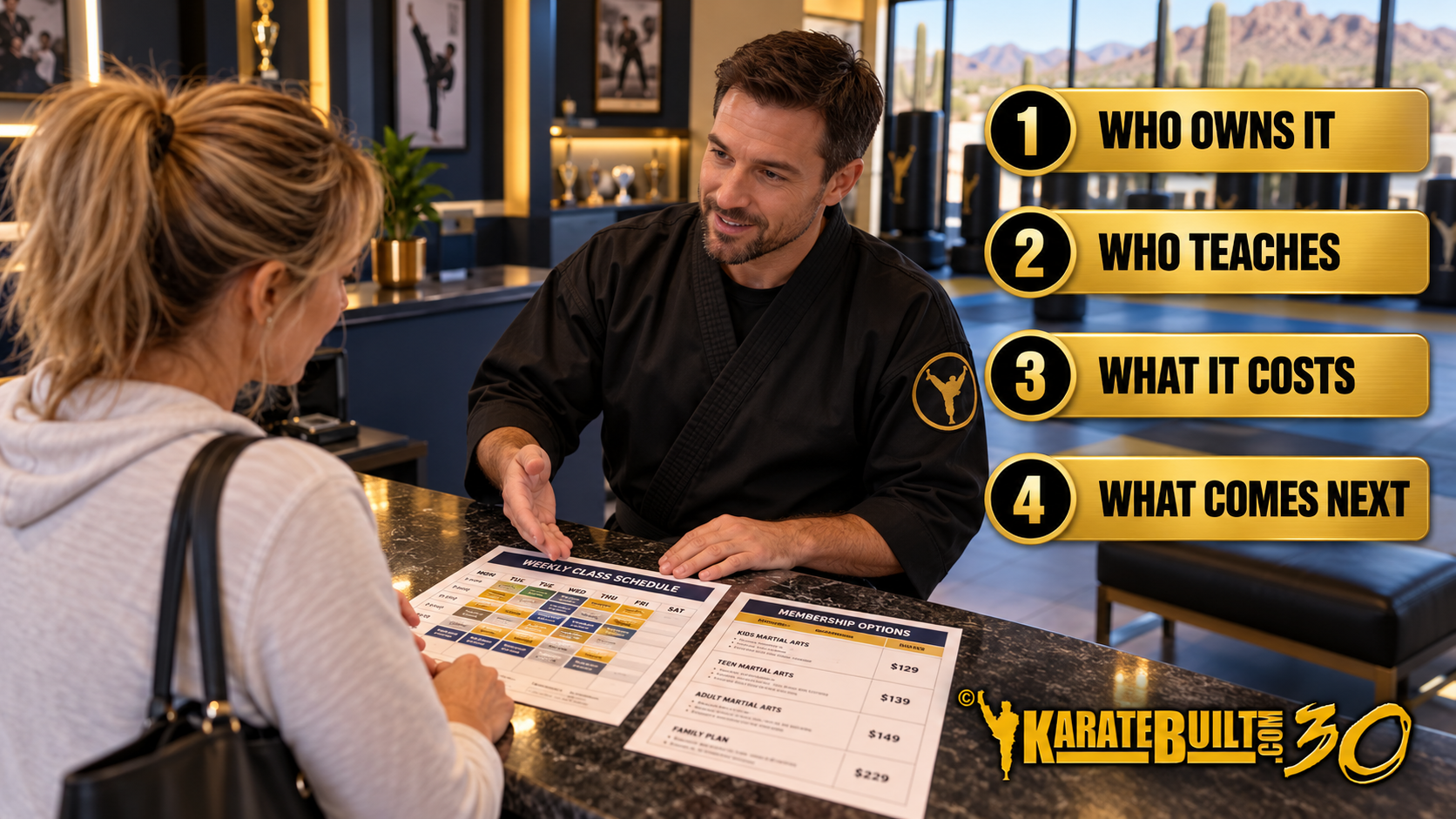
Ask every school these four questions, and listen for clear, specific answers.
“Who will teach my child every week, and what training have they completed?” Get a name. Ask how long that person has taught at this school and what certification they hold.
“Who owns this school, and how often are they on the floor?” You want to know who is accountable and whether you can reach them.
“What does my child have to show to earn the next belt?” Listen for real standards. A belt that arrives on a calendar schedule regardless of skill tells you something.
“What will this cost in total, in writing, including testing fees, gear, and contract terms?” A good school will put every number on paper without hesitation.
Ask all four at every school, including ours. I mean that. A school that welcomes these questions is usually a school worth considering. For a longer checklist, read How to Choose a Martial Arts School.
How is an owner-operated school different?
In an owner-operated school, the person who owns the business is also the person teaching, so decisions and accountability sit in the same room as your child.
Here is our own situation, so you can apply the four questions to us. I founded KarateBuilt in 1995 and still own it. We teach Songahm Taekwondo, the style of the American Taekwondo Association, which you can read about on our taekwondo classes in Cave Creek page. Our full-time certified instructors complete well over 300 hours of supervised training, and our Chief Instructor is Master Laura Sanborn. We don’t charge belt testing fees.
The strength of an owner-operated school is speed and accountability. When a lesson isn’t working for a child, the person who can change it is standing right there. The trade-off is that the school depends heavily on the quality of that one owner. There’s no corporate office to call if the owner falls short.
That’s exactly why the four questions matter more than the sign. Whether you’re in Cave Creek or North Phoenix, the right school is the one that answers them well. If you’re still sorting out the local options, I compared program types in Cave Creek Karate: Why One Search Brings Up Two Very Different Programs.
Frequently Asked Questions
Is a franchise martial arts school worse than an independent one?
No. A franchise can bring consistent curriculum and required instructor training, and an independent school can offer more flexibility, so judge each school by its instructors and its answers to the four questions.
How do I find out who owns a school?
Ask at the front desk first. In Arizona, you can also look up a business on the Arizona Corporation Commission’s public entity search, which lists the officers or members of registered companies.
What instructor credentials should I ask about?
Ask about rank, years teaching children, the specific instructor certification they hold, and safety training such as CPR and first aid. Then watch them teach a class.
Who owns and teaches at KarateBuilt in Cave Creek?
I founded and own KarateBuilt, and I teach alongside our Chief Instructor, Master Laura Sanborn, and our certified instructor team. Families from Cave Creek and North Phoenix are welcome to ask us all four questions in person.
Here is your next step. Write the four questions on your phone and ask them at every school you visit, including ours at KarateBuilt Martial Arts, 29850 N. Tatum Blvd., Suite 105, Cave Creek, AZ 85331. New students start with two weeks FREE plus a free uniform, a $199 value. Call or text (602) 737-2098 and bring your questions.
Chief Master Greg Moody, Ph.D. holds a doctorate in Special Education, is a licensed psychotherapist (LAC), and is an 8th Degree Black Belt with over 30 years of experience teaching children. He has been recognized as the nation’s #1 martial arts school owner eight times.
Sincerely,
Ch. Master Greg Moody, Ph.D.
P.S. Get Dr. Moody’s Book on Bullying – Click Here
KarateBuilt L.L.C. was founded in 1995 by Dr. Greg Moody, an 8th-degree Black Belt and Chief Master Instructor, KarateBuilt Martial Arts and Karate for Kids offer lessons for pre-school children ages 3-6 and elementary age kids ages 7 and up are designed to develop critical building blocks kids need – specialized for their age group – for school excellence and later success in life.
KarateBuilt Martial Arts Adult Karate training is a complete adult fitness and conditioning program for adults who want to lose weight, get (and stay in shape), or learn self-defense in a supportive environment.
Instructors can answer questions or be contacted 24 hours of the day, 7 days a week at 866-311-1032 for one of our nationwide locations. You can also visit our website at KarateBuilt.com.
About Dr. Greg Moody: Dr. Moody is an eighth-degree black belt and chief master instructor. He has a Ph.D. in Special Education from Arizona State University (along with a Master’s Degree in Counseling and a Bachelor’s Degree in Engineering – he actually is a rocket scientist). He has been teaching martial arts for over 25 years and has owned eight martial arts schools in Arizona and California. Chief Master Moody is a motivational speaker and educator and teaches seminars in bullying, business, and martial arts training, around the world. See more at DrGregMoody.com.
Dr. Moody is also a licensed psychotherapist and maintains a practice at Sheade Therapywhere he specializes in couples therapy and men’s issues.
The KarateBuilt Martial Arts Headquarters at KarateBuilt LLC is in Cave Creek, Arizona at 29850 N. Tatum Blvd., Suite 105, Cave Creek AZ 85331. You can locate the Chief Instructor, Master Laura Sanborn there directly at (480) 575-8171. KarateBuilt Martial Arts serves Cave Creek, Carefree, Scottsdale, and Paradise Valley Arizona as well as Grand Rapids, MI.