Why do the easiest things to compare tell me the least?
Most parents narrow their shortlist using price and drive time. Both are easy to find on a website, and neither one predicts whether your child will still be training in three years or whether they’ll quit after two months.
Price tells you what a school charges. It tells you nothing about who teaches your child, what happens after the free trial ends, or what a graduate of that program actually looks like. Drive time tells you how convenient the parking lot is. It tells you nothing about whether the instructor on the floor has any training in how children develop.
The nine questions below are harder to answer from a website. You’ll need to ask them directly, in person, and watch how the school responds. A school with nothing to hide will answer all nine without hesitation, whereas school that dodges two or three of them just told you something important.
Use this list on every school you’re considering, including mine. A school that can’t stand up to these questions isn’t worth your child’s time, and I’d rather you find that out now than eight months in.
Come visit KarateBuilt in Cave Creek and ask us every one of these questions in person. Bring the list.
Who is actually on the floor with my child, and how long have they been here?
This question matters more than any credential on the wall. You want to know the name and tenure of the specific adult who will correct your child’s form, manage their frustration, and shape their first experience of the sport.
A good answer names a person, states how long they’ve worked at that school, and explains their role in plain terms. “Sarah has been our lead instructor for six years, and she’ll be running your child’s class” is a good answer.
A bad answer is vague: “Our instructors are all certified” without naming anyone, or a staff list with heavy turnover every few months. High instructor turnover is one of the strongest predictors of a program that won’t feel consistent for your child.
What training does the instructor have in child development specifically?
A black belt teaches technique. It does not teach someone how a six-year-old’s attention span works or how to redirect a frustrated four-year-old without a power struggle. Those are different skill sets, and both matter.
A good answer describes specific training beyond the belt: coursework, certifications, or a background in education, coaching, or child psychology. It should sound less like a marketing line and more like an actual credential you could look up.
A bad answer treats martial arts rank as if it automatically qualifies someone to teach small children. Rank tells you about technical skill. It doesn’t tell you whether that person knows how to work with a five-year-old who’s having a rough day.
What happens after the intro period ends?
Every school looks great during the trial. The real test is what class looks like once the introductory offer runs out and your child becomes a regular student instead of a prospect.
A good answer walks you through the actual structure: what a typical month looks like, how progress is tracked, how often your child gets individual feedback. Ask to observe a regular class, not just a trial class, and see if the energy matches.
A bad answer is a shrug or a redirect back to the trial pricing. If a school can’t clearly describe life after the honeymoon period, that’s usually because the honeymoon period is where most of the effort goes.
This is exactly the kind of question worth asking in person. Schedule a visit and sit in on a regular class, not just an intro session.
What does a student look like three years in?
This question cuts through the sales pitch faster than almost any other. A school with a real long-term program can describe, in detail, what a three-year student is capable of.
A good answer is specific: belt rank ranges, physical skills, leadership roles like helping teach younger students, and often examples of actual students who started young and stuck with it. Ask to meet one of them.
A bad answer is generic, something like “they get really good at karate” with no detail. A school that can’t paint a clear picture of year three probably hasn’t kept many students that long.
What is the total first-year cost, including everything?
Sticker price rarely tells the whole story. Uniforms, belt testing fees, tournament costs, equipment, and required gear can add hundreds of dollars on top of monthly tuition.
A good answer gives you a full number, in writing, if possible, that includes every recurring and one-time cost for a full year. You should be able to compare that total number directly against another school’s total number.
A bad answer quotes only the base monthly rate and gets vague about testing fees or equipment costs. Ask directly: “What is the total I should expect to spend in the first twelve months?” A school that respects your time will just tell you.
What happens when my child has a hard week?
Every child has an off week: a bad day at school, a tantrum in class, a stretch where they don’t want to go. How a school handles that moment says more about its culture than almost anything else.
A good answer describes a specific approach: how instructors de-escalate frustration, how they communicate with parents, and how they keep a hard week from turning into a dropped student. Ask for an example of a real situation.
A bad answer is dismissive, something like “we just have them sit out” or no real answer at all. A child’s hard week is exactly when a well-trained instructor earns their value, and a school that hasn’t thought about this hasn’t thought hard enough about kids.
How are classes grouped by age and ability?
This connects directly to whether your child will actually thrive, not just attend. A four-year-old and a nine-year-old have different attention spans, motor skills, and needs, and a class built for one will frustrate the other.
A good answer describes clear age bands, typically something like four to six, seven to nine, and ten and up, with class length and structure that changes at each stage. Ask what the group size and instructor ratio looks like at your child’s specific age.
A bad answer lumps a wide age range into one class “because it works out fine.” It rarely works out fine for the youngest child in that room.
What is the path after black belt?
Black belt is often sold as the finish line, but at a well-run school it’s closer to a beginning. This question reveals whether the program has any long-term thinking built in.
A good answer describes what happens next: instructor training tracks, leadership opportunities, advanced curriculum, or a path to teaching younger students. It should sound like a real program, not an afterthought.
A bad answer treats black belt as the end of the relationship, with nothing meaningful planned beyond it. If a school hasn’t thought past the black belt test, they likely haven’t thought much about keeping a student engaged for the years leading up to it either.
What happens if we need to pause?
Life happens. Families move, kids get busy with other activities, budgets shift for a season. How a school handles a pause tells you whether they see your family as a person or a contract.
A good answer describes flexible options: a hold on the account, a reduced rate, or an easy way to return later without penalty or pressure.
A bad answer locks you into rigid, punishing contract terms with no room for real life. Ask to see the actual cancellation and pause policy in writing before you sign anything.
Ask this one before you enroll anywhere, not after. Contact us and we’ll walk you through our policy in plain language, no fine print surprises.
What should I stop paying attention to?
Three things get outsized weight from parents and predict almost nothing about outcomes: facility newness, ad frequency, and discount depth.
A brand-new building with fresh paint feels impressive, but a mat and a qualified instructor teach your child, not the lobby furniture. Some of the best programs run in modest spaces with instructors who have been perfecting their craft for decades.
A school that advertises constantly isn’t necessarily better than one that relies on word of mouth. Marketing budget and teaching quality are two completely separate things, and a heavy ad presence often just means a bigger marketing budget, not a better program.
A steep discount can be a genuine value, or it can be a sign of a school working hard to fill seats because retention is weak. Judge the value of what’s being taught, not the size of the number crossed out next to the price.
What should I do with this list?
Bring these nine questions to every school on your shortlist, ask them out loud, and write down the answers. The differences will become obvious fast.
A school confident in its program will welcome every one of these questions. A school that gets defensive or vague already told you what you need to know.
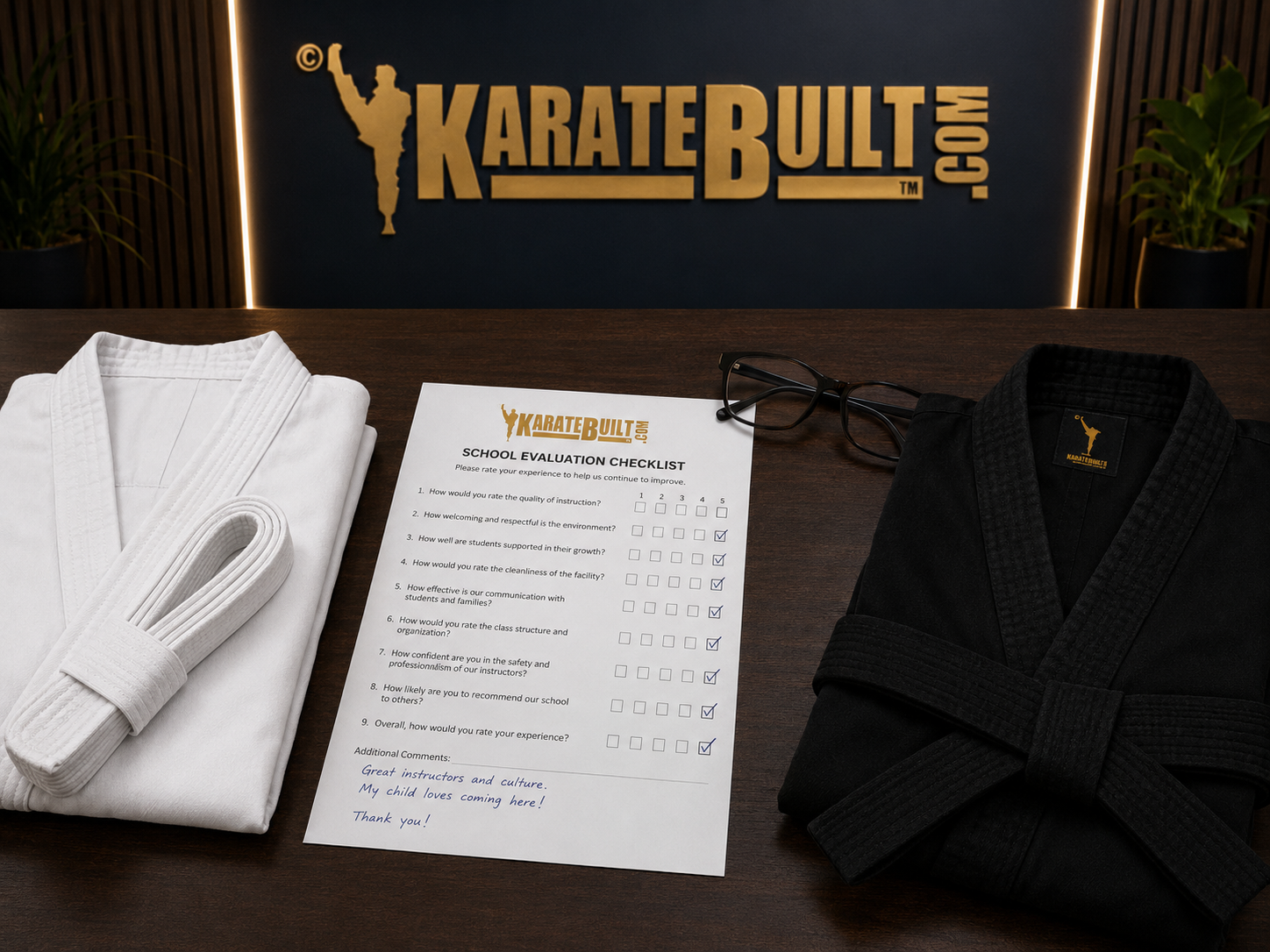
Request our printed checklist version of these nine questions to bring with you on every school visit, including ours. Come see KarateBuilt in Cave Creek and ask us anything on this list. We’ll answer all nine, in person, no script.
Chief Master Greg Moody, Ph.D. holds a doctorate in Special Education, is a licensed psychotherapist (LAC), and is an 8th Degree Black Belt with over 30 years of experience teaching children. He has been recognized as the nation’s #1 martial arts school owner eight times.
Sincerely,
Ch. Master Greg Moody, Ph.D.
P.S. Get Dr. Moody’s Book on Bullying – Click Here
KarateBuilt L.L.C. was founded in 1995 by Dr. Greg Moody, an 8th-degree Black Belt and Chief Master Instructor, KarateBuilt Martial Arts and Karate for Kids offer lessons for pre-school children ages 3-6 and elementary age kids ages 7 and up are designed to develop critical building blocks kids need – specialized for their age group – for school excellence and later success in life.
KarateBuilt Martial Arts Adult Karate training is a complete adult fitness and conditioning program for adults who want to lose weight, get (and stay in shape), or learn self-defense in a supportive environment.
Instructors can answer questions or be contacted 24 hours of the day, 7 days a week at 866-311-1032 for one of our nationwide locations. You can also visit our website at KarateBuilt.com.
About Dr. Greg Moody: Dr. Moody is an eighth-degree black belt and chief master instructor. He has a Ph.D. in Special Education from Arizona State University (along with a Master’s Degree in Counseling and a Bachelor’s Degree in Engineering – he actually is a rocket scientist). He has been teaching martial arts for over 25 years and has owned eight martial arts schools in Arizona and California. Chief Master Moody is a motivational speaker and educator and teaches seminars in bullying, business, and martial arts training, around the world. See more at DrGregMoody.com.
The KarateBuilt Martial Arts Headquarters at KarateBuilt LLC is in Cave Creek, Arizona at 29850 N. Tatum Blvd., Suite 105, Cave Creek AZ 85331. You can locate the Chief Instructor, Master Laura Sanborn there directly at (480) 575-8171. KarateBuilt Martial Arts serves Cave Creek, Carefree, Scottsdale, and Paradise Valley Arizona as well as Grand Rapids, MI.