Screen Time and the Growing Body: What Eight Hours of Sitting Does to a Child
October 2, 2026 by Chief Master Greg Moody, Ph.D.
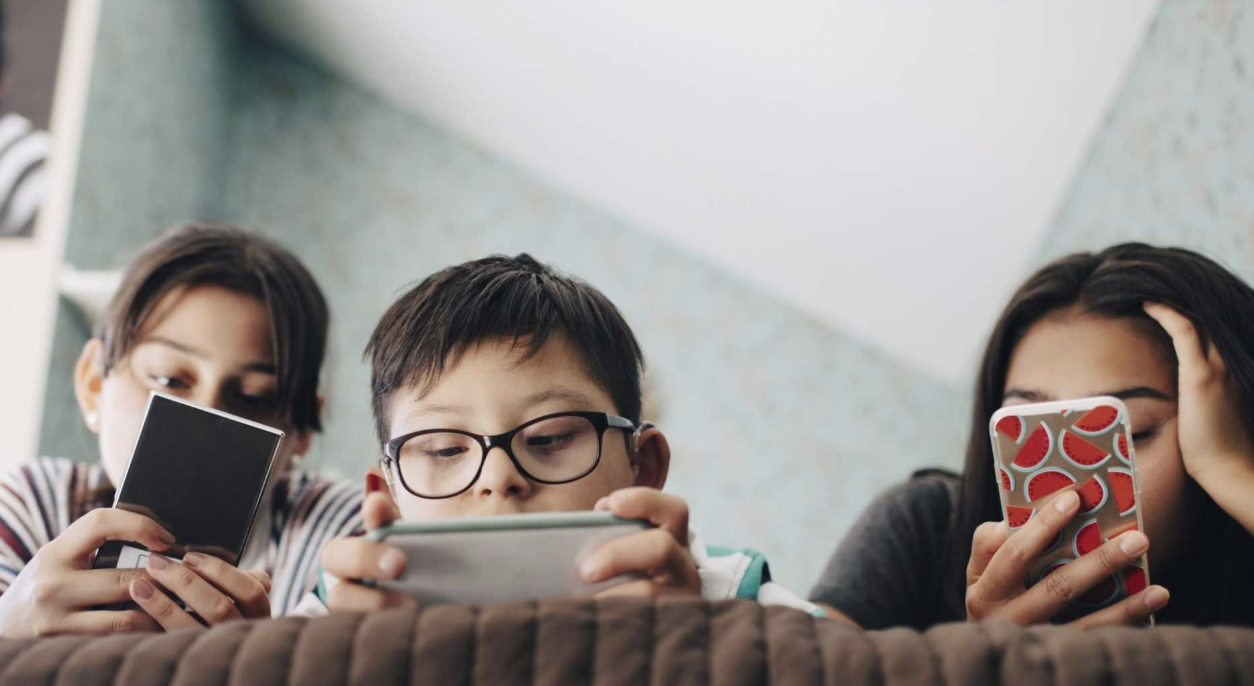
It’s 4:15 on a weekday afternoon. Your child is on the couch with a tablet, and you already know how the next hour goes.
You’ve tried timers. You’ve tried charts on the fridge, screen-free Sundays, and taking the device away for a week. Every one of them worked for a little while. Every one of them turned into an argument.
You don’t need me to tell you screens are a problem. You need a better answer than another rule you have to enforce every single day.
I have one. It starts with looking at the problem from a different angle.
What are the real screen time effects on children?
The biggest screen time effect on children is the movement that screen time pushes out of the day.
Most of the debate at home is about the screen itself: what’s on it, how long, how late. Those questions matter. From where I stand, though, the physical cost shows up in the movement a child misses during those hours. An afternoon on the couch is an afternoon their muscles, bones, lungs, and heart went without work.
Researchers call this displacement. Every hour has room for one main activity. When the screen takes the hour, running, climbing, jumping, and wrestling with a sibling lose it.
Count a typical day. The ride to school, six hours in a school seat, the ride home, homework at the table, then the screen. For plenty of kids, that adds up to eight hours of sitting or more before dinner.
What does the research show as kids get older?
Long-term tracking shows physical activity and sleep falling while recreational screen time climbs through the elementary years.
A 2026 study in the journal Sleep Medicine followed more than 2,000 Australian children from ages 4 and 5 into ages 12 and 13. As a group, the kids moved less and slept less each year, while their recreational screen time went up. (Nikooharf Salehi et al., 2026)
The researchers sorted the children into four patterns. Roughly 30 percent held onto healthy habits. The rest showed a steady decline, a steep decline, or the least favorable mix of all three. Boys, kids with a higher BMI, and kids with less access to outdoor space were more likely to land in the rougher groups.
Two things stand out to me. First, the three habits moved together. Second, the slide happened across the same ages when most of our students start training. Six to twelve is when the pattern gets set.
What does a sedentary lifestyle do to a growing body?
A kids sedentary lifestyle robs the body of the load it needs to build strong bones, muscles, and sleep patterns during the years it grows fastest.
Before I ever opened a school, I worked as an aerospace engineer. Much of that job was about load. We designed every structure around the forces it would carry, and the forces shaped the design. A child’s body follows a similar rule. It builds itself around the demands you put on it.
Here is what I see when those demands disappear.
Bones. Growing bones get stronger when they’re loaded by running, jumping, and landing. The CDC calls these bone-strengthening activities and recommends them at least three days a week for school-age kids.
Muscles and posture. Hours in a chair and on a couch shorten the hips and round the shoulders forward. Kids who spend their afternoons that way often come to their first class unable to hold a simple horse stance for thirty seconds.
Sleep. A body that hasn’t worked all day has a hard time winding down at night. Add the glow of a screen close to bedtime, and you get the late, restless nights the Australian study tracked.
Attention and mood. In my work in special education and counseling, I’ve watched fidgeting, short tempers, and poor focus ease once a child gets a real daily outlet. A body that moves hard in the afternoon settles better in the evening.
How much physical activity do kids need in 2026?
The current CDC guideline for children ages 6 to 17 is at least 60 minutes of moderate-to-vigorous physical activity every day. (CDC)
Within that hour, the CDC asks for three specific things. Vigorous activity that gets the heart pounding, at least three days a week. Muscle-strengthening work, at least three days a week. Bone-strengthening work like jumping and running, at least three days a week.
Only about one in five American kids meets the daily target. (Healio)
That gap is exactly where the afternoon screen lives.
Why do screen time rules keep turning into fights?
Screen rules take something away and leave an empty hour behind, and an empty hour fills back up with the easiest thing in the house.
My doctorate is in special education. One of the first things you learn in that field is how to change a behavior that isn’t working. You teach a replacement behavior. You give the child something specific to do in place of the old habit. A gap left empty gets filled by the old habit almost every time.
Screen limits work the same way. Take the tablet at 4:00, and your child spends 4:01 negotiating, sulking, or hunting for another screen. You end up as the enforcer, and the enforcer loses a lot of afternoons.
Replace the hour, and the argument has nothing to hold onto. Your child can’t be on a tablet while they’re somewhere else doing something harder and more interesting.
How does martial arts replace screen time?
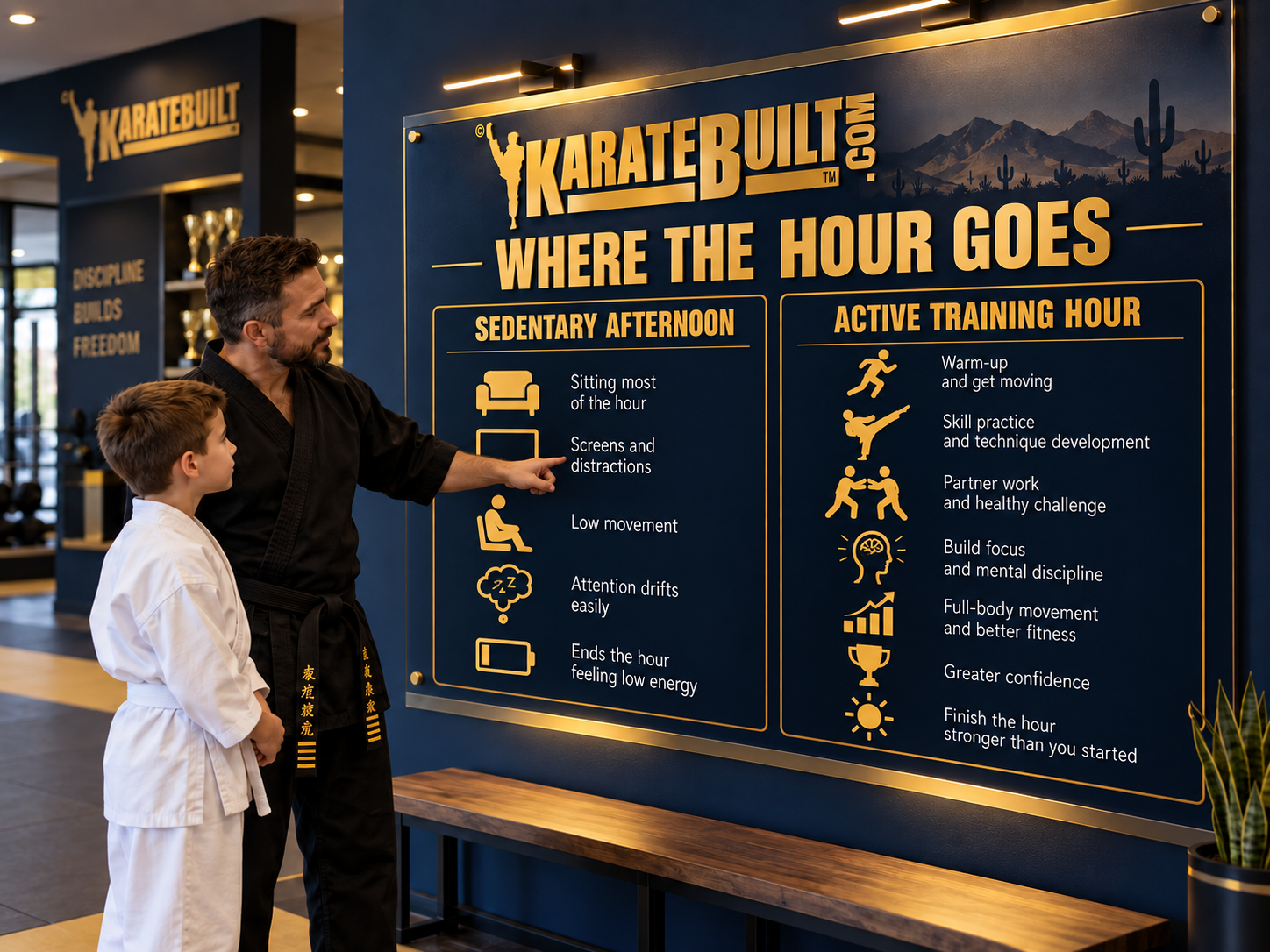
A martial arts class takes a full afternoon hour and fills it with the exact kinds of movement the CDC recommends, in a place where screens stay out.
Look at what one class at our school covers.
Vigorous activity. Drills, footwork, and pad work get the heart rate up fast and keep it there.
Muscle strength. Stances, push-ups, core work, and holding positions build strength using a child’s own body weight.
Bone strength. Kicks, jumps, and landings put healthy load through the legs and hips.
Focus. For the whole hour, your child’s attention is on an instructor, a partner, and their own body. The phone stays in the bag. The uniform goes on, and the screen world waits outside.
Then there’s the part parents tell me about most. Kids who train in the afternoon come home tired in a good way. They eat dinner. They fall asleep. The bedtime fight about one more video tends to fade on its own, because the body is ready to rest.
The conversation at home changes too. You get to be the parent who drives them to the thing they look forward to.
Does one hour a few times a week really make a difference?
Yes. Two or three classes a week moves a child from mostly sitting to regularly training, and that shift compounds over the growing years.
The Australian study showed the slide happening slowly, year by year. The fix works the same way. A child who trains a few afternoons a week for a few years builds strength, habits, and sleep patterns they carry into their teens.
You won’t win every afternoon. You only need to win a few of them on purpose, on a schedule, somewhere a screen can’t follow.
What’s the first step?
Book a trial class at our school and pick one afternoon hour to give back to your child’s body.
Look at your week. Find the hour that usually goes to the couch and the tablet. Tuesday at 4:30 or Thursday at 5:00, whatever it is in your house.
Then call the school and book a trial class for that exact slot. Bring your child in comfortable clothes. We’ll handle the rest, and you can watch from the side as that hour goes to work.
Sincerely,
Chief Master Greg Moody, Ph.D. holds a doctorate in Special Education, is a licensed psychotherapist (LAC), and is an 8th Degree Black Belt with over 30 years of experience teaching children. He’s taught over 18,000 students, over 1,800 of them Black Belts. He has been recognized as the nation’s #1 martial arts school owner eight times, and he’s a four-time #1 Amazon Bestselling Author.
P.S. Get Dr. Moody’s Book on Bullying – Click Here
KarateBuilt L.L.C. was founded in 1995 by Dr. Greg Moody, an 8th-degree Black Belt and Chief Master Instructor, KarateBuilt Martial Arts and Karate for Kids offer lessons for pre-school children ages 3-6 and elementary age kids ages 7 and up are designed to develop critical building blocks kids need – specialized for their age group – for school excellence and later success in life.
KarateBuilt Martial Arts Adult Karate training is a complete adult fitness and conditioning program for adults who want to lose weight, get (and stay in shape), or learn self-defense in a supportive environment.
Instructors can answer questions or be contacted 24 hours of the day, 7 days a week at 866-311-1032 for one of our nationwide locations. You can also visit our website at KarateBuilt.com.
About Dr. Greg Moody: Dr. Moody is an eighth-degree black belt and chief master instructor. He has a Ph.D. in Special Education from Arizona State University (along with a Master’s Degree in Counseling and a Bachelor’s Degree in Engineering – he actually is a rocket scientist). He has been teaching martial arts for over 25 years and has owned eight martial arts schools in Arizona and California. Chief Master Moody is a motivational speaker and educator and teaches seminars in bullying, business, and martial arts training, around the world. See more at DrGregMoody.com.
The KarateBuilt Martial Arts Headquarters at KarateBuilt LLC is in Cave Creek, Arizona at 29850 N. Tatum Blvd., Suite 105, Cave Creek AZ 85331. You can locate the Chief Instructor, Master Laura Sanborn there directly at (480) 575-8171. KarateBuilt Martial Arts serves Cave Creek, Carefree, Scottsdale, and Paradise Valley Arizona as well as Grand Rapids, MI.