

In-School Karate vs. a Dedicated Martial Arts School: What Fall Registration Won’t Tell You
A Parent’s Guide to Comparing Rec Programs and Dedicated Schools Before You Enroll
Fall registration is open, and every parent scrolling through the school activity sheet right now is facing the same choice. Check the box for the in-school karate elective that meets once a week in the gym, or drive across town to a dedicated martial arts school with mats, mirrors, and a belt system. Both options get marketed as “karate,” and both promise confidence, discipline, and focus. But they are not the same product, and no one has laid out an honest, evidence-based comparison of what a parent is actually signing up for. That’s what this post does.
Two Different Things Wearing the Same Uniform
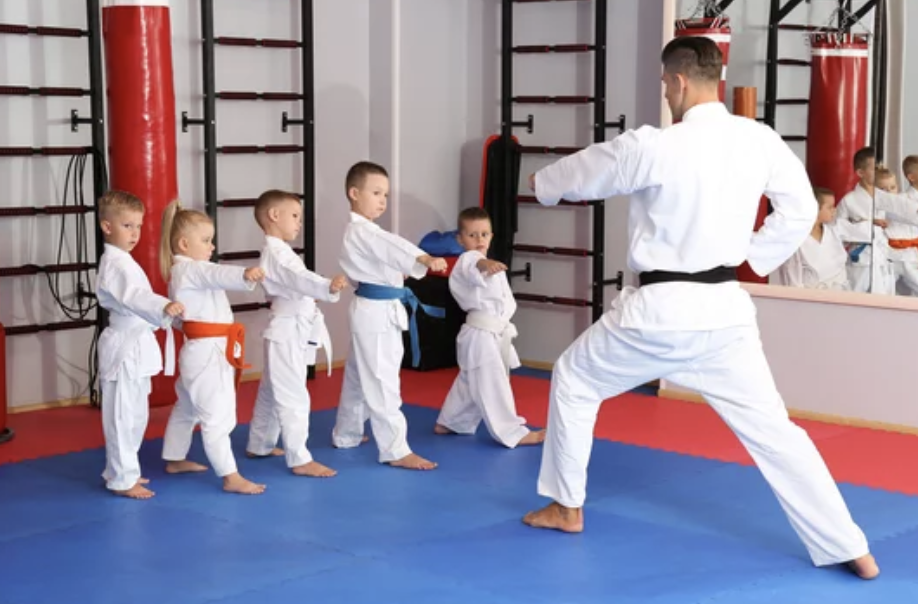 An in-school or after-school karate program is usually a recreational add-on. A school district, YMCA, or park program contracts with an instructor (sometimes a martial artist, sometimes a PE teacher or aide who took a weekend certification) to run a karate-themed activity once or twice a week for a semester. The goal is enrichment and supervised movement during the after-school window. It often ends when the semester ends, with no requirement or invitation to continue.
A dedicated martial arts school is a standalone academy built around a single purpose. Classes run multiple days a week, year-round, under instructors whose full-time job is teaching that art. Students train inside a ranking system that carries from one belt to the next, often across several years, with testing standards, a full technical curriculum, and a coaching relationship that deepens over time.
The uniform looks similar. The structure underneath it does not.
What the Instructor Actually Knows
Here’s a detail most parents never think to ask about: martial arts instruction has no federal licensing requirement in the United States. Anyone can rent a room, call it a dojo, and start charging tuition. One industry analysis of the field summed up the problem bluntly, noting that almost anyone can open a facility, brand it as a martial arts school, and teach whatever curriculum they choose without oversight (Dojo Practice, 2026). This gap matters, because it means the credential behind the person teaching your child counts for more than the sign on the door.
In a typical in-school or rec-center program, staffing requirements are built for general youth supervision, not martial arts mastery. A posted requirement for a YMCA martial arts instructor role, for example, asks for a high school diploma, one year of experience teaching youth in a structured setting, and a martial arts certification “beyond belt rank” (YMCA of Greater New York, n.d.). That’s a reasonable bar for a recreational activity. It is not the same bar as a full-time black belt instructor who has spent years under a chief instructor learning curriculum design, age-appropriate progressions, and classroom management specifically for martial arts.
Dedicated schools aren’t automatically better on this front. The same lack of licensing that lets a rec program hire a weekend-certified instructor also lets a low-quality dojo hand out belts for cash. Martial artists have a name for this: a “McDojo,” a school where rank is sold rather than earned, sparring is an afterthought, and the curriculum has no real depth (Haito Karate, 2025). The way to tell the difference isn’t the price tag or the size of the sign. It’s asking direct questions: who certified this instructor, how long have they trained, and what does a student have to demonstrate to earn the next belt.
 What the Research Actually Shows
Comparisons get a little lazy here. They wave at “studies show martial arts helps kids” without saying which kind of program, how often, or for how long. The actual research is more specific, and more useful, than that.
A widely cited study published in the Journal of Applied Developmental Psychology placed elementary school children into a structured martial arts program (called LEAD for Leadership Exploration and Development) and compared them to children in standard PE classes (Lakes & Hoyt, 2004). The martial arts group showed significantly greater gains in self-regulation, particularly in cognitive and emotional control, than the PE comparison group (Lakes & Hoyt, 2004). The researchers were careful to note something important: prior martial arts research had mostly studied at-risk or already-delinquent kids. This study used random assignment with typically developing children, which made the results harder to dismiss as a fluke of who chooses to enroll (Lakes & Hoyt, 2004).
A 2022 randomized trial out of the University of Surrey, published in Developmental Psychology, tested this further (University of Surrey, 2022). Researchers split 240 primary school students into a taekwondo group and a standard PE group, running two 45-minute sessions a week for eleven weeks (University of Surrey, 2022). The taekwondo group showed measurable improvements in self-regulation and a reduction in conduct problems compared to the control group (University of Surrey, 2022).
A systematic review of the broader literature found consistent evidence that martial arts training supports self-control, emotion regulation, and social skill development in children, alongside gains in gross motor competence like balance and coordination (Systematic Review, 2022). A separate meta-analysis of child and youth studies found that martial arts training was associated with reduced aggression and improved attentional self-control, with some of the clearest results showing up in school-based programs targeting behavior (Aggression Meta-Analysis, 2017).
Here’s the honest caveat parents deserve: several of these strongest studies were themselves school-based interventions, delivered by trained instructors running a structured curriculum for a defined period. The research supports martial arts training generally when it’s consistent, instructor-led, and built around a real curriculum. It does not automatically support any activity labeled “karate,” regardless of who’s teaching it or how often it meets.
This distinction is the whole ballgame. A once-a-week semester elective with a rotating instructor is a different dose than three classes a week for three years under one coach tracking a child’s progress belt by belt. The studies above tested something closer to a structured, curriculum-driven program, which is the model a dedicated school is built to deliver every week of the year, not just for one semester.
Frequency, Continuity, and What Actually Compounds
Character development doesn’t happen in a single class. It compounds, the same way strength or vocabulary does, through repetition spaced out over months and years.
An in-school program typically runs for a semester and stops. When it starts again, a child may be relearning the same introductory material with a different instructor, because enrollment resets every term and staffing turns over with school schedules. There’s rarely a rank to protect, a testing cycle to prepare for, or a coach who remembers what a student struggled with last spring.
A dedicated school is structured around continuity. A white belt earning a yellow belt eight weeks in isn’t just learning a new kick. They’re learning that effort produces a visible, tracked result, and that the same instructor who watched them fail the first attempt is the one who signs off when they finally land it. That loop, of effort, feedback, and earned progress from one person over time, is the mechanism behind most of the confidence and discipline gains parents actually want. It requires the frequency and the consistency that a once-a-week semester program isn’t built to provide.
Class Size, Supervision, and Safety
Supervision ratios matter for both safety and the quality of correction a child receives. A rec-based karate elective is often run at a ratio built for general childcare or PE, sometimes twenty or more kids to one instructor, with the instructor also managing behavior, transitions, and logistics that have nothing to do with technique.
A dedicated school builds its ratios around teaching a physical skill safely. Contact drills, falling, and partner work all require closer supervision than a group calisthenics session. Ask any program, in-school or dedicated, what their student-to-instructor ratio looks like during actual sparring or partner drills, not just during warm-ups. The answer tells you a lot.
Cost and What You’re Actually Buying
In-school programs are usually cheaper. That’s a real, legitimate factor for a lot of families, but the honest way to compare cost is to compare it against what’s being delivered. A semester of one class a week, taught by rotating rec staff, without a persistent belt system, is a different product than year-round training with a dedicated instructor and a tracked curriculum. Neither is wrong. They’re just not interchangeable, and a parent choosing based on price alone deserves to know what they’re trading away.
A Short Checklist for Either Option
Whether you’re looking at the in-school flyer or a dedicated school’s fall special, ask the same five questions:
- Who is teaching, and what is their specific martial arts credential, not just their job title?
- How often does the class meet, and does that frequency continue past one semester?
- Is there a real belt or rank progression with clear testing standards, or does everyone move up together on a schedule?
- What’s the supervision ratio during partner drills and sparring, specifically?
- What happens when the semester or session ends? Is there a next step, or does the child start over?
A program that answers all five clearly is worth considering, in school or out of it. A program that dodges two or more of them is worth a second look before you sign anything.
The Bottom Line
In-school karate can be a genuinely good use of an after-school hour, and the research on structured, instructor-led martial arts training for kids is real and encouraging. Yet the studies behind those results describe something closer to what a dedicated school delivers by design: trained instructors, consistent frequency, and a curriculum that builds on itself over time, not a semester-long elective that resets every fall.
If you’re deciding this week, ask the five questions above wherever you’re considering enrolling, and if you want to see what a full, credentialed, year-round curriculum actually looks like, registration at KarateBuilt is always open.

Works Cited
Aggression Meta-Analysis. (2017). Reducing aggression with martial arts: A meta-analysis of child and youth studies. ScienceDirect. https://www.sciencedirect.com/science/article/abs/pii/S1359178917300976
Dojo Practice. (2026). Instructor certification & lineage verification in 2026. https://www.dojopractice.com/instructor-certification-lineage-verification-in-2026/
Haito Karate. (2025). 15 signs you’re in a McDojo: What to watch out for. https://haitokarate.com/15-signs-youre-in-a-mcdojo-what-to-watch-out-for/
Lakes, K. D., & Hoyt, W. T. (2004). Promoting self-regulation through school-based martial arts training. Journal of Applied Developmental Psychology, 25(3), 283-302. https://www.sciencedirect.com/science/article/abs/pii/S0193397304000309
Systematic Review. (2022). Effects of participating in martial arts in children: A systematic review. ResearchGate. https://www.researchgate.net/publication/362632228_Effects_of_Participating_in_Martial_Arts_in_Children_A_Systematic_Review
University of Surrey. (2022). Traditional martial arts can improve self-regulation in school children [Summary of study published in Developmental Psychology]. News-Medical. https://www.news-medical.net/news/20220107/Traditional-martial-arts-can-improve-self-regulation-in-school-children.aspx
YMCA of Greater New York. (n.d.). Martial arts instructor [Job posting]. https://ymcanyc.org/careers/martial-arts-instructor/rockaway-ymca
This post is for general informational purposes and reflects publicly available research as of 2026. It is not a substitute for evaluating any specific program directly.
P.S. Get Dr. Moody’s Book on Bullying – Click Here
KarateBuilt.com and KarateBuilt Martial Arts have been selected as the nation’s #1 martial arts schools for EIGHT YEARS IN A ROW!
KarateBuilt L.L.C. was founded in 1995 by Dr. Greg Moody, an 8th-degree Black Belt and Chief Master Instructor, KarateBuilt Martial Arts and Karate for Kids offer lessons for pre-school children ages 3-6 and elementary age kids ages 7 and up are designed to develop critical building blocks kids need – specialized for their age group – for school excellence and later success in life.
KarateBuilt Martial Arts Adult Karate training is a complete adult fitness and conditioning program for adults who want to lose weight, get (and stay in shape), or learn self-defense in a supportive environment.
Instructors can answer questions or be contacted 24 hours of the day, 7 days a week at 866-311-1032 for one of our nationwide locations. You can also visit our website at KarateBuilt.com.
About Dr. Greg Moody: Dr. Moody is an eighth-degree black belt and chief master instructor. He has a Ph.D. in Special Education from Arizona State University (along with a Master’s Degree in Counseling and a Bachelor’s Degree in Engineering – he actually is a rocket scientist). He has been teaching martial arts for over 25 years and has owned eight martial arts schools in Arizona and California. Chief Master Moody is a motivational speaker and educator and teaches seminars in bullying, business, and martial arts training, around the world. See more at DrGregMoody.com.
Dr. Moody is also a licensed psychotherapist and maintains a practice at Integrated Mental Health Associates (IntegratedMHA.com) where he specializes in couples therapy and men’s issues.
The KarateBuilt Martial Arts Headquarters at KarateBuilt LLC is in Cave Creek, Arizona at 29850 N. Tatum Blvd., Suite 105, Cave Creek AZ 85331. You can locate the Chief Instructor, Master Laura Sanborn there directly at (480) 575-8171. KarateBuilt Martial Arts serves Cave Creek, Carefree, Scottsdale, and Paradise Valley Arizona as well as Grand Rapids, MI.
Also, check us out on Today in Business and Educators Observer!
Here is Dr. Moody’s Amazon Author Page with over 16 of his Amazon Bestselling books: Click HERE
P.P.P.S. From a parent:
“Since joining this program, my son Herman is more disciplined, motivated, and unstoppable in every challenge he faces!” – Emily Green