Why Kids Quit Activities, and the One Thing That Predicts Whether They’ll Stay
August 4, 2026 by KarateBuilt Staff
Every parent who’s watched a child walk away from an activity they used to beg for has asked the same quiet question: was that just who my kid is, or did I miss something? After three decades of coaching thousands of children through exactly this moment, I can tell you it’s almost never the first one. There’s a specific, predictable reason kids stay or go, and once you see it, you’ll never look at a quitting decision the same way again.
What are you really afraid of when you consider starting something new?
You’re not afraid of wasting money. You’re afraid of wasting your belief in your child, and in yourself as the parent who picks the right things for them.
Your child quit soccer, or piano, or swim, and somewhere in that ending you started building a story: maybe they just aren’t a “stick with it” kid. Maybe you pushed too hard, or not hard enough. Maybe you’re about to spend another season and another few hundred dollars finding out the same thing all over again.
I want to offer you a different explanation, one I’ve watched play out with thousands of children over three decades of running a school. Your child probably isn’t a quitter. The activity probably stopped showing them they were getting anywhere. That’s a fixable problem, and it has almost nothing to do with your child’s character.
If you’re on the fence about trying something new, come watch a class at KarateBuilt in Cave Creek before you decide anything. No pressure, just a look at how we handle exactly this.
What are the four explanations parents usually land on, and which ones actually hold up?
Most parents settle on one of four stories after a child quits: the child lost interest, the child isn’t disciplined enough, the parent pushed too hard, or the activity itself wasn’t a good fit. Three of these four are usually wrong, or at least beside the point.
“My child lost interest” is often a description, not an explanation. Interest doesn’t vanish on its own. It fades when a child stops being able to see that anything is changing. Losing interest is usually a symptom, not the root cause.
“My child isn’t disciplined enough” puts the blame on the child’s character, and it’s rarely fair. Discipline is easiest to sustain when a person can see a reason to keep going. Ask an adult to run every day with no way to track pace, distance, or improvement, and watch how long their discipline lasts either.
“I pushed too hard” is a story many caring parents tell themselves, and sometimes it’s true. But more often, pushing wasn’t the problem. The activity gave the child nothing to hold onto between the pushing and the progress, so the pushing felt like pressure instead of support.
The fourth explanation, that the activity wasn’t a good fit, is the one worth taking seriously. Sometimes it really is a mismatch of interest or temperament, but before writing off an entire category of activity, it’s worth checking one thing first: did your child ever get to see their own progress in a way that felt real to them?
What does “visible progress” actually mean, and why does it matter this much?
Visible progress means a child can point to something concrete and say, “I can do that now, and I couldn’t before.” It’s the difference between growth that’s happening and growth the child can actually perceive.
Adults can sustain effort on invisible progress. A grown adult can go to the gym for eight months, see no dramatic change in the mirror, and keep showing up because they trust the process and think in terms of long-term health. That trust is built on years of understanding how effort and delayed payoff connect.
Most children can’t do that yet, and it isn’t a flaw. It’s simply where their brains are in development. A child’s sense of time is compressed. Six weeks feels like forever, and if nothing visibly changed in that time, the effort starts to feel pointless, no matter how much genuine progress happened underneath the surface.
This is why an activity with a clear, visible marker of “you got better” tends to hold a child’s engagement far longer than one where growth stays invisible until a season-ending performance or tryout. The child needs proof along the way, not just at the end.
This is exactly why we built our program around visible, earned progress at every stage, not just at the end of a season. Schedule a visit and see how we make growth visible from week one.
Is belt progression really a retention system, or is it just a marketing gimmick?
A real belt system is a retention system, not a marketing device. It exists to make effort legible to a child in a way that keeps them engaged long enough for the training to actually work.
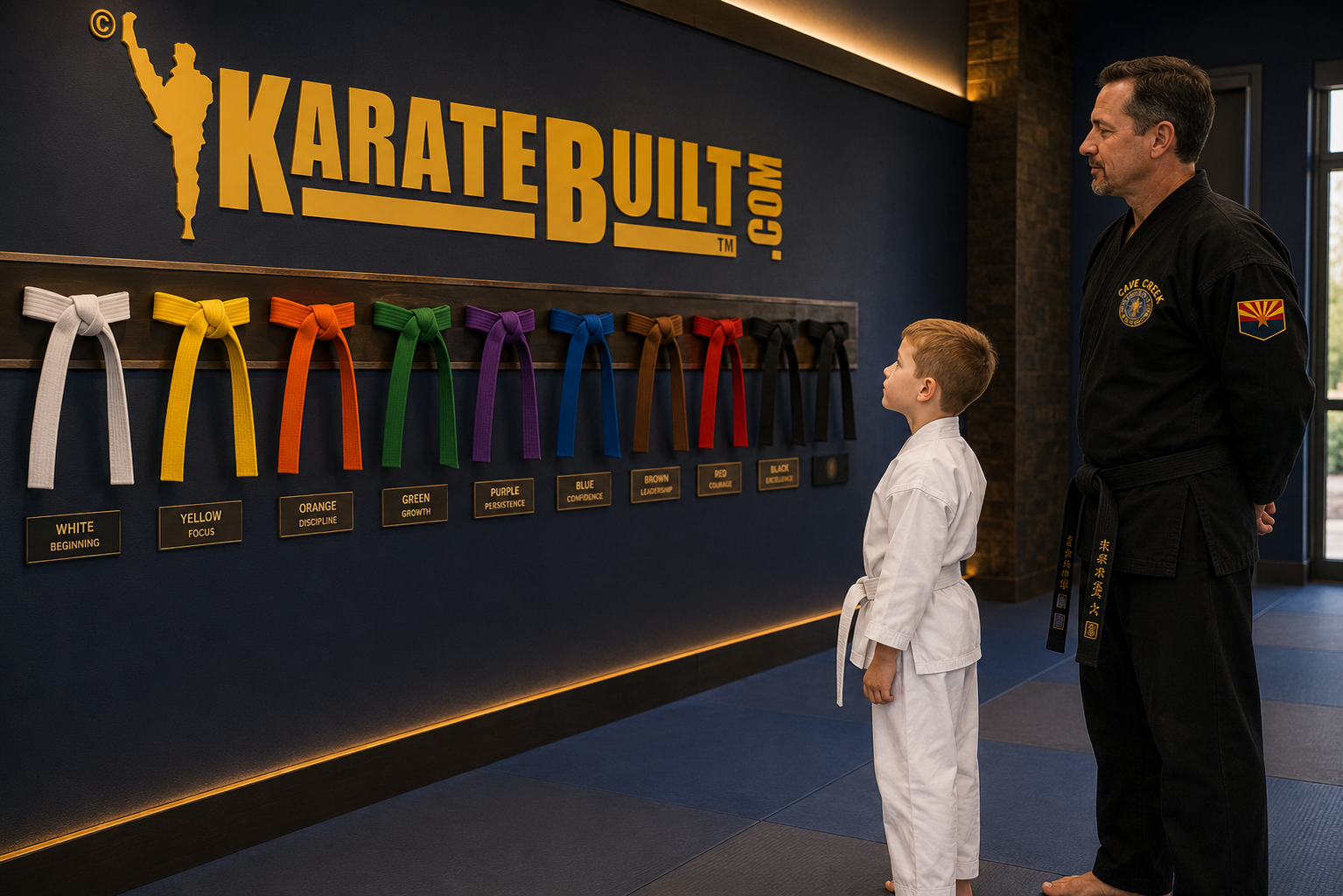
A well-run belt system breaks a long journey into small, achievable, clearly defined steps. A child doesn’t have to imagine some distant future skill. They can point to a stripe on their belt and know exactly what they earned it for and what comes next.
Here’s how to tell a real system from a hollow one. A real system ties every belt and stripe to a specific, demonstrated skill, and a child can usually tell you what they did to earn it. A hollow system hands out promotions mostly on a calendar, regardless of what was actually learned, which teaches a child that showing up matters more than growing, and eventually that message stops motivating anyone.
Ask any school directly: “What does my child have to demonstrate to earn the next belt?” A specific answer is a good sign. A vague answer, something like “they’ll get there when they’re ready,” with no clear description of what “ready” means, is worth questioning.
What can I do at home in the first six weeks of anything new?
The first six weeks are the highest-risk window for quitting, so this is exactly when a parent’s attention matters most. A few small habits at home can make a real difference in whether an activity survives past that window.
Ask specific questions instead of general ones. “What’s one thing you got better at today?” gives a child a chance to notice their own progress out loud. “How was practice?” invites a one-word answer and misses the opportunity entirely.
Notice small changes and name them. If your child’s kick looks more controlled than it did three weeks ago, say so specifically. Children often don’t recognize their own gradual improvement unless someone points it out.
Resist the urge to judge the whole activity in the first two or three sessions. Almost everything feels awkward and unfamiliar early on, for children and adults alike. Give it the same six weeks you’d want someone to give you before deciding you weren’t cut out for something new.
Keep a simple record, even an informal one. A few notes on your phone about what your child worked on each week, or a photo of a new skill, gives both of you something concrete to look back on. When a child hits a rough patch in week four, being able to show them how far they’ve already come, in specifics, can carry them through it.
Talk about effort, not just outcome. A child who hears “you worked hard on that kick and it showed” learns to associate effort itself with a payoff, which matters more in the long run than any single result. That habit of noticing effort tends to transfer well beyond whatever activity you started with.
When is quitting actually the right call?
Sometimes quitting is the right decision, and a good coach should tell you that honestly instead of trying to keep every student enrolled no matter what. There’s a real difference between a child who’s struggling through a normal adjustment period and a child who’s genuinely mismatched with an activity.
Watch for signs that go beyond ordinary early awkwardness: persistent anxiety before every single session that doesn’t ease over several weeks, physical symptoms like stomachaches tied specifically to attendance, or a complete absence of any moment of enjoyment even after progress became visible. Those are different from a bad week or two.
If a child has genuinely tried, seen real visible progress, and still shows no connection to the activity after a fair trial period, that’s meaningful information, not a failure. Some activities aren’t the right match for a particular child, and that’s fine. The goal was never to force a fit that isn’t there.
The difference between that outcome and the far more common one, quitting because progress was never made visible in the first place, is worth knowing before you decide your child “just isn’t the activity type.” Most children are. They just need to be able to see themselves getting better.
If your child has quit something before, come tell us about it. We’ll show you exactly how we make progress visible from the very first class, and you can judge for yourself whether this time might go differently.
Chief Master Greg Moody, Ph.D. holds a doctorate in Special Education, is a licensed psychotherapist (LAC), and is an 8th Degree Black Belt with over 30 years of experience teaching children. He has been recognized as the nation’s #1 martial arts school owner eight times.
Sincerely,
Ch. Master Greg Moody, Ph.D.
P.S. Get Dr. Moody’s Book on Bullying – Click Here
KarateBuilt L.L.C. was founded in 1995 by Dr. Greg Moody, an 8th-degree Black Belt and Chief Master Instructor, KarateBuilt Martial Arts and Karate for Kids offer lessons for pre-school children ages 3-6 and elementary age kids ages 7 and up are designed to develop critical building blocks kids need – specialized for their age group – for school excellence and later success in life.
KarateBuilt Martial Arts Adult Karate training is a complete adult fitness and conditioning program for adults who want to lose weight, get (and stay in shape), or learn self-defense in a supportive environment.
Instructors can answer questions or be contacted 24 hours of the day, 7 days a week at 866-311-1032 for one of our nationwide locations. You can also visit our website at KarateBuilt.com.
About Dr. Greg Moody: Dr. Moody is an eighth-degree black belt and chief master instructor. He has a Ph.D. in Special Education from Arizona State University (along with a Master’s Degree in Counseling and a Bachelor’s Degree in Engineering – he actually is a rocket scientist). He has been teaching martial arts for over 25 years and has owned eight martial arts schools in Arizona and California. Chief Master Moody is a motivational speaker and educator and teaches seminars in bullying, business, and martial arts training, around the world. See more at DrGregMoody.com.
The KarateBuilt Martial Arts Headquarters at KarateBuilt LLC is in Cave Creek, Arizona at 29850 N. Tatum Blvd., Suite 105, Cave Creek AZ 85331. You can locate the Chief Instructor, Master Laura Sanborn there directly at (480) 575-8171. KarateBuilt Martial Arts serves Cave Creek, Carefree, Scottsdale, and Paradise Valley Arizona as well as Grand Rapids, MI.