What Age Should My Child Start Karate? A Child Development Answer
July 31, 2026 by KarateBuilt Staff
What are you actually asking me?
You aren’t really asking for a number. You’re asking whether your child will succeed. You have probably already heard “any age is fine” from one school and “wait until seven” from another, and neither answer told you what you needed to know.
The real question underneath yours: will my child walk into that room and thrive, or will they freeze, act out, or beg to quit after three weeks? That outcome has almost nothing to do with your child’s birthday. It has everything to do with whether the class in front of them was built for a child their age.
A five-year-old placed in a class designed for five-year-olds lights up. The same child dropped into a class built for nine-year-olds struggles to sit still, misses instructions, and falls behind kids who aren’t more talented, just more developmentally ready for that format. The parent watches this happen and draws the wrong conclusion: “My child wasn’t ready for karate.” The truth is simpler and more fixable. The class wasn’t ready for the child.
I have spent over three decades and a Ph.D. in Special Education studying exactly this gap between a child’s stage of development and the design of the room they’re placed in. This article gives you the developmental facts, not the sales pitch, so you can judge any program with clear eyes, including mine.
If you want a firsthand look before you decide anything, come visit our school in Cave Creek. Watch a class at your child’s age level and see the fit for yourself.
What is actually developing in my child right now?
At every age, a different set of brain and body systems is doing the heavy lifting. A good karate class trains the systems that are ready and gently stretches the ones still forming. A poorly matched class demands skills your child’s brain hasn’t built yet, and that mismatch is what creates frustration, not the sport itself.
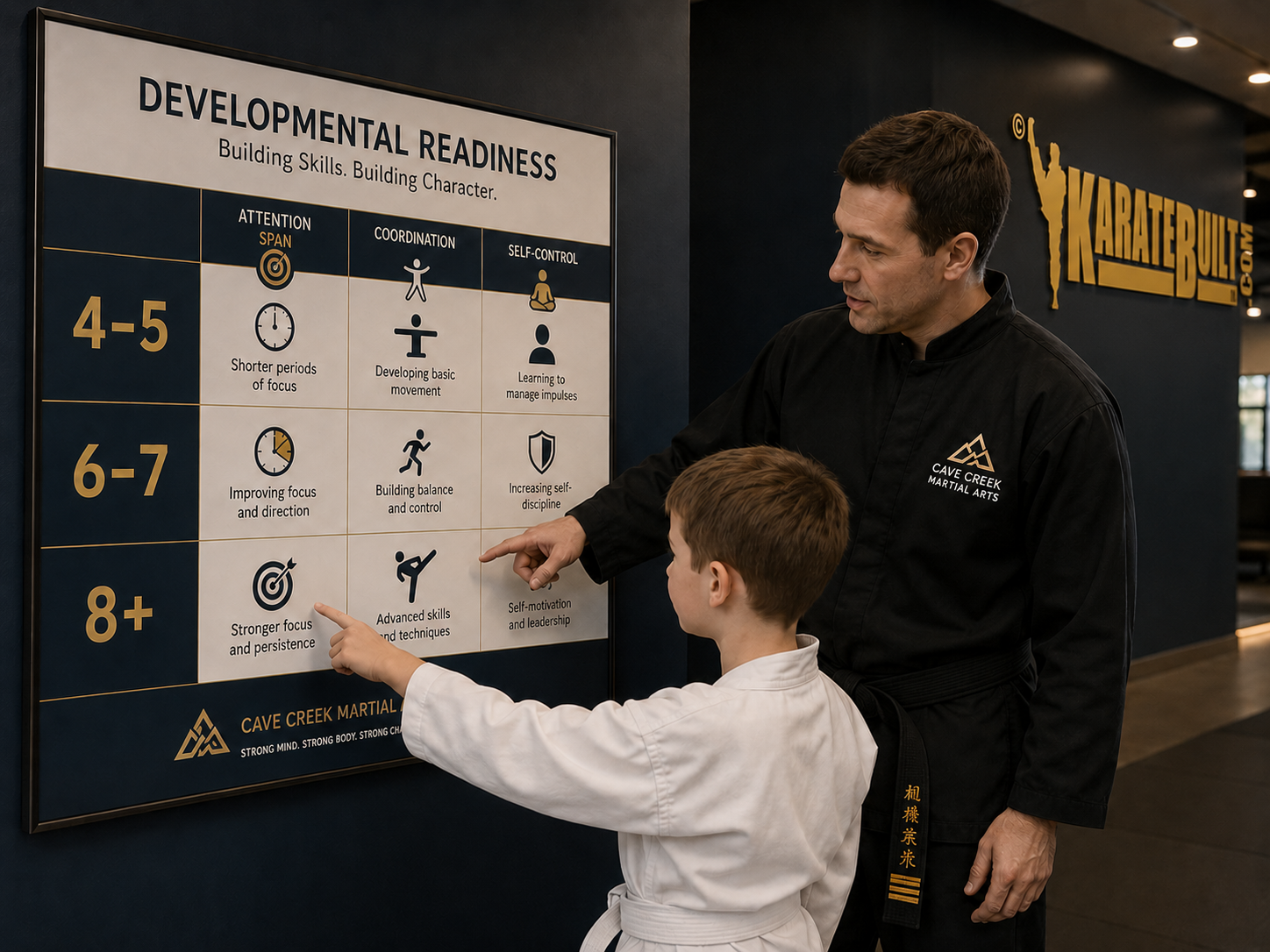
Ages 4 to 5
Attention span runs in short bursts, often two to four minutes before a child needs a new activity or a physical reset. Motor sequencing is basic: a child this age can throw one clear punch or kick but struggles to chain three or four movements together smoothly. Impulse control is still under heavy construction, which means waiting in line or standing still for thirty seconds is a genuine skill they are actively learning, not a behavior problem. Correction has to be simple, physical, and immediate. “Turn your foot this way” lands. A three-step verbal explanation does not.
Ages 6 to 7
Attention span stretches to five or eight minutes of focused work. Motor sequencing improves fast at this stage; children can now link two or three techniques into a short combination and remember the order. Impulse control is stronger but still fragile under excitement or fatigue, especially near the end of a long day. Correction can now include a short reason (“bend your knee so you don’t lose balance“), and most children can hold that instruction for the rest of class.
Ages 8 and up
ttention span extends to the length of a full class period. Motor sequencing supports longer forms and sparring combinations with multiple steps. Impulse control is developed enough to manage delayed rewards, like training for months toward a belt test. Correction can be layered and abstract, including feedback on strategy and self-assessment, not just physical position.
None of this is a judgment about intelligence or potential. It is simply what four-year-old brains and eight-year-old brains are built to do. The program has to match the brain, not the other way around.
I have watched this play out hundreds of times over the years. A parent enrolls a bright, capable four-year-old in a class designed for grade-schoolers, because it was the only option at the school they found first. Within a month, the child associates karate with sitting still and getting corrected, and the parent quietly pulls them out. Six months later, that same child joins an age-matched class and becomes one of the most enthusiastic students in the room. The child didn’t change. The fit did.
This is why I ask parents to think in terms of developmental stage first and calendar age second. A child who just turned five but shows strong impulse control and curiosity may be ready for a slightly more structured class. A child who is six but still needs constant physical redirection will do better in a shorter, activity-heavy format. The stages above are a map, not a rule.
What should a class actually look like at my child’s stage?
Ages 4 to 5
Class length should run 30 to 40 minutes, no longer. Group size should stay small, ideally 8 to 12 children per instructor, so redirection is fast and personal. The instruction-to-activity ratio should lean heavily toward activity: short bursts of teaching followed immediately by movement, games, and repetition. If a 5-year-old is sitting and listening for more than a minute at a stretch, the class is built for an older child.
Ages 6 to 7
Class length can extend to 40 to 45 minutes. Group size can grow slightly, up to 12 to 15 students, since children this age can self-manage a bit more between corrections. The instruction-to-activity ratio should still favor activity, but structured combinations and simple partner drills belong here now.
Ages 8 and up
Class length runs a full 45 to 60 minutes. Group size can expand further because attention and self-control support a more traditional format. Instruction can run longer between activity breaks, and students can handle multi-step drills, sparring concepts, and detailed technique correction.
This is exactly why we run separate curriculums by age group instead of one program for every child. Book a readiness visit and you’ll see the difference in the first ten minutes.
What are the four signs my child is ready right now?
Age is a rough guide. These four signs matter more than a birthday.
One: your child can follow a two-step instruction from an adult who isn’t you. Not perfectly, but consistently enough that a teacher, coach, or grandparent can direct them without a parent translating.
Two: your child recovers from frustration within a few minutes. Everyone gets frustrated learning something new. A ready child cries, sulks, or complains, then gets back up and tries again without a 20-minute meltdown.
Three: your child can stand in one spot for 30 seconds without physical redirection. This doesn’t mean perfectly still. It means they can hold a position with one or two reminders instead of constant hands-on correction.
Four: your child shows curiosity about the activity itself. They ask questions about karate, practice a kick in the living room, or talk about wanting to go. Interest is one of the strongest predictors of how a child handles the first few weeks.
If your child hits three or four of these, they are ready for a well-matched class today, regardless of what age is printed on a chart.
What are the three signs a program is wrong for my child’s age?
Even a great instructor can’t fix a class built for the wrong developmental stage. Watch for these three signs during any trial class.
One: the class length exceeds what your child’s age group can sustain. A 45-minute class for a 4-year-old will produce a meltdown by minute 20, and that’s a design problem, not a discipline problem.
Two: the group is too large for the number of adults in the room. One instructor with 20 four- and five-year-olds cannot give the physical, immediate correction that age group needs. Watch the ratio, not just the headline number of students.
Three: instruction relies on long verbal explanations before any movement. If a 5-year-old is asked to listen to a two-minute explanation before doing anything, most of that information is lost before the first kick happens.
If you see even one of these on a trial visit, the issue is the program’s design, not your child’s readiness.
What should I do if I’m still unsure?
Come watch, then let your child try. This is the single most reliable way to answer the readiness question, more reliable than any age chart or article, including this one.
A genuine readiness visit includes three things: you watching a class at your child’s actual age group, a conversation with an instructor about what they specifically noticed in your child, and a trial class where your child participates rather than just observes. Ten minutes into that trial, most parents already know the answer.
At KarateBuilt in Cave Creek, we built our curriculum around these exact developmental stages because a 5-year-old and an 8-year-old are not the same student wearing a smaller uniform. Our age-matched classes exist specifically so the four-year-olds you just read about get a room built for four-year-olds.
Schedule a readiness visit at KarateBuilt Martial Arts in Cave Creek. Bring your child, watch the age-matched class in action, and get a direct answer instead of another guess.
Chief Master Greg Moody, Ph.D. holds a doctorate in Special Education, is a licensed psychotherapist (LAC), and is an 8th Degree Black Belt with over 30 years of experience teaching children. He has been recognized as the nation’s #1 martial arts school owner eight times.
Sincerely,
Ch. Master Greg Moody, Ph.D.
P.S. Get Dr. Moody’s Book on Bullying – Click Here
KarateBuilt L.L.C. was founded in 1995 by Dr. Greg Moody, an 8th-degree Black Belt and Chief Master Instructor, KarateBuilt Martial Arts and Karate for Kids offer lessons for pre-school children ages 3-6 and elementary age kids ages 7 and up are designed to develop critical building blocks kids need – specialized for their age group – for school excellence and later success in life.
KarateBuilt Martial Arts Adult Karate training is a complete adult fitness and conditioning program for adults who want to lose weight, get (and stay in shape), or learn self-defense in a supportive environment.
Instructors can answer questions or be contacted 24 hours of the day, 7 days a week at 866-311-1032 for one of our nationwide locations. You can also visit our website at KarateBuilt.com.
About Dr. Greg Moody: Dr. Moody is an eighth-degree black belt and chief master instructor. He has a Ph.D. in Special Education from Arizona State University (along with a Master’s Degree in Counseling and a Bachelor’s Degree in Engineering – he actually is a rocket scientist). He has been teaching martial arts for over 25 years and has owned eight martial arts schools in Arizona and California. Chief Master Moody is a motivational speaker and educator and teaches seminars in bullying, business, and martial arts training, around the world. See more at DrGregMoody.com.
The KarateBuilt Martial Arts Headquarters at KarateBuilt LLC is in Cave Creek, Arizona at 29850 N. Tatum Blvd., Suite 105, Cave Creek AZ 85331. You can locate the Chief Instructor, Master Laura Sanborn there directly at (480) 575-8171. KarateBuilt Martial Arts serves Cave Creek, Carefree, Scottsdale, and Paradise Valley Arizona as well as Grand Rapids, MI.