What a Year of Martial Arts Actually Costs in Cave Creek (And What You Get for It)
August 27, 2026 by KarateBuilt Staff
It’s late August, and you’re staring at a spreadsheet with soccer, swim, piano, and maybe martial arts on it, trying to figure out what your family can actually afford this year.
Most martial arts schools will not give you a real annual number. You’ll get a monthly rate or a “call us for details,” but you’ll rarely get the full picture, added up, before you walk in the door.
I’ve run a school in Cave Creek for over two decades. I’ve trained thousands of kids and adults, written twenty books on martial arts and personal development, and built a program that’s been named School of the Year eight times. So let me do something most schools won’t by showing you the math.
What Does a Year of Martial Arts Actually Cost in Cave Creek?
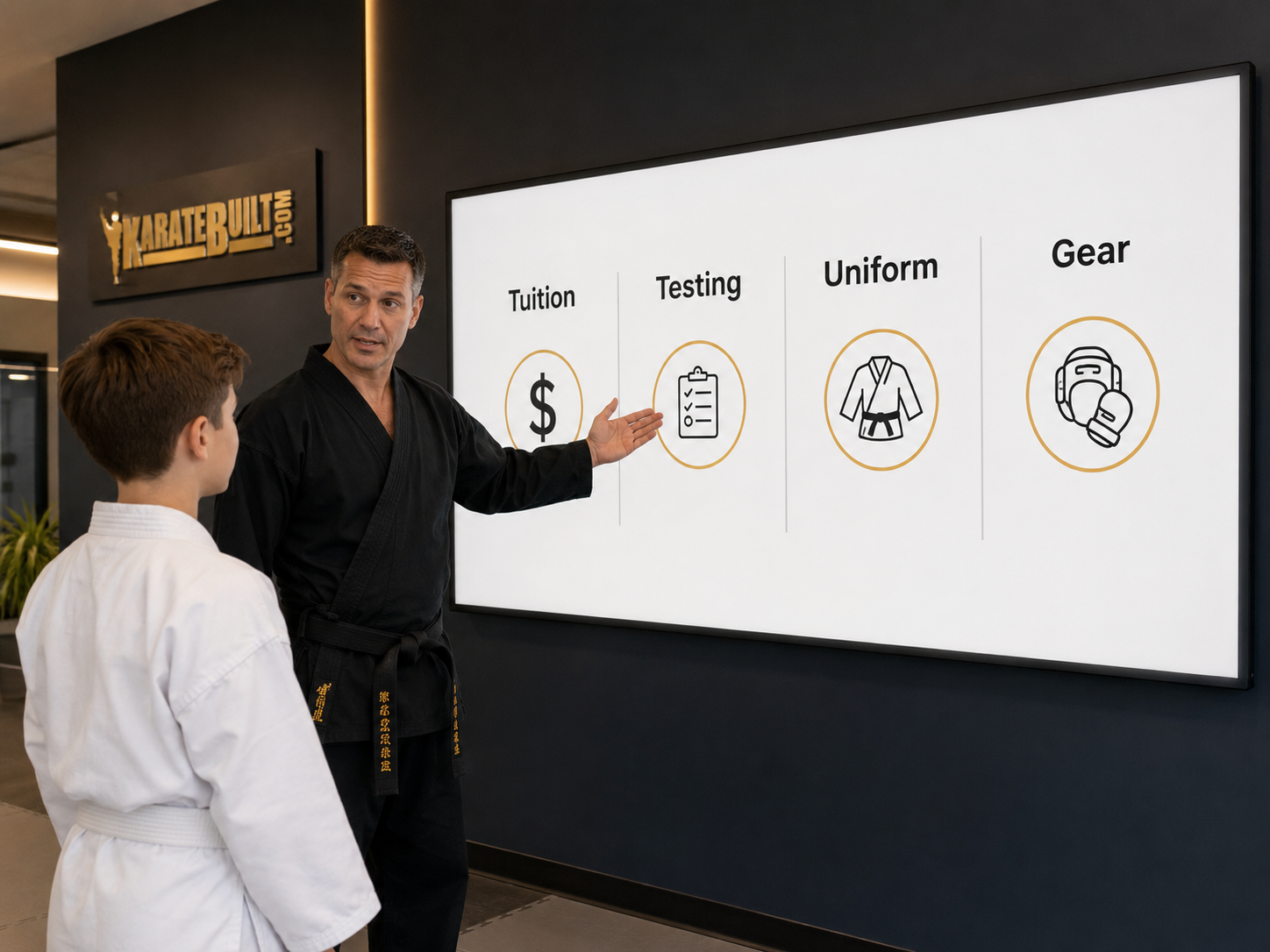
Break it into three parts: tuition, testing, and gear.
Tuition. This is the recurring monthly cost of classes. It typically covers unlimited or scheduled group classes, access to the school’s curriculum, and instruction from certified staff. Rates vary by program, age group, and how many classes a week a student trains. Ask your school for the exact monthly number and multiply by twelve. This is your baseline.
Testing. Most legitimate martial arts schools charge a testing fee at each belt promotion. It usually covers the belt itself, a certificate, and staff time to run and grade the test. Testing frequency depends on the student’s pace, but a typical student tests several times a year. Ask how often students in your child’s program test, and what each test costs, so you can multiply it out for the year.
Uniform and gear. A student needs at least one uniform, sometimes called a dobok, to start. As students progress, many programs add sparring gear, such as gloves, foot guards, and a mouthguard, particularly once a student reaches an age or rank where contact training begins. Some schools bundle this into a starter package, while some charge separately. Ask what’s included in your enrollment and what you’ll need to purchase later.
Add those three numbers and you have your real annual cost. If a school won’t walk you through all three, that’s worth noting.
I’m not going to invent a number for you here, because your number depends on your child’s age, program, and pace. What I will tell you is this: ask your school for tuition, testing, and gear, laid out separately, in writing. A school confident in its value will hand that to you without hesitation.
Want your actual number instead of a guess? Come in and we’ll build it with you in fifteen minutes.
How Does That Compare to What Other Sports Cost?
According to recent national data, American families spent an average of $1,016 on their child’s primary sport in 2024. That’s a 46% increase over five years. Across all sports a child plays, families spend roughly $1,500 per child, per year, on average.
That number includes club fees, equipment, travel, tournaments, and gear replacement as kids grow. Anyone who has bought cleats twice in one season knows how fast it adds up.
Martial arts tends to run in a similar range once you count tuition, testing, and gear honestly. The difference isn’t usually the total but what you’re actually paying for.
A youth soccer season buys practices, games, and a uniform that gets replaced every year. A year of martial arts, done right, buys something else entirely. That’s the part worth examining closely, because it changes how you should weigh the number.
What Does a Family Actually Get for That Number?
An excellent question! Here’s how to check it for yourself, at home and at school.
Focus you can observe. Watch a class. A well-run children’s program holds a six-year-old’s attention for a full class period through structure, not just fun. If you see kids locked in, following multi-step instructions, and correcting their own form, that’s trained focus. You can test this at home too by asking your child to follow a three-step instruction without repeating it. Over months of training, that gets easier.
Discipline that shows up outside the school. Ask your child’s teacher, six months in, whether anything has changed. Parents consistently report improvements in classroom behavior, homework follow-through, and the ability to sit still and listen. You don’t have to take my word for it, ask the teacher directly.
Physical competence. By the end of a year, a student should be able to fall safely, throw a properly aligned punch and kick, and move with real coordination. This is checkable. Watch them warm up. Watch how they carry their weight. Bodies that train correctly move differently than bodies that don’t.
Conflict skills. A student who trains well for a year should be able to tell you, specifically, what to do if a peer is bothering them at school, what to do if a stranger grabs their wrist, and when to walk away from a fight. If you ask your child these questions and get vague answers, that’s useful information about the program, not just the child.
A visible rank structure. At the end of a year, most students should hold a belt rank that reflects real skill, not attendance. Ask to see the requirements for their current rank and the next one. A serious school can show you exactly what’s being tested and why.
Confidence you can see, not just hear about. This is harder to quantify, but you’ll know it when you see it. Kids who train well tend to stand differently. They make eye contact more easily. They speak up when they have something to say. Ask your child’s other coaches, their teachers, or their grandparents whether they’ve noticed a change.
None of this happens automatically. It happens because of consistent, well-taught, well-tested training, over months, not weeks. That’s what the number is actually buying, if the school is doing its job.
Is It Worth It for Your Family?
Only you can answer that, and only once you have real numbers on both sides.
Add up tuition, testing, and gear for the martial arts program you’re considering. Compare it honestly against what you’re already spending on other activities. Weigh it against the outcomes above, the ones you can actually verify at home and in the classroom, not just the ones on a brochure.
I built this school to be judged on results a parent can check for themselves. Focus. Discipline. Physical skill. These are real answers to real safety questions. A rank that means something. I’d rather earn your trust with a number and a demonstration than a sales pitch.
If you want your family’s exact annual number, tuition, testing, and gear, laid out clearly, come talk to us.
Book fifteen minutes with us. We’ll walk through your family’s actual number, answer every question, and let you watch a class before you decide anything.
Chief Master Greg Moody, Ph.D. holds a doctorate in Special Education, is a licensed psychotherapist (LAC), and is an 8th Degree Black Belt with over 30 years of experience teaching children. He has been recognized as the nation’s #1 martial arts school owner eight times.
Sincerely,
Ch. Master Greg Moody, Ph.D.
P.S. Get Dr. Moody’s Book on Bullying – Click Here
KarateBuilt L.L.C. was founded in 1995 by Dr. Greg Moody, an 8th-degree Black Belt and Chief Master Instructor, KarateBuilt Martial Arts and Karate for Kids offer lessons for pre-school children ages 3-6 and elementary age kids ages 7 and up are designed to develop critical building blocks kids need – specialized for their age group – for school excellence and later success in life.
KarateBuilt Martial Arts Adult Karate training is a complete adult fitness and conditioning program for adults who want to lose weight, get (and stay in shape), or learn self-defense in a supportive environment.
Instructors can answer questions or be contacted 24 hours of the day, 7 days a week at 866-311-1032 for one of our nationwide locations. You can also visit our website at KarateBuilt.com.
About Dr. Greg Moody: Dr. Moody is an eighth-degree black belt and chief master instructor. He has a Ph.D. in Special Education from Arizona State University (along with a Master’s Degree in Counseling and a Bachelor’s Degree in Engineering – he actually is a rocket scientist). He has been teaching martial arts for over 25 years and has owned eight martial arts schools in Arizona and California. Chief Master Moody is a motivational speaker and educator and teaches seminars in bullying, business, and martial arts training, around the world. See more at DrGregMoody.com.
The KarateBuilt Martial Arts Headquarters at KarateBuilt LLC is in Cave Creek, Arizona at 29850 N. Tatum Blvd., Suite 105, Cave Creek AZ 85331. You can locate the Chief Instructor, Master Laura Sanborn there directly at (480) 575-8171. KarateBuilt Martial Arts serves Cave Creek, Carefree, Scottsdale, and Paradise Valley Arizona as well as Grand Rapids, MI.