The Instructor-to-Student Ratio Nobody Mentions, and Why It Decides Your Child’s Progress
October 20, 2026 by Chief Master Greg Moody, Ph.D.
You’ve toured two schools, maybe three. You asked about tuition, the schedule, and whether the uniform comes with the trial. Almost nobody thinks to ask the question that matters most in the first year: how many kids are in a karate class on a normal weeknight, and how many adults are teaching them?
That number almost never shows up on a brochure, and it decides more about your child’s progress than the belt colors, the logo, or the monthly price.
Here is the short version. A child in a crowded class gets supervised, whereas a child in a right-sized class gets corrected. From the parent chairs the two look almost identical, and over a year of training they produce very different students.
How many kids should be in a karate class?
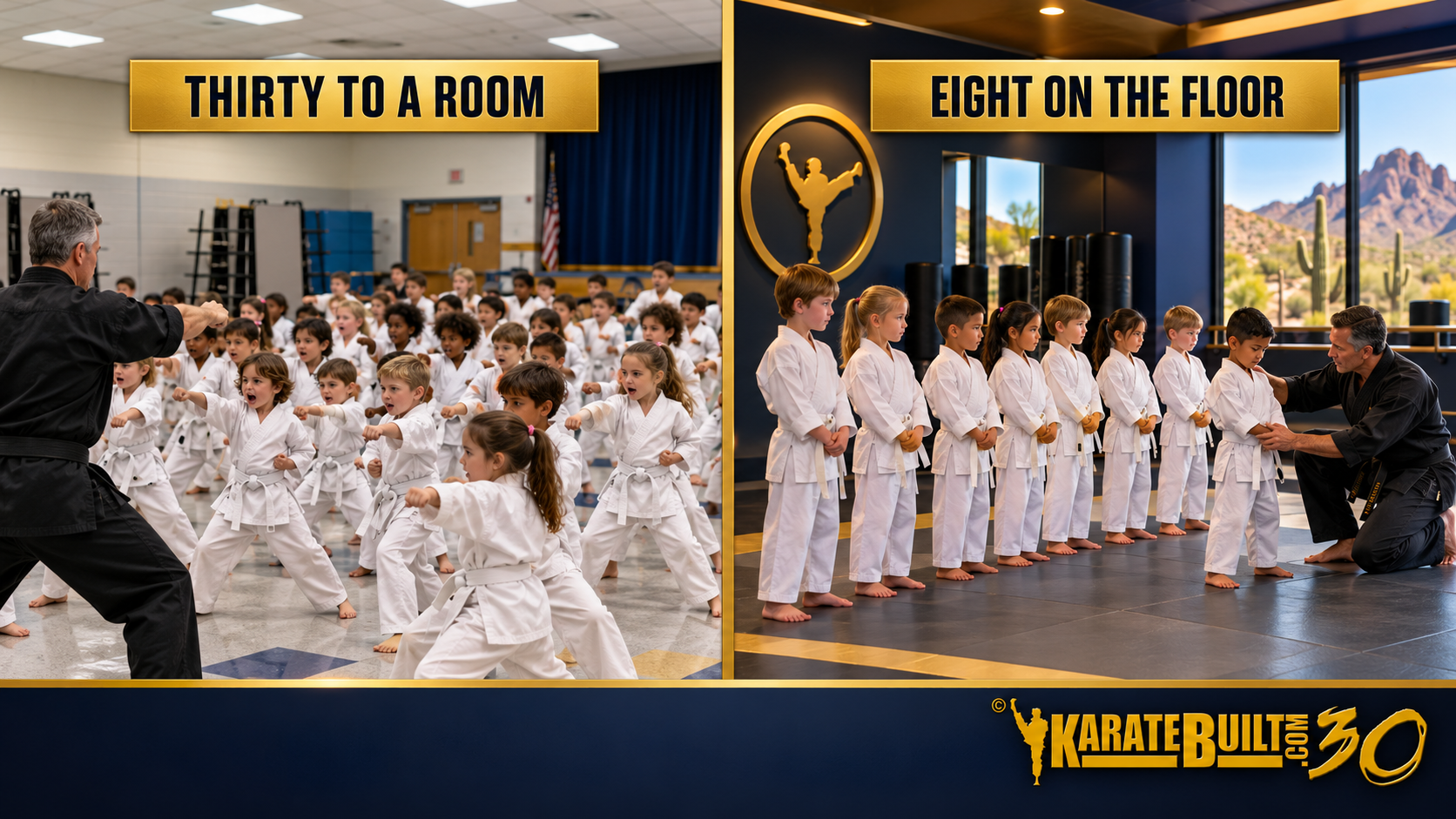
A karate class should be small enough that one instructor can see every child, reach every child, and correct every child several times in a single class.
That sounds obvious until you run the numbers. Most kids’ classes last 45 to 60 minutes. Picture a 45-minute class with 25 children and one instructor. If that instructor spent every single minute on one-on-one correction, which never happens, each child would get less than two minutes. Subtract the bow-in, the warm-up, the lining up, and the water break, and the real figure drops to seconds.
Many after-school karate programs that meet on elementary campuses run 20 to 30 students per class, and to their credit, they say so up front. That size works fine for an hour of supervised activity after the last bell. It makes individual correction very hard. If you’re weighing a campus class against a dedicated school, I compared the two in Cave Creek Karate: Why One Search Brings Up Two Very Different Programs.
So, when you compare programs, count two things: the children on the floor and the adults actually teaching them. Divide the first number by the second. That ratio tells you far more than the headcount alone.
What does a large class actually cost my child?
A large class costs your child corrections, and corrections are how good technique gets built.
Researchers have looked at this in a setting every parent knows, which is school PE. Skala et al. (2012) observed 211 third-, fourth-, and fifth-grade PE classes across 74 Texas public schools. Students spent roughly a quarter of class time on management, meaning lining up, waiting, and listening to directions. Larger classes were linked with less active time and more management time (Skala et al., 2012).
That study looked at PE, and it measured an association, so I won’t stretch it further than it goes. The pattern still matches what I see on the floor every week. Each extra child adds a little more managing and takes away a little teaching.
My doctorate is in special education, where one rule comes up constantly: feedback works best when it arrives close to the mistake. A correction given right away gets absorbed. A correction given three weeks later has to undo three weeks of practice first.
Here is what that looks like in karate. A crooked front stance practiced two hundred times without correction becomes a very confident crooked front stance. Fixing it later takes far longer than teaching it right the first time.
Before I opened a school, I worked as an aerospace engineer. We measured every part against a tolerance, and a part that drifted got caught early or it got expensive. Your child’s technique follows the same rule.
Why do most schools not publish their class size?
Most schools leave class size off their websites because the number changes from night to night, and a large number can make a parent nervous.
I’ll start with the fair reason. Class size moves. A Monday class might have nine students and a Thursday class might have twenty-two, depending on school schedules, sports seasons, and who has a cold that week. A school that posts one number risks getting caught out by the calendar.
The second reason deserves a plain answer too. A full floor is good for the books. A school with no posted limit can keep adding students to the same time slot, and nobody outside the building ever sees the count.
In-school programs publish their numbers. When I looked through the storefront schools in our market, I could not find a single one that posts a student-to-instructor ratio. That leaves the counting to you, and the good news is that it takes about ten minutes.
What should I look for when I watch a class?
Look for how often one child gets individual attention, because that number predicts progress better than anything else in the room.
Bring this short list with you.
Count the room. Count the children on the floor and the adults teaching them. Leave out the front desk and the parent refilling water bottles.
Pick one child and watch for ten minutes. Count how many times an instructor speaks to that child by name, adjusts a stance, or gives one specific fix.
Watch the waiting. Notice how long kids stand in line between turns. Long lines usually mean too many kids for the adults on the floor.
Watch the mistake. When a child gets something wrong, see whether anyone notices, and how quickly.
Ask about your night. Ask how many students attend the class your child would actually join, on its busiest night of the week.
Ten minutes along the wall will tell you more than an hour of conversation at the front desk.
Does a small class mean slower belt progress?
A small class usually means steadier belt progress, because mistakes get fixed before a belt test exposes them.
Some parents worry that a smaller class moves at a slower pace. In my experience the opposite happens. In a crowded room, a child can hide a weak technique for months. Then testing day arrives, the gap shows up in front of the examiners, and the child has to go back and rebuild.
At KarateBuilt, a child earns the next rank by showing both technique and character skills, like focus and self-control, at a belt test. Close coaching means your child walks into that test having already fixed what an instructor spotted weeks earlier. The pace stays steady, and the new belt means something.
How does KarateBuilt in Cave Creek handle class size?
KarateBuilt publishes its ratio: No more than 20 students per instructor in Karate for Kids, and we staff the floor to hold that number.
We group classes by age. Our preschool classes serve ages 3 to 6, and our Karate for Kids program serves ages 7 and up, because a four-year-old and a nine-year-old learn in very different ways. Preschool classes run at no more than 15 students per instructor. You can read more about our kids karate program in Cave Creek.
That ratio buys your child three things. Someone sees the mistake while it is still small. Someone knows your child’s name, their goals, and the one thing they struggled with last week. And your child gets enough repetitions with feedback to move forward with real confidence.
Families from Carefree and Cave Creek train side by side here, and every family starts the same way. Before a child joins a class, we hold a Family Conference, a private meeting where we get to know your child and recommend the right class for them.
I founded KarateBuilt in 1995. I hold a Ph.D. in special education and a Master of Counseling, and I’m a licensed clinician. Our school has been named Nation’s #1 Martial Arts School eight times, and we’ve produced more than 1,800 Black Belts. Paying attention to class size is one of the reasons those numbers hold up.
Frequently Asked Questions
How many kids are in a karate class at KarateBuilt?
Our Karate for Kids classes hold up to 20 students per instructor, and we add instructors as a class grows so the ratio holds.] Ask at the front desk and we’ll tell you the number for any class on the schedule.
Is a bigger class bad for a beginner?
A bigger class can work well when enough instructors are on the floor. The ratio matters more than the headcount, so count the adults teaching along with the kids.
Can I watch a class before I enroll?
Yes. Families from Cave Creek and Carefree are welcome to sit along the wall and watch a full class. Call or text (602) 737-2098 to pick a time.
What is the instructor-to-student ratio for the youngest ages?
Preschool classes for ages 3 to 6 run at no more than 15 students per instructor. Young children need more adult eyes, more short wins, and more help right after a mistake.
Here is your next step. Come watch a class at KarateBuilt Martial Arts, 29850 N. Tatum Blvd., Suite 105, Cave Creek, AZ 85331, and count the children on the floor. Then count the instructors. New students start with two weeks FREE plus a free uniform, a $199 value. Call or text (602) 737-2098 to pick your night.
References
Skala, K. A., Springer, A. E., Sharma, S. V., Hoelscher, D. M., & Kelder, S. H. (2012). Environmental characteristics and student physical activity in PE class: Findings from two large urban areas of Texas. Journal of Physical Activity and Health, 9(4), 481–491. https://doi.org/10.1123/jpah.9.4.481
Chief Master Greg Moody, Ph.D. holds a doctorate in Special Education, is a licensed psychotherapist (LAC), and is an 8th Degree Black Belt with over 30 years of experience teaching children. He has been recognized as the nation’s #1 martial arts school owner eight times.
Sincerely,
Ch. Master Greg Moody, Ph.D.
P.S. Get Dr. Moody’s Book on Bullying – Click Here
KarateBuilt L.L.C. was founded in 1995 by Dr. Greg Moody, an 8th-degree Black Belt and Chief Master Instructor, KarateBuilt Martial Arts and Karate for Kids offer lessons for pre-school children ages 3-6 and elementary age kids ages 7 and up are designed to develop critical building blocks kids need – specialized for their age group – for school excellence and later success in life.
KarateBuilt Martial Arts Adult Karate training is a complete adult fitness and conditioning program for adults who want to lose weight, get (and stay in shape), or learn self-defense in a supportive environment.
Instructors can answer questions or be contacted 24 hours of the day, 7 days a week at 866-311-1032 for one of our nationwide locations. You can also visit our website at KarateBuilt.com.
About Dr. Greg Moody: Dr. Moody is an eighth-degree black belt and chief master instructor. He has a Ph.D. in Special Education from Arizona State University (along with a Master’s Degree in Counseling and a Bachelor’s Degree in Engineering – he actually is a rocket scientist). He has been teaching martial arts for over 25 years and has owned eight martial arts schools in Arizona and California. Chief Master Moody is a motivational speaker and educator and teaches seminars in bullying, business, and martial arts training, around the world. See more at DrGregMoody.com.
Dr. Moody is also a licensed psychotherapist and maintains a practice at Sheade Therapywhere he specializes in couples therapy and men’s issues.
The KarateBuilt Martial Arts Headquarters at KarateBuilt LLC is in Cave Creek, Arizona at 29850 N. Tatum Blvd., Suite 105, Cave Creek AZ 85331. You can locate the Chief Instructor, Master Laura Sanborn there directly at (480) 575-8171. KarateBuilt Martial Arts serves Cave Creek, Carefree, Scottsdale, and Paradise Valley Arizona as well as Grand Rapids, MI.