Does Martial Arts Actually Help Kids With ADHD? What the Mechanism Really Is
August 3, 2026 by KarateBuilt Staff
Every parent of a child with ADHD has heard well-meaning advice about structure and discipline, usually followed by a suggestion to try a martial art. What rarely gets explained is why that advice holds up, or how to determine that a program will genuinely help your child from one that will just add another place they struggle to keep up. This post breaks down the actual mechanism behind it, so you can walk into any school with a clear, informed lens instead of a slogan.
What are parents usually told, and why isn’t it enough?
If you’ve read anything about ADHD and martial arts, you’ve probably read some version of “structure is good for kids with ADHD.” That sentence is true, and it’s also useless for making a real decision.
It doesn’t tell you what structure means in practice. It doesn’t tell you why a karate class would build executive function any better than soccer, piano, or a well-run classroom. And it doesn’t tell you how to determine if a program will actually help apart from one that will just add another place where your child struggles and hears “pay attention” twenty times a class.
I hold a Ph.D. in Special Education and I’m a licensed clinician. I’ve spent over three decades watching thousands of children move through martial arts training. Some of those children had ADHD diagnoses. Many made real, visible gains in focus and self-control. Some did not, and the program was usually why.
This article explains the actual mechanism, in language you can use tonight to evaluate any program, including mine. If your child has ADHD or a strong suspicion of it, you deserve a real answer instead of a slogan.
If you want to see these mechanisms in action, come watch a class at KarateBuilt in Cave Creek. Bring your questions.
What is executive function, in plain terms?
Executive function is the brain’s management system. It’s the set of skills that let a person start a task, hold a plan in mind, resist an impulse, and switch attention when needed.
Think of it as the difference between knowing what to do and actually doing it. A child with ADHD often knows the rule perfectly well. Sitting still, waiting a turn, following a two-step direction. The gap isn’t knowledge. The gap is in the brain systems that turn knowledge into action in the moment.
Those systems include working memory, holding information in mind long enough to use it, inhibitory control, stopping an impulse before it becomes an action, and cognitive flexibility, shifting from one task or rule to another without a meltdown. All three tend to develop more slowly, and with more variability, in children with ADHD.
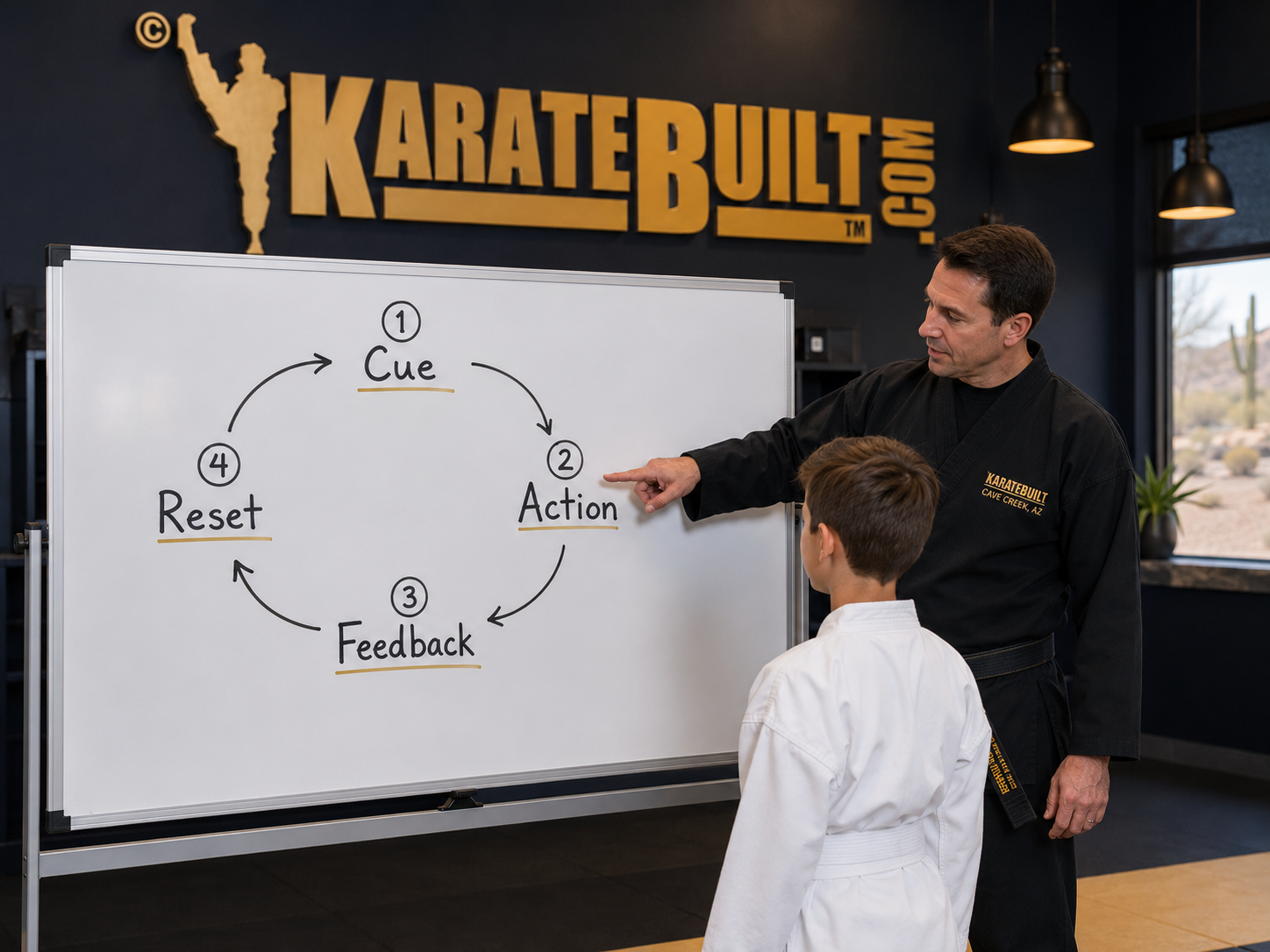
This matters because it reframes the question. The question isn’t “will karate make my child calmer.” The question is “does this specific class structure give my child repeated, low-stakes practice at starting, stopping, and switching, with fast enough feedback that the brain can actually learn from it.” That’s a testable question, and it leads directly to four specific mechanisms.
What is the first mechanism: short task cycles?
Short task cycles mean breaking practice into brief segments, often thirty seconds to two minutes, so a child completes a task before attention runs out. This matches how long a young child’s attention span actually holds, instead of demanding more than the brain can currently sustain.
In a well-run class, this looks like a drill: ten kicks, then a break, then a different drill. Each cycle has a clear start and a clear end that the child can feel completing. A child gets to finish something, again and again, in a single class period.
That matters because finishing something is itself a skill under construction. Every completed cycle is a small, repeated rehearsal of “I started this and I got to the end,” and that rehearsal builds a pattern the brain can eventually generalize elsewhere, like finishing homework or a chore.
What is the second mechanism: immediate corrective feedback?
Immediate corrective feedback means a child finds out right away, within seconds, whether an action was correct, instead of waiting for a grade or a report weeks later. Fast feedback loops are especially important for a brain that struggles to connect a delayed consequence to the action that caused it.
In class, this looks like an instructor correcting foot position the moment a kick lands wrong, not at the end of the session. The gap between the action and the correction stays small enough for the connection to actually register.
A classroom test returned two weeks later teaches almost nothing about the moment the mistake happened. A correction given three seconds after a technique teaches the brain, in real time, exactly what to adjust. That immediacy is a large part of why physical practice can build self-monitoring skills that are harder to build through delayed feedback systems like grades.
This kind of fast, physical feedback loop is exactly what we build class structure around. Schedule a visit and watch how quickly instructors correct and redirect in a live class.
What is the third mechanism: externalized self-regulation cues?
Externalized self-regulation cues are outside signals, a word, a stance, a physical marker, that a child can use to manage their own behavior instead of relying purely on internal impulse control, which is often the weakest system in an ADHD brain. The cue does part of the regulating work until the internal skill catches up.
In class, this looks like a consistent ready stance a child returns to before starting a technique, or a specific word an instructor uses every time before giving an instruction, so the child’s brain has a reliable, external signal that a moment of focus is starting.
Over time and with enough repetition, children often start using these same cues on their own, outside of class. A child pausing in a “ready stance” moment before reacting to a frustrating situation at home is externalized regulation transferring into daily life. That transfer isn’t guaranteed for every child, but it’s the mechanism worth watching for.
What is the fourth mechanism: a visible progression that makes effort legible?
A visible progression means a child can see, concretely, that effort produces a specific and trackable result, like a stripe on a belt or a new technique earned. That visibility matters enormously for a child whose brain often struggles to connect effort now with a payoff later.
In class, this looks like a belt and stripe system where a child can point to a physical object and say, “I earned that because I worked on my front kick for six weeks.” The connection between effort and outcome is not abstract. It’s sitting in a drawer at home.
For many children with ADHD, delayed and abstract rewards, like grades or long-term praise, don’t motivate consistent effort well. A concrete, visible marker of progress can bridge that gap and keep a child engaged in practicing a skill long enough for real improvement to happen.
Why do some martial arts programs help while others make things worse?
Some programs build every one of these four mechanisms into class structure, and children with ADHD often do well in them. Other programs use the same uniform and the same vocabulary but run classes that work against every mechanism above, and children in those programs often do worse, not better.
A program built on long lecture segments, wide age ranges crammed into one class, vague or delayed feedback, and belt promotions handed out mostly on a calendar instead of earned skill will struggle to help a child with ADHD. The structure looks disciplined from the outside, but it doesn’t match how this particular brain learns.
The difference has nothing to do with the style of martial arts, the country it originated in, or how strict the instructor appears. It has everything to do with whether the class is actually built around short cycles, fast feedback, external cues, and visible progression. A strict-looking class with none of these can do real harm to a child’s confidence. A relaxed-looking class with all four can do genuine good.
What should I look for and ask when I visit a school?
Watch a live class before you enroll, and watch specifically for the four mechanisms, not the general vibe of the room. Ask the instructor directly how they handle each one.
Ask how long each drill or activity segment runs. If the honest answer is “as long as it takes to explain,” that’s a sign the class isn’t built around short task cycles.
Ask how corrections are given, immediately and individually, or in a general comment to the whole group at the end. Ask whether the school has specific training in child development or ADHD, not just martial arts rank. Ask how belt and stripe progress is tracked and whether it reflects actual skill or just time enrolled.
Bring this list of questions to any school you’re considering, including ours, and watch how directly the instructors answer. Come see a class at KarateBuilt in Cave Creek and ask us every one of these.
When is martial arts not the right choice?
Martial arts is not a treatment for ADHD, and no responsible instructor should present it as one. It is a physical and behavioral practice that can support the same skills a clinician or physician is also working on, not a replacement for either.
If your child is in an active crisis, experiencing severe emotional dysregulation, or working through a co-occurring condition that needs clinical attention first, a martial arts class is not the place to start that work. A group class isn’t equipped to manage that level of need, and a good school should tell you that honestly rather than enroll a family who needs a different kind of support first.
If your child has a strong sensory sensitivity to noise, physical contact, or crowded rooms, some class formats will need real modification, and not every school is equipped to provide that. Ask directly whether a school has experience adapting for sensory needs before you assume it does.
Martial arts work best as one part of a broader plan that may include medical care, therapy, and school support, not as a stand-alone fix. Any instructor who tells you otherwise is overselling what a physical class can do.
If you’re weighing whether martial arts fits into your child’s broader plan, come talk with us directly. We’ll give you an honest answer, including if we’re not the right fit right now.
Chief Master Greg Moody, Ph.D. holds a doctorate in Special Education, is a licensed psychotherapist (LAC), and is an 8th Degree Black Belt with over 30 years of experience teaching children. He has been recognized as the nation’s #1 martial arts school owner eight times.
Sincerely,
Ch. Master Greg Moody, Ph.D.
P.S. Get Dr. Moody’s Book on Bullying – Click Here
KarateBuilt L.L.C. was founded in 1995 by Dr. Greg Moody, an 8th-degree Black Belt and Chief Master Instructor, KarateBuilt Martial Arts and Karate for Kids offer lessons for pre-school children ages 3-6 and elementary age kids ages 7 and up are designed to develop critical building blocks kids need – specialized for their age group – for school excellence and later success in life.
KarateBuilt Martial Arts Adult Karate training is a complete adult fitness and conditioning program for adults who want to lose weight, get (and stay in shape), or learn self-defense in a supportive environment.
Instructors can answer questions or be contacted 24 hours of the day, 7 days a week at 866-311-1032 for one of our nationwide locations. You can also visit our website at KarateBuilt.com.
About Dr. Greg Moody: Dr. Moody is an eighth-degree black belt and chief master instructor. He has a Ph.D. in Special Education from Arizona State University (along with a Master’s Degree in Counseling and a Bachelor’s Degree in Engineering – he actually is a rocket scientist). He has been teaching martial arts for over 25 years and has owned eight martial arts schools in Arizona and California. Chief Master Moody is a motivational speaker and educator and teaches seminars in bullying, business, and martial arts training, around the world. See more at DrGregMoody.com.
The KarateBuilt Martial Arts Headquarters at KarateBuilt LLC is in Cave Creek, Arizona at 29850 N. Tatum Blvd., Suite 105, Cave Creek AZ 85331. You can locate the Chief Instructor, Master Laura Sanborn there directly at (480) 575-8171. KarateBuilt Martial Arts serves Cave Creek, Carefree, Scottsdale, and Paradise Valley Arizona as well as Grand Rapids, MI.