

Why Traditional Discipline Beats Quick-Fix Confidence Programs
The Parent Moment That Started This 
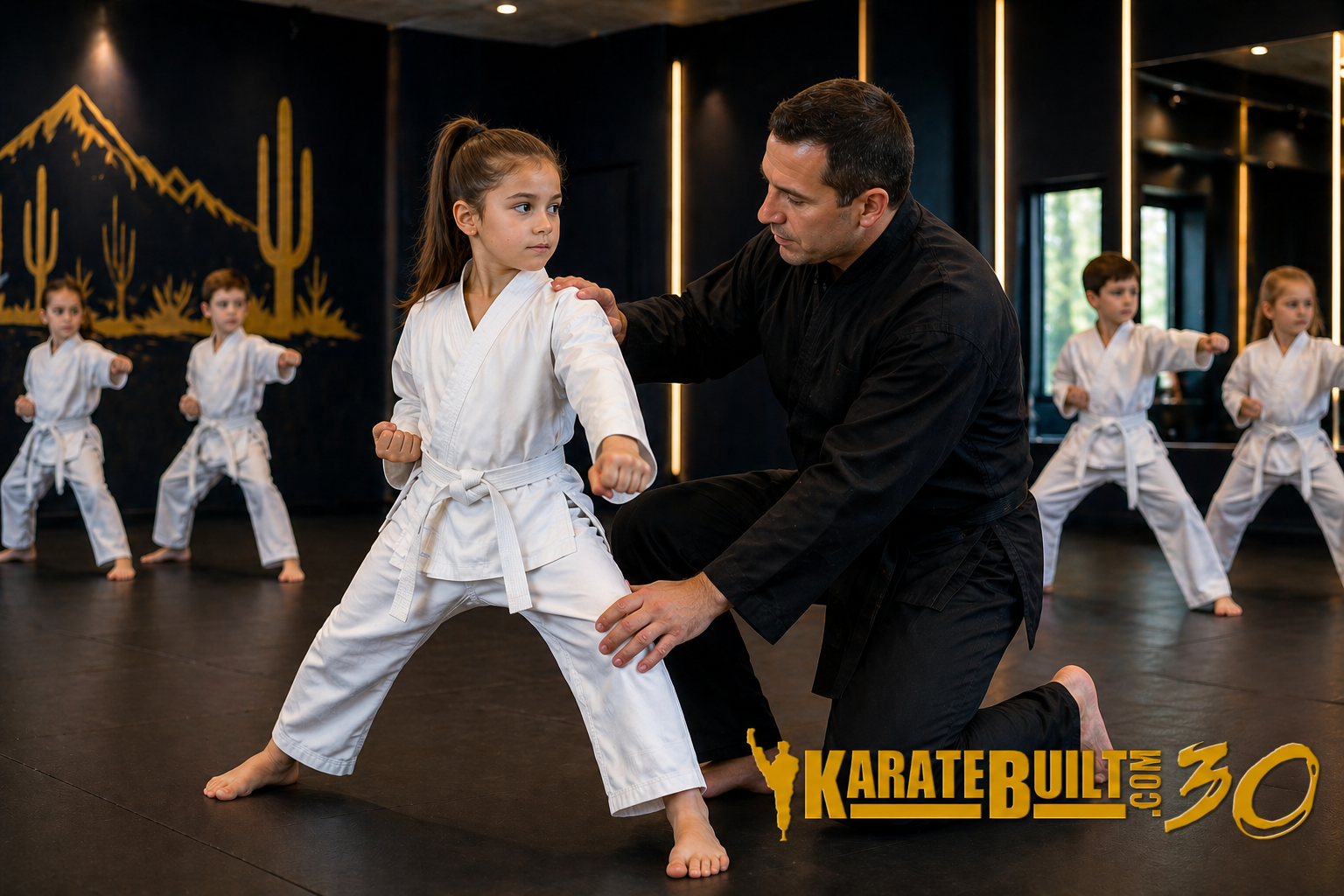
A mom sat across from me last week in the lobby of our Cave Creek school. Her daughter is eight. Bright kid. Reads two grades ahead.
And she will not raise her hand in class. She will not order her own food at a restaurant. She freezes when a teacher asks her a direct question.
Mom told me she had already tried two confidence programs. One was an app. One was a six-week after-school workshop with affirmations, vision boards, and a graduation certificate. Her daughter loved them both.
And nothing changed.
That conversation is not unusual. I hear a version of it almost every week. So let’s talk plainly about why those programs feel good and almost never work — and what actually builds a confident child.
The Bait-and-Switch in Modern Confidence Content
Most of what gets sold to parents under the word “confidence” today is a feeling, not a skill. It is a workshop, a journal, a sticker chart, a TikTok mantra, a one-day camp.
The pitch is appealing because it is fast. Sign up, attend, your child leaves smiling, you check the box.
The problem is that confidence is not a mood. Confidence is the calm a child feels when they have done a hard thing on purpose, more than once, in front of someone who saw it.
You cannot install that in a weekend. You cannot affirm your way into it. And no certificate handed out at the end of a six-week class will create it, because the child knows the certificate was coming no matter what they did.
Confidence is not a mood. It is the calm a child feels when they have done a hard thing on purpose, more than once, in front of someone who saw it.
That is the bait-and-switch. Parents are sold a feeling. Children need a structure.
What Real Confidence Is Actually Built On
I have spent thirty years working with kids — including hundreds of children with ADHD and on the autism spectrum — across martial arts, classroom education, and clinical psychotherapy. I have a Ph.D. in education with a focus on special education and counseling psychology, and I run a licensed therapy practice in addition to our school.
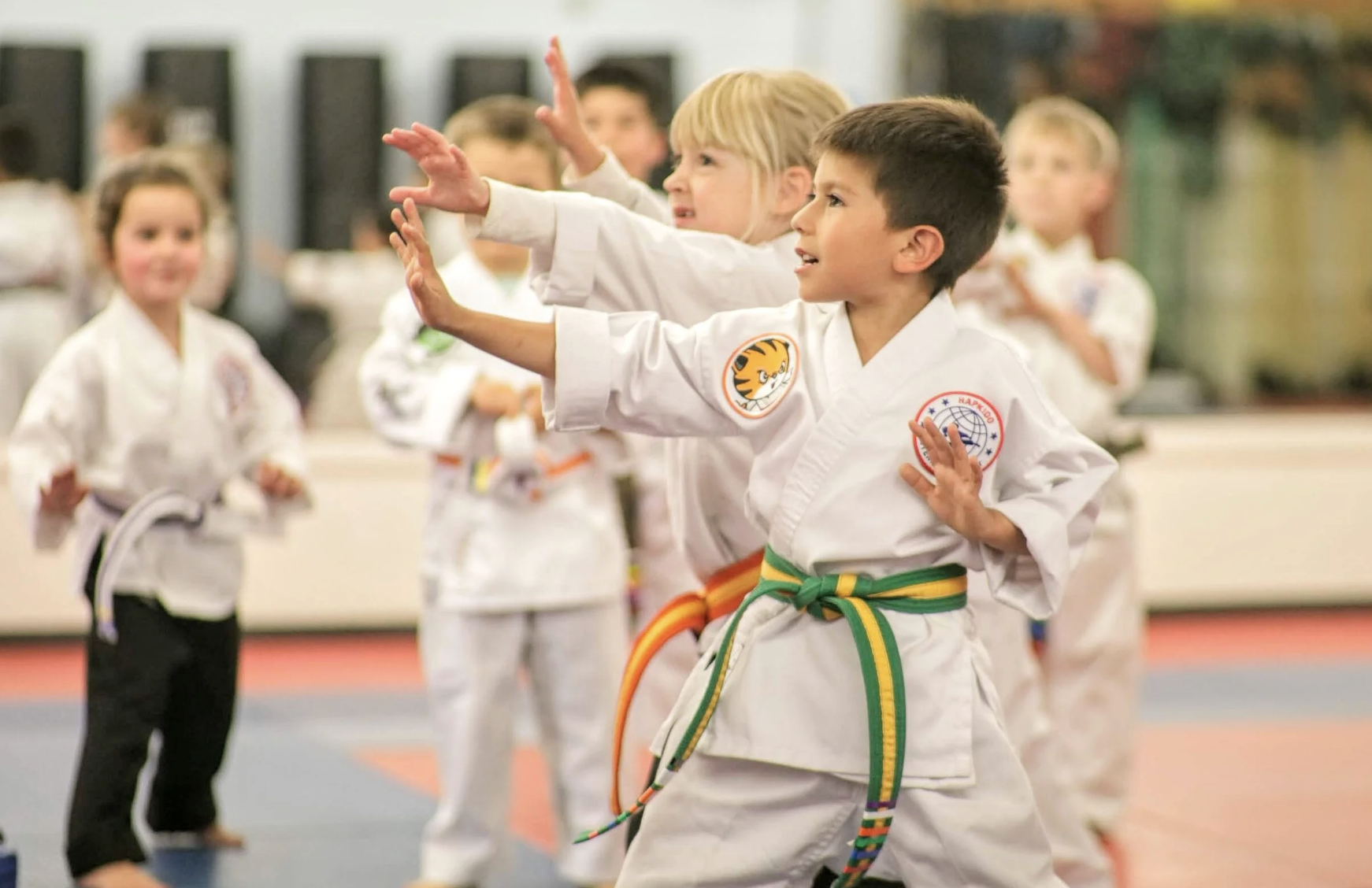 I am telling you that across every population, real confidence in a child stands on three legs:
- Mastery. The child can actually do the thing. Not “tried it once.” Can do it on demand.
- Repeatable challenge. The next thing is always slightly harder than the last thing. Not overwhelming. Not boring. Stretch zone.
- Structured feedback. An adult the child respects tells them, specifically and honestly, what they did well and what they need to fix. Not generic praise. Not punishment. Coaching.
Take any one of those three away and the structure collapses. Mastery without challenge becomes boredom. Challenge without mastery becomes anxiety. Either of those without structured feedback becomes guesswork — and a child who is guessing is a child who quietly decides they are not good enough.
This is not opinion. This is consistent with the research on self-efficacy that came out of Bandura’s work in the late twentieth century and has been replicated for forty years. Children build belief in themselves by doing, not by being told.
How a Properly Run Martial Arts School Delivers All Three
Not every martial arts school does this well. Many do not. But a properly run traditional school — and I will be specific about what that means — is one of the most efficient confidence-building environments ever designed for children.
Here is the structure.
Mastery is built into the curriculum. A white belt does not move to yellow by attendance. They move because they can perform a defined set of techniques, a form, a one-step, and answer questions about respect and effort. The standard does not bend. The child either meets it or they do not, and if they do not, we coach them until they do.
Repeatable challenge is built into the belt system. Every belt is harder than the last. The child always has a clear next target. Two months from now they know what they are working toward. Two years from now they know what they are working toward. The horizon is always visible and the next step is always close enough to reach.
Structured feedback is built into every class. A child does a kick. The instructor sees it. The instructor names exactly what was strong, names exactly what to fix, and the child does it again. That loop happens dozens of times per class. By the end of a forty-five-minute class, a six-year-old has received more honest, specific feedback than they may have received all week at school.
Add the uniform — the dobok — and the bow, and the standing in line, and the “Yes, sir” and “Yes, ma’am,” and you have something the modern world has almost stopped offering kids: an environment where the rules are clear, the standard is the same for everyone, and the adults are not afraid to tell the truth.
That environment is not harsh. Done right, it is warm. But it is honest. And honesty, delivered by a trusted adult inside a structure the child trusts, is the soil confidence grows in.
Three Short Case Examples
Names and details are changed. The patterns are exact.
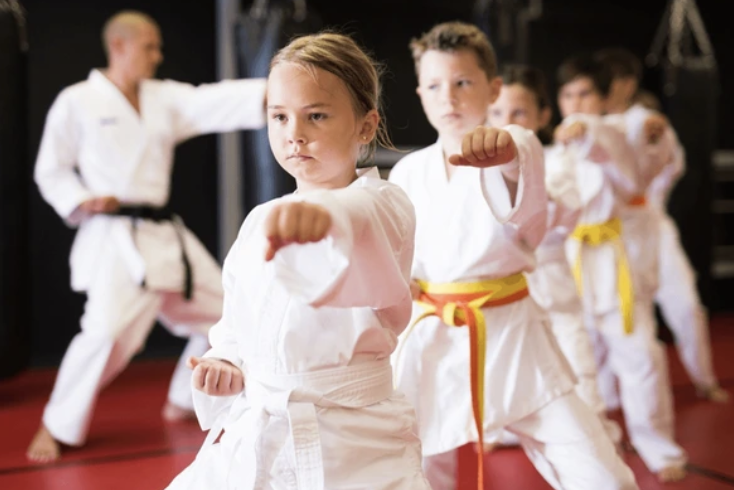
Case one. A seven-year-old boy I will call Mason. Diagnosed ADHD. His parents had tried two confidence programs and a social skills group. He came in unable to stand still in line for ten seconds. Within six months at the school, he was leading the warm-up for the white belt class. The thing that changed him was not motivation. It was the same instructor giving him the same correction in the same words, three times a week, until his body learned where to put itself. Mastery first. Confidence followed.
Case two. A nine-year-old girl I will call Priya. Anxious. Bright. Cried at her first three classes. Her parents almost pulled her out. We did not let her quit and we did not coddle her. We gave her one small, specific job each class — count the front kicks, demonstrate one stance for the new student. By her yellow belt test six months later, she stood in front of forty parents, performed her form alone, and bowed. Her mother cried. The child did not. The child shrugged and asked when she could test for orange.
Case three. A twelve-year-old boy I will call Elliot. On the autism spectrum, high-functioning, no friends, getting bullied at school. He had been through a confidence camp the previous summer and came home worse. We did not target his confidence directly. We targeted his skill. By the time he earned his green belt — about a year in — he had stopped being a target at school. He never had to fight anyone. Bullies could see he carried himself differently. He stood differently. He looked people in the eye. That came from the structure, not from a pep talk.
The child shrugged and asked when she could test for orange. That is what real confidence sounds like.
What Parents Should Look For
If you take nothing else from this article, take this checklist when you evaluate any program that claims to build confidence in your child:
- Is there a defined skill the child must master, with a standard that does not move?
- Is the next challenge always visible and slightly harder than the last?
- Does a respected adult give the child specific, honest feedback in real time, every session?
- Does the child have to earn the next level, and can they actually fail to earn it?
- Is the environment warm but the standard firm?
If the answer to any of those is no, you are looking at a feeling, not a structure. Your child will enjoy it and will not change.
The Close
You cannot shortcut a child into confidence. You can only build the conditions where confidence is the natural result.
That is what a traditional martial arts school, run honestly, has always done. It is why the model has lasted for centuries while confidence trends come and go every eighteen months.
If you live in Cave Creek or North Scottsdale and your child needs more than a sticker chart, come see what real structure looks like in person. Bring your questions. Bring your skepticism. I would rather have an honest conversation with you about your child than sell you anything.
Schedule a Private Starter Session
Book a private starter session and a parent strategy meeting with Chief Master Greg Moody, Ph.D. at KarateBuilt Cave Creek.
P.P.S. Get Dr. Moody’s Book on Bullying – Click Here
KarateBuilt.com and KarateBuilt Martial Arts have been selected as the nation’s #1 martial arts schools for EIGHT YEARS IN A ROW!
KarateBuilt L.L.C. was founded in 1995 by Dr. Greg Moody, an 8th-degree Black Belt and Chief Master Instructor, KarateBuilt Martial Arts and Karate for Kids offer lessons for pre-school children ages 3-6 and elementary age kids ages 7 and up are designed to develop critical building blocks kids need – specialized for their age group – for school excellence and later success in life.
KarateBuilt Martial Arts Adult Karate training is a complete adult fitness and conditioning program for adults who want to lose weight, get (and stay in shape), or learn self-defense in a supportive environment.
Instructors can answer questions or be contacted 24 hours of the day, 7 days a week at 866-311-1032 for one of our nationwide locations. You can also visit our website at KarateBuilt.com.
About Dr. Greg Moody: Dr. Moody is an eighth-degree black belt and chief master instructor. He has a Ph.D. in Special Education from Arizona State University (along with a Master’s Degree in Counseling and a Bachelor’s Degree in Engineering – he actually is a rocket scientist). He has been teaching martial arts for over 25 years and has owned eight martial arts schools in Arizona and California. Chief Master Moody is a motivational speaker and educator and teaches seminars in bullying, business, and martial arts training, around the world. See more at DrGregMoody.com.
Dr. Moody is also a licensed psychotherapist and maintains a practice at Integrated Mental Health Associates (IntegratedMHA.com) where he specializes in couples therapy and men’s issues.
The KarateBuilt Martial Arts Headquarters at KarateBuilt LLC is in Cave Creek, Arizona at 29850 N. Tatum Blvd., Suite 105, Cave Creek AZ 85331. You can locate the Chief Instructor, Master Laura Sanborn there directly at (480) 575-8171. KarateBuilt Martial Arts serves Cave Creek, Carefree, Scottsdale, and Paradise Valley Arizona as well as Grand Rapids, MI.
Also, check us out on Today in Business and Educators Observer!
Here is Dr. Moody’s Amazon Author Page with over 16 of his Amazon Bestselling books: Click HERE
P.P.P.S. From a parent:
“Since joining KarateBuilt, my son is more disciplined, motivated, and unstoppable in every challenge he faces!” – Herman Green