Back-to-School ADHD & Martial Arts: What Actually Works in Cave Creek
July 20, 2026 by KarateBuilt Staff
Why August training beats October worry
Every August I get the same phone call. A parent in Cave Creek or North Scottsdale tells me their child did fine over the summer, but school starts in two weeks, and they’re worried. Homework battles are coming back. The teacher already flagged concerns last spring. Medication helps some, but not with everything, and the parent wants to know if martial arts training is a real answer or just another activity to add to an already full schedule.
I’ve spent 30 years teaching kids, and I hold a Ph.D. in Special Education along with a psychotherapy license. I’m going to answer this the way I’d answer it in my office, not the way a marketing brochure would.
Does martial arts actually help kids with ADHD?
Yes, when the training is structured correctly. Not every program will produce results, but the ones that work share a few specific features:
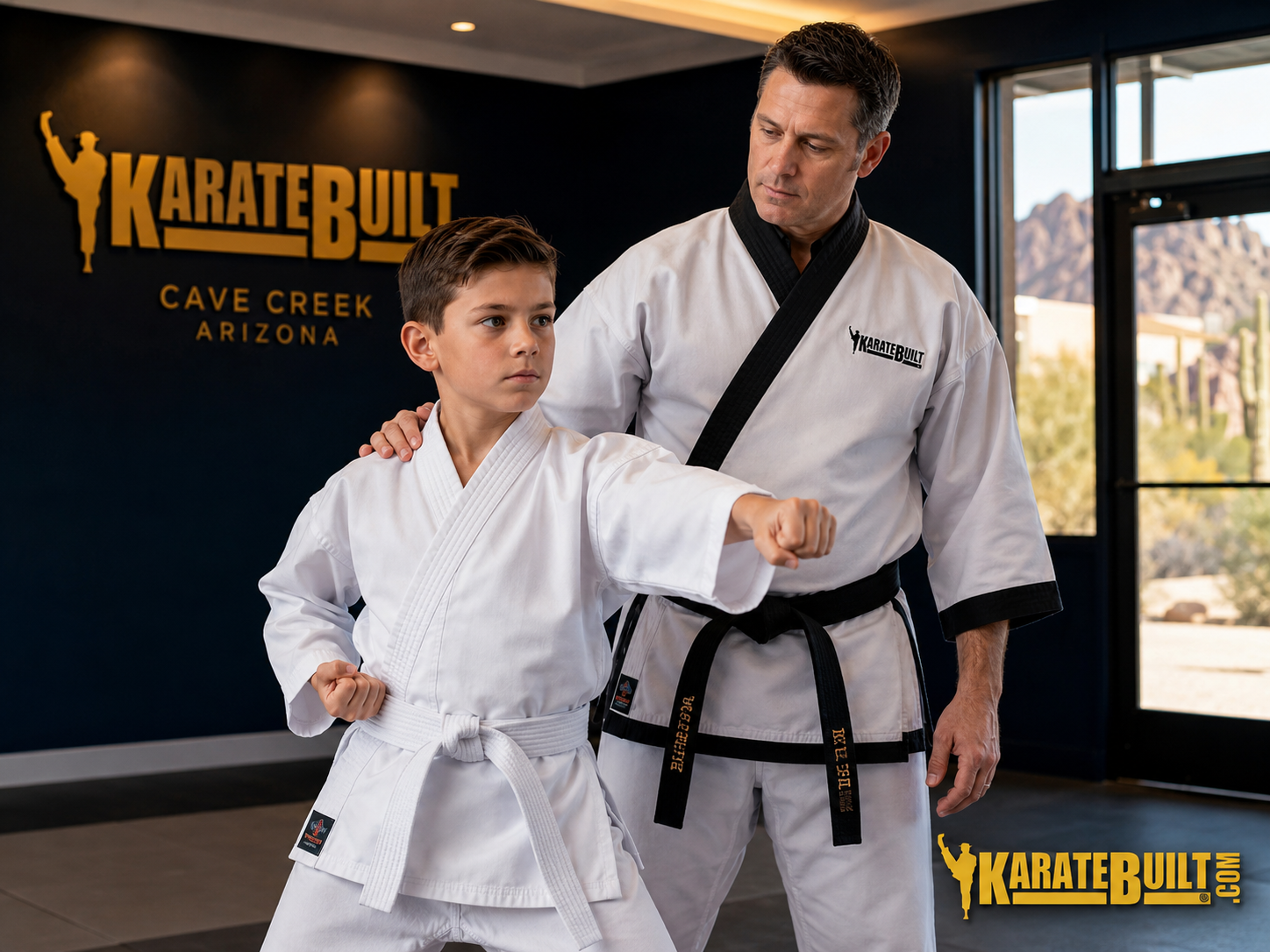
External structure that becomes internal structure. A child with ADHD often struggles to generate their own rules for behavior. A martial arts class provides those rules constantly: bow when you enter, stand at attention, wait your turn, execute the technique on the count. Over months, the child starts applying that same internal checklist in other settings.
Immediate feedback loops. Unlike a classroom where a teacher might address behavior once an hour, an instructor corrects posture, focus, or impulse control every few seconds. Kids with ADHD respond better to fast, frequent feedback than to delayed consequences.
Physical outlet paired with cognitive demand. The child isn’t just running around. They’re memorizing sequences, tracking an opponent, and controlling their body at the same time. That combination is what builds executive function, not the exercise alone.
Researchers have studied this specific combination. Haffner and colleagues, in a study published in a European child psychiatry journal, found that children with ADHD who trained in Tae Kwon Do showed measurable improvements in impulse control and attention compared to children who did not train. The mechanism they pointed to wasn’t just “more exercise.” It was the structured, rule-based nature of martial arts training specifically.
Why does the back-to-school window matter for ADHD training?
Timing changes outcomes. Starting in August instead of October gives a child a running start before the classroom adds pressure.
Habits form before demands increase. A child who begins training in August has three to four weeks of practice before the first spelling test or the first group project. The self-regulation skills are already partially built when school asks for them.
Summer schedules are looser, which hurts more than it helps. Without school structure, many kids with ADHD lose ground over the summer. Their sleep shifts, their routines disappear, and their impulse control softens from lack of practice. Martial arts training during this window rebuilds the muscle before school needs it.
Parents can watch for early wins. A month of training before school starts gives you real data. Is your child listening better at home? Following two-step instructions? That tells you what to expect once the classroom adds stress back into the picture.
The Aspen Institute’s Project Play initiative has tracked how structured youth sport and activity participation correlates with better attention and behavior regulation in children, and their research consistently points to consistency and structure, not intensity or competition, as the strongest predictor of behavioral improvement. A child who trains twice a week for a month builds more regulation capacity than a child who trains once and quits.
What should Cave Creek parents look for in a martial arts school for a child with ADHD?
Not every school is built for this. Some make ADHD symptoms worse by adding chaos instead of removing it.
Small class sizes with clear ratios. A crowded room with one instructor and thirty kids will not give your child the individual correction they need. Look for a school that keeps ratios low enough for real feedback.
Instructors trained in behavior, not just technique. Ask directly whether the head instructor has any background in child development, psychology, or special education. A black belt teaches technique, but it doesn’t automatically teach someone how to work with an ADHD brain.
A uniform and clear expectations from day one. The uniform itself matters more than people assume. It signals a transition into a structured environment, the same way changing into gym clothes signals a transition into PE class. A school that skips this structure loses one of its most useful tools.
A plan for regression, not just progress. Kids with ADHD have bad days. Ask how the school handles a child who is dysregulated that day. A good program has a plan. A weak one just sends the child home.
IBISWorld’s industry data on martial arts schools in the United States shows significant variation in instructor qualifications and program structure across the industry, which is exactly why parents need to ask specific questions rather than assuming all programs are interchangeable.
How does structure at a martial arts school translate to classroom behavior?
Parents want proof this transfers, not just theory. Here’s the actual mechanism.
Both settings demand the same core skill: sit still, wait your turn, follow multi-step instructions. A martial arts class and a classroom are structurally similar. Practicing the skill in one setting builds the muscle for the other.
Repetition builds automaticity. A child who has stood at attention two hundred times doesn’t have to think as hard about standing still in a school assembly. The behavior becomes closer to automatic instead of requiring constant willpower.
Rank and belt progression teach delayed gratification. ADHD often comes with a weak sense of long-term reward. Belt testing, which can take months to earn, gives a child practice tolerating delayed reward in a context where the goal is visible and concrete.
Instructors coordinate with parents, and parents can coordinate with teachers. A school that tracks a child’s focus and behavior week to week gives parents specific language to bring to a teacher conference. “He’s holding a stance for 30 seconds now” is more useful to a teacher than “He’s doing better.”
What is the right first step for a family in Cave Creek or North Scottsdale?
Don’t sign up for a semester based on a website. Talk to the person who will actually be running your child’s training.
Meet the instructor before you commit to anything. You want to hear directly how they’d handle your specific child, not a generic sales pitch.
Ask about their credentials in behavior and child development, not just their belt rank. Both matter, but only one of them tells you whether they know how to work with an ADHD brain specifically.
Get a straight answer about class size and structure. If they can’t tell you their instructor-to-student ratio without checking, that’s information too.
Start before the first week of school, not after. The earlier your child starts, the more practice they’ve had before the classroom demands the skill back.
If you want a direct conversation about your child’s specific situation before school starts, schedule a Family Conference with our team. This is a sit-down conversation, not a sales tour, where we talk through your child’s specific challenges and whether our training environment is the right fit before you commit to anything.
Chief Master Greg Moody, Ph.D. holds a doctorate in Special Education, is a licensed psychotherapist (LAC), and is an 8th Degree Black Belt with over 30 years of experience teaching children. He has been recognized as the nation’s #1 martial arts school owner eight times.
Sincerely,
Ch. Master Greg Moody, Ph.D.
P.S. Get Dr. Moody’s Book on Bullying – Click Here
KarateBuilt L.L.C. was founded in 1995 by Dr. Greg Moody, an 8th-degree Black Belt and Chief Master Instructor, KarateBuilt Martial Arts and Karate for Kids offer lessons for pre-school children ages 3-6 and elementary age kids ages 7 and up are designed to develop critical building blocks kids need – specialized for their age group – for school excellence and later success in life.
KarateBuilt Martial Arts Adult Karate training is a complete adult fitness and conditioning program for adults who want to lose weight, get (and stay in shape), or learn self-defense in a supportive environment.
Instructors can answer questions or be contacted 24 hours of the day, 7 days a week at 866-311-1032 for one of our nationwide locations. You can also visit our website at KarateBuilt.com.
About Dr. Greg Moody: Dr. Moody is an eighth-degree black belt and chief master instructor. He has a Ph.D. in Special Education from Arizona State University (along with a Master’s Degree in Counseling and a Bachelor’s Degree in Engineering – he actually is a rocket scientist). He has been teaching martial arts for over 25 years and has owned eight martial arts schools in Arizona and California. Chief Master Moody is a motivational speaker and educator and teaches seminars in bullying, business, and martial arts training, around the world. See more at DrGregMoody.com.
The KarateBuilt Martial Arts Headquarters at KarateBuilt LLC is in Cave Creek, Arizona at 29850 N. Tatum Blvd., Suite 105, Cave Creek AZ 85331. You can locate the Chief Instructor, Master Laura Sanborn there directly at (480) 575-8171. KarateBuilt Martial Arts serves Cave Creek, Carefree, Scottsdale, and Paradise Valley Arizona as well as Grand Rapids, MI.